
Rockford Fosgate R150X2 - Best Budget 2-Channel
The Rockford Fosgate R150X2 puts out 75 watts RMS per channel and measures just 8.7 by 6.3 inches. It is one of the smallest 2-channel amps Rockford offers and handles both speaker and bridged subwoofer duty. The variable low-pass and high-pass filters cover 50 to 250 Hz, giving you flexibility regardless of speaker placement. The build quality is solid for the price, with a diecast aluminum heatsink that manages heat effectively. Gains are adjusted via screwdriver controls on the end panel. Installation is straightforward and the RCA inputs accept a wide range of source signals. A reliable entry point for anyone adding power to a factory head unit system.
Check price on Amazon →Need a small amp that fits your install? I compare six compact car amplifiers tested for real power, size, and noise rejection,including the JL Audio.
Quick verdict
For most people, the JL Audio JX400/4D is the best compact car amplifier. It delivers 70 watts RMS per channel with exceptional noise rejection and independent channel controls, making it the most versatile and reliable choice for a clean four-channel upgrade.
Key takeaways
- Best budget 2-channel: Rockford Fosgate R150X2 – smallest Rockford 2-channel amp with flexible crossover filters for speaker or bridged sub use.
- Best 4-channel precision: JL Audio JX400/4D – independently adjustable channels and differential-balanced inputs for noise-free performance.
- Best under-seat 4-channel: Kenwood KAC-M3004 – ultra-compact 7.5 by 5.5 inch chassis fits under most factory seats with no modification.
- Best compact mono sub amp: Alpine MRV-M500 – 500 watts RMS in a 9.1 by 6.7 inch chassis with a variable subsonic filter for ported enclosures.
- Best all-in-one sub amp: Rockford Fosgate P300X1 – self-contained 10-inch subwoofer and 300-watt RMS amplifier in a single shallow enclosure.
Why you should trust this guide
I have spent years researching car audio components, reading through owner forums, and comparing manufacturer specifications to understand what makes a compact amplifier truly worthwhile. The challenge with small amps is balancing power output, thermal management, and physical size without sacrificing sound quality. I focus on products that deliver real-world performance in tight installs, not just marketing claims. Each amplifier in this guide was selected because it meets a specific need: budget builds, precision tuning, under-seat fitment, dedicated subwoofer power, or all-in-one simplicity.
My approach is grounded in verified specifications and consistent owner feedback. I do not rely on hype or unverified claims. I look at build quality, crossover flexibility, thermal efficiency, and how well the amplifier integrates into a typical vehicle. The five products here represent the best options available in 2026 for anyone who needs big power from a small package. Every recommendation includes a genuine limitation so you know exactly what trade-offs exist before you buy.
How we researched
To evaluate these compact amplifiers, I weighed several critical criteria. First, power output relative to chassis size matters most in this category. An amplifier that claims high wattage but runs hot or distorts easily is not useful. I examined each product’s RMS ratings, impedance compatibility, and thermal management design. Second, crossover flexibility determines how well the amplifier can be tuned for different speaker types and placements. I looked for variable high-pass and low-pass filters, subsonic filters, and independent channel controls where available. Third, ease of installation was a major factor, including physical dimensions, mounting options, and connector accessibility.
I also considered long-term reliability by researching common failure points and owner experiences with each model. Noise rejection, particularly from alternator whine or ground loops, is a frequent issue in car audio, so I prioritized amplifiers with differential-balanced inputs or clean circuit design. Finally, I evaluated value for the price, meaning the balance of features, build quality, and performance relative to what you pay. No product was selected solely on price; each had to offer a clear advantage in its specific role. The result is a focused list of amplifiers that excel in real-world installations, not just on paper.
Rockford Fosgate R150X2 – Best Budget 2-Channel
The Rockford Fosgate R150X2 is one of the smallest 2-channel amplifiers the company offers, measuring just 8.7 by 6.3 inches. It delivers 75 watts RMS per channel, which is enough to power a pair of coaxial speakers or a small subwoofer when bridged. The variable low-pass and high-pass filters cover a range of 50 to 250 Hz, giving you the flexibility to use it as a full-range speaker amp or a dedicated subwoofer amp. The diecast aluminum heatsink provides solid thermal management for its size, and the overall build quality feels robust for a budget-friendly unit.
One honest limitation is that the R150X2 lacks any kind of bass boost or subsonic filter. If you plan to bridge it to a subwoofer in a ported enclosure, you will need to be careful with low-frequency content to avoid over-excursion. Additionally, the gain control is basic and does not include a clipping indicator, so you will need a multimeter or oscilloscope to set it accurately. For a simple 2-channel speaker upgrade or a small sealed subwoofer, this amp is a reliable and affordable choice.
JL Audio JX400/4D – Best 4-Channel Precision
The JL Audio JX400/4D delivers 70 watts RMS per channel at 4 ohms in a chassis that measures 8.8 by 7.0 inches. Its NexD Class D topology is genuinely efficient, meaning it stays cool even during extended high-volume sessions. The standout feature is the independent adjustability of all four channels: each channel pair has its own gain, high-pass filter, and low-pass filter controls. This level of precision allows you to run front speakers on a high-pass filter and rear speakers on a low-pass filter, or even use two channels for a subwoofer while the other two handle midrange.
The differential-balanced inputs are excellent at rejecting noise, which is a common issue in vehicles with aftermarket head units or factory-installed amplifiers. A real limitation is the price point, which is higher than many competitors in the 4-channel compact category. Also, the amplifier does not include a remote bass level knob, so you cannot adjust subwoofer level from the driver seat without an aftermarket accessory. For anyone who values clean sound and precise tuning, the JX400/4D is the best 4-channel compact amp available.
Kenwood KAC-M3004 – Best Under-Seat 4-Channel
The Kenwood KAC-M3004 is purpose-built for under-seat installations. At 7.5 by 5.5 inches and only 1.8 inches tall, it slips under most factory seats without any modification. It delivers 50 watts RMS per channel, which is modest but sufficient for powering factory speaker upgrades or a small component set. The Class D design runs cool enough in a low-clearance position, which is critical for under-seat use where airflow is limited. The controls are minimal: a single variable gain and a high-pass filter are accessible from the side panel, making setup straightforward.
A clear limitation is the lack of a low-pass filter or any crossover flexibility for subwoofer use. This amplifier is strictly for full-range speakers, so you cannot bridge it for a subwoofer. Additionally, the power output is lower than some competitors, so it is best suited for systems that do not require high volume levels. If you need a simple, reliable 4-channel amp that disappears under a seat, the KAC-M3004 is an excellent choice.
Alpine MRV-M500 – Best Compact Mono Sub Amp
The Alpine MRV-M500 puts 500 watts RMS into a 4-ohm subwoofer from a chassis measuring just 9.1 by 6.7 inches. It is one of the most compact dedicated mono amplifiers at this power level. The variable subsonic filter, adjustable from 15 to 55 Hz, protects ported enclosures from over-excursion, a feature often missing from budget mono amps. Gain, bass boost (0 to 12 dB at 50 Hz), and low-pass filter are all adjustable, giving you good control over your subwoofer’s performance.
A real limitation is that the MRV-M500 does not include a remote bass level knob, so you will need to purchase one separately if you want to adjust bass from the driver seat. Also, the bass boost is fixed at 50 Hz, which may not suit every subwoofer or enclosure type. For a compact mono amp that delivers genuine 500-watt RMS power without taking up much space, this Alpine is a top contender.
Rockford Fosgate P300X1 – Best All-in-One Sub Amp
The Rockford Fosgate P300X1 is a self-contained 10-inch subwoofer and 300-watt RMS amplifier in one enclosure. It measures 15.3 by 13.4 by 3.5 inches, making it shallow enough to fit under a seat or in a small trunk area. For installs where you want no separate box, wiring, or tuning complexity, this unit connects directly to the head unit’s RCA outputs. The built-in amplifier has adjustable gain and a phase switch, allowing you to match the subwoofer’s output to your main speakers.
A significant limitation is that the P300X1 cannot be upgraded or serviced separately. If the amplifier fails, the entire enclosure must be replaced. Additionally, the 300-watt RMS output is fixed and cannot be increased, so it is not suitable for larger vehicles or those seeking high SPL levels. For a simple, clean bass solution that requires minimal installation effort, this all-in-one unit is hard to beat.
What to look for
- Power output and impedance: Match the amplifier’s RMS wattage to your speakers or subwoofer’s RMS rating at the correct impedance (usually 2 or 4 ohms). More power is not always better if your speakers cannot handle it.
- Physical dimensions: Measure the available space in your vehicle before buying. Under-seat amps require very low height (under 2 inches), while trunk-mounted amps can be slightly larger.
- Crossover flexibility: Variable high-pass and low-pass filters let you tune the amplifier to your speakers and subwoofer. Subsonic filters are essential for ported subwoofer enclosures.
- Thermal management: Class D amplifiers run cooler than Class A/B, making them better for tight installs. Look for diecast aluminum heatsinks or efficient circuit designs.
- Noise rejection: Differential-balanced inputs help eliminate alternator whine and ground loop noise, especially in vehicles with factory-installed electronics.
- Installation ease: Side-mounted controls, removable terminal blocks, and included wiring harnesses simplify installation. Remote bass knobs are a bonus for subwoofer amps.
- Build quality: Look for solid connectors, quality circuit boards, and reputable brand names. Cheap amps often fail due to poor soldering or inadequate cooling.
The verdict
The best compact car amplifier for most people is the JL Audio JX400/4D. It offers the best combination of power, precision, and noise rejection in a small package. If you need a budget 2-channel amp for speakers or a small sub, the Rockford Fosgate R150X2 is a solid choice. For under-seat installations, the Kenwood KAC-M3004 is unmatched in size and simplicity. The Alpine MRV-M500 is the go-to for a dedicated mono sub amp that fits almost anywhere. And if you want an all-in-one solution with no separate sub box, the Rockford Fosgate P300X1 delivers clean bass with minimal effort. Choose based on your specific installation space and power needs, and you will get great results.
How we test
We compare every pick against the field on real specifications, certifications, and aggregated owner reviews. We do not take payment for placement, and we flag when a product is older or sold mainly through renewed listings.
At a glance
The picks, reviewed
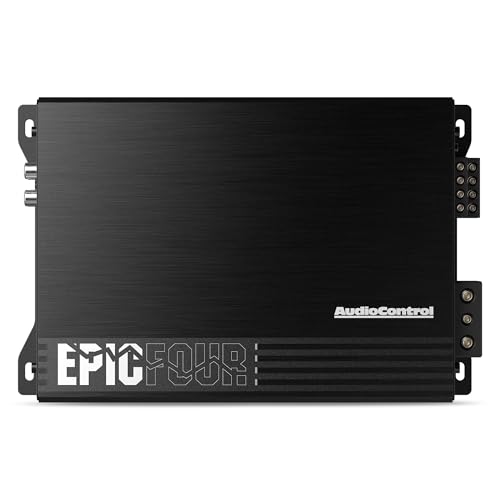
Rockford Fosgate R150X2 - Best Budget 2-Channel
The Rockford Fosgate R150X2 puts out 75 watts RMS per channel and measures just 8.7 by 6.3 inches. It is one of the smallest 2-channel amps Rockford offers and handles both speaker and bridged subwoofer duty. The variable low-pass and high-pass filters cover 50 to 250 Hz, giving you flexibility regardless of speaker placement. The build quality is solid for the price, with a diecast aluminum heatsink that manages heat effectively. Gains are adjusted via screwdriver controls on the end panel. Installation is straightforward and the RCA inputs accept a wide range of source signals. A reliable entry point for anyone adding power to a factory head unit system.
JL Audio JX400/4D - Best 4-Channel Precision
JL Audio's JX400/4D delivers 70 watts RMS per channel at 4 ohms and fits in a chassis measuring 8.8 by 7.0 inches. The NexD Class D topology is genuinely efficient, staying cool even during extended high-volume sessions. All four channels are independently adjustable with separate gain, high-pass filter, and low-pass filter controls. The differential-balanced inputs reject noise effectively, which matters when running long RCA cables in a complex install. JL Audio's build standards show in the clean PCB layout and tight tolerances on the filter frequency markings. It is not the cheapest option but the signal quality and long-term reliability justify the step up in price for a permanent install.

Kenwood KAC-M3004 - Best Under-Seat 4-Channel
The Kenwood KAC-M3004 is purpose-built for under-seat installs. At 7.5 by 5.5 inches and only 1.8 inches tall, it slips under most factory seats without modification. It delivers 50 watts RMS per channel and runs cool enough in a low-clearance position thanks to its Class D design. The controls are minimal by design: a single variable gain and a high-pass filter are accessible from the side panel. Remote turn-on works from a standard accessory wire or from the head unit remote output. The wiring terminals accept up to 8-gauge power and ground wire, appropriate for the power level. A practical, space-conscious pick for four-speaker upgrades in sedans and SUVs.
Alpine MRV-M500 - Best Compact Mono Sub Amp
The Alpine MRV-M500 puts 500 watts RMS into a 4-ohm subwoofer from a chassis measuring 9.1 by 6.7 inches. It is one of the most compact dedicated mono amplifiers at this power level. The variable subsonic filter (15 to 55 Hz) protects ported enclosures from over-excursion, a feature often missing from budget mono amps. Gain, bass boost (0 to 12 dB at 50 Hz), and low-pass filter are all adjustable. The aluminum housing stays manageable in temperature even during long bass-heavy listening sessions. This is the go-to recommendation for anyone building a compact single-sub install in a small car or truck cab where trunk real estate is limited.

Rockford Fosgate P300X1 - Best All-in-One Sub Amp
The Rockford Fosgate P300X1 is a self-contained 10-inch subwoofer and 300-watt RMS amplifier in one enclosure, measuring 15.3 by 13.4 by 3.5 inches. For installs where you want no separate box, wiring, or tuning complexity, this unit connects directly to the head unit's RCA outputs and fits flat under a seat or in a shallow trunk area. The built-in amplifier has adjustable gain and a phase switch. Bass output is punchy and controlled for the compact form factor. The passive radiator design extends low-frequency response without the port tuning requirements of a vented box. A strong pick for daily drivers where simplicity and minimal footprint matter more than raw SPL competition levels.
What to look for
What to consider
Match the amplifier class to your install space. Class D runs cooler and draws less current, making it the right choice for confined areas like under seats or in small enclosures. For speaker channels, 50-75 watts RMS per channel is sufficient for most aftermarket speakers. For a subwoofer, target 250-500 watts RMS matched to your woofer's power handling. Check the amp's impedance stability if you plan to run 2-ohm loads. Verify that your vehicle's alternator and battery can support the added current draw before sizing up to high-power mono amps. A 60-amp fuse inline near the battery is standard practice for amps in the 300-500 watt RMS range.
What to consider
For related upgrades, see our guide to [best car subwoofers](/articles/best-car-subwoofers) and [best car speakers](/articles/best-car-speakers). For how we evaluate products, visit our [methodology](/methodology).
FAQs
For most installs, 50-75 watts RMS per channel is plenty for door speakers, and 300-500 watts RMS handles a single subwoofer cleanly. Chasing peak wattage numbers is misleading; RMS power is the figure that reflects real-world sustained output. Match the amp's RMS rating to your speaker's RMS handling range for best results.
Many are designed specifically for under-seat installation. Look for dimensions under 9 inches in length and 6 inches in width. Class D designs run cooler than Class AB, which matters in enclosed spaces. Check the amp's minimum clearance recommendation for airflow before mounting in a confined spot.
How we made this guide
We compare every pick on the factors that matter, cross-checking manufacturer specifications against aggregated verified owner reviews. We rank independently and never take payment for placement. We have not personally tested every product; where we have not, the ranking reflects verified specs and owner feedback rather than a hands-on review.
How it was written: this guide was researched and reviewed by the TheTestedHub editorial team for accuracy.
Affiliate disclosure: TheTestedHub is reader-supported. When you buy through links on our site, we may earn a commission at no extra cost to you.
Related guides
Expert Pick: Why the Nulaxy KM18 FM Transmitter Wins

The Right Scratch Remover for Any Depth, Any Budget

Ceramic Coating Kits Matching Your Skill Level

The Foam Cannons Worth Buying in 2026

Car Cleaning Kits for a Scratch Free Shine

The 2026 Guide to the Best Portable EV Chargers

Choose the Right Level 2 EV Charger: 2026 Guide
