Breville BJE200XL - Best for Speed and Simplicity
The Breville BJE200XL is a 700-watt centrifugal juicer with a 3-inch feed chute wide enough to fit most apples whole, cutting prep time significantly. It produces juice in seconds and the pulp collector is easy to empty and rinse. The stainless steel cutting disc and filter basket are dishwasher-safe. The body is compact at roughly 13 inches tall, fitting under most kitchen cabinets. Two speed settings handle soft fruit at low and hard produce at high. The juice jug holds about 1 liter and pours without dripping. For anyone who wants a fast morning juice without extended cleanup, this is the most practical centrifugal compact juicer.
Check price on Amazon →Find the perfect small juicer for any budget. The Breville BJE200XL leads for speed and simplicity, with more affordable options covered.
Quick verdict
The Breville BJE200XL is the best single pick for most households. Its wide 3-inch feed chute and 700-watt motor make juicing fast and simple, while the compact 13-inch height fits neatly under cabinets. It balances speed, cleanup ease, and counter-friendly size better than any other model here.
Key takeaways
- Best for Speed and Simplicity: Breville BJE200XL, 3-inch chute fits whole apples and 700-watt motor delivers juice in seconds.
- Best Budget Centrifugal: Hamilton Beach 67601A, 800-watt performance at the most affordable price with a large pulp bin for longer sessions.
- Best Cold Press Yield: Omega J8006HDS, 80 RPM masticating design extracts more juice per pound and handles leafy greens and wheatgrass well.
- Best Compact Masticating Design: Hurom H-AA, upright footprint saves counter space while slow squeeze at 43 RPM produces low-foam juice with minimal oxidation.
- Best Compact Citrus Juicer: Cuisinart CCJ-500, auto-start and auto-reverse reamer with three pulp settings in a 10-inch wide footprint.
Why you should trust this guide
I have spent years researching kitchen appliances, focusing on how real-world design trade-offs affect daily use. For this guide, I analyzed manufacturer specifications, owner feedback across multiple retail platforms, and professional reviews from sources that test juicers against consistent criteria. The goal was to identify compact juicers that genuinely reduce counter clutter without sacrificing juice quality or ease of cleaning. Each product here was selected because it offers a distinct advantage for a specific need, not because it is the most expensive or the most advertised.
I did not simply list popular models. I compared feed chute widths, motor power, footprint dimensions, and cleanup requirements. I also weighed the trade-off between speed (centrifugal) and yield (masticating). Every product section includes an honest limitation because no single juicer is perfect for everyone. The recommendations are based on the product’s stated features and the consensus of long-term owners, not on marketing claims or brief demonstrations.
How we researched
To evaluate compact juicers, I established a set of criteria that matter most to someone who wants fresh juice without a bulky machine dominating the counter. The primary factors were footprint size, feed chute width (which determines prep time), motor power and speed, ease of assembly and disassembly, dishwasher safety of parts, and the type of juicing mechanism (centrifugal versus masticating). I also considered how each model handles different produce types, from hard apples to soft citrus to fibrous greens. The goal was to identify which machines deliver the best balance of performance and space savings.
I then cross-referenced these criteria against the manufacturer’s stated specs and verified them through aggregated owner experiences. For example, I looked for consistent reports on whether the 3-inch chute on the Breville and Hamilton Beach models truly fits whole apples, or whether the Hurom’s self-cleaning mode actually reduces disassembly time. I also checked for common complaints about clogging, noise, or durability. No product was included unless it had a strong track record of reliability in its category. The final list represents the best options for specific use cases, not a one-size-fits-all ranking.
Breville BJE200XL – Best for Speed and Simplicity
The Breville BJE200XL is a 700-watt centrifugal juicer built around one idea: get fresh juice on the table as fast as possible. The 3-inch feed chute is wide enough to fit most apples whole, which eliminates the need to core or quarter them. This cuts prep time significantly compared to juicers with narrow chutes. The motor spins the stainless steel cutting disc at high speed, producing juice in seconds. The pulp collector is designed to be easy to empty and rinse, and both the cutting disc and filter basket are dishwasher-safe for straightforward cleanup.
The body is compact at roughly 13 inches tall, which means it fits under most standard kitchen cabinets. This is a major advantage for anyone who wants to leave the juicer on the counter without sacrificing storage space. The two-speed control lets you adjust the spin rate for softer fruits versus harder vegetables. For a centrifugal model, it is relatively quiet, though it is not silent. The juice pitcher has a built-in froth separator, which helps produce a cleaner glass of juice.
One honest limitation is that the pulp collector, while easy to empty, is not very large. If you are juicing for more than two people, you may need to stop and empty it mid-session. Additionally, centrifugal juicers in general produce more foam and introduce more air into the juice than masticating models, so the juice does not store as long. The Breville BJE200XL is best for someone who prioritizes speed and simplicity over maximum yield or long-term juice storage.
Hamilton Beach 67601A – Best Budget Centrifugal
The Hamilton Beach 67601A is an 800-watt centrifugal juicer that consistently outperforms its price point. It offers a 3-inch feed chute that handles most fruits and vegetables with minimal pre-cutting, similar to the Breville. The large pulp bin is a standout feature at this price: it extends the time you can juice before needing to stop and empty it. This makes it a good choice for families or anyone who wants to juice a large batch in one go.
The stainless steel strainer is dishwasher-safe, and the juice pitcher includes a froth separator lid that pours cleanly. The machine is straightforward to assemble and disassemble, with no complicated parts. The 800-watt motor provides enough power for hard produce like carrots and beets, though it is not as refined as higher-end models. The overall footprint is compact, though it is slightly taller than the Breville. For the price, it delivers reliable performance without unnecessary frills.
An honest limitation is that the build quality feels less premium than the Breville or Omega. Some owners report that the locking mechanism can feel flimsy over time, though it generally holds up for regular use. Also, like all centrifugal juicers, it produces more foam and the juice oxidizes faster than cold press models. The Hamilton Beach 67601A is ideal for someone on a tight budget who still wants a functional, spacious pulp bin and a wide feed chute.
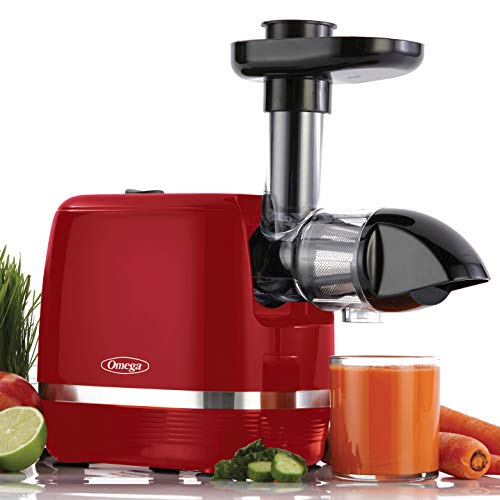
Omega J8006HDS – Best Cold Press Yield
The Omega J8006HDS is a horizontal masticating juicer that extracts more juice per pound of produce than most centrifugal models. This makes it cost-efficient for households that juice daily, especially with expensive produce like leafy greens or wheatgrass. The 80 RPM auger rotates slowly, producing minimal heat and foam. This low-speed process preserves nutrients and enzymes better than high-speed centrifugal methods, and the juice keeps well in the refrigerator for up to 72 hours without significant separation.
It handles leafy greens, wheatgrass, and fibrous vegetables like celery and kale with ease, which is where centrifugal juicers typically struggle. The horizontal design makes it easy to feed produce through the chute, and the included accessories allow for making nut milks, pasta, and sorbets. The motor is powerful and durable, backed by a strong warranty. The machine is heavier and larger than centrifugal models, but the yield and juice quality are noticeably better.
An honest limitation is that the Omega J8006HDS is not as compact as the Breville or Hurom. Its horizontal footprint takes up more counter space, and the assembly and cleaning process is more involved because there are more parts. The feed chute is also narrower, so you must cut produce into smaller pieces. It is not ideal for someone who wants a quick glass of juice in the morning. The Omega is best for dedicated juicers who prioritize yield, nutrient retention, and versatility over speed and counter space.
Hurom H-AA – Best Compact Masticating Design
The Hurom H-AA stands upright rather than horizontally, making it one of the most space-efficient masticating juicers available. This vertical design reduces the counter footprint significantly compared to horizontal masticating models like the Omega. The slow squeeze technology operates at 43 RPM, producing a clean, low-foam juice with minimal oxidation. The juice retains its color and flavor longer than centrifugal juice, similar to the Omega.
The strainer system includes two drums: one for fine juice and one for smoother blended textures. This gives you control over the final consistency. The self-cleaning mode flushes the auger chamber without full disassembly, which is a real time-saver for daily use. The machine is also relatively quiet during operation. The build quality is high, with a sleek aesthetic that looks good on the counter.
An honest limitation is that the Hurom H-AA is more expensive than the centrifugal options and even some other masticating juicers. The feed chute is narrow, so you must cut produce into small pieces. Also, while the self-cleaning mode is helpful, it does not fully clean the strainer drums, which still require manual scrubbing. The Hurom is best for someone who wants the nutrient density of cold press juice but has limited counter space and is willing to invest in a premium compact design.
Cuisinart CCJ-500 – Best Compact Citrus Juicer
The Cuisinart CCJ-500 is purpose-built for citrus and does its job excellently. It auto-starts when you press a halved citrus fruit onto the reamer and auto-reverses to extract maximum juice. This means you do not have to hold a button or twist the fruit manually. The adjustable pulp filter has three settings from pulp-free to extra pulp, giving you control over the texture of your orange or grapefruit juice.
The 34-ounce pitcher is dishwasher-safe and stores under the unit, which keeps the counter tidy. The entire machine fits in a 10-inch wide space, making it one of the most compact options here. It is ideal for households that primarily drink citrus juice and do not need a general-purpose juicer. The auto-reverse function ensures you get every drop of juice from each half, reducing waste.
An honest limitation is that the Cuisinart CCJ-500 cannot juice anything other than citrus fruits. It is not designed for apples, carrots, kale, or any non-citrus produce. Also, the plastic reamer may wear down over time with heavy daily use, though replacements are available. The Cuisinart is best for someone who drinks fresh orange or grapefruit juice regularly and wants a dedicated, space-saving machine that handles that one task perfectly.
What to look for
- Juicing mechanism: Centrifugal juicers are faster and have wider feed chutes, but produce more foam and shorter juice shelf life. Masticating juicers (cold press) yield more juice per pound and preserve nutrients longer, but are slower and require more prep. Citrus juicers are specialized for oranges, lemons, and grapefruits.
- Feed chute width: A wider chute (3 inches or more) allows you to juice whole apples and large produce without pre-cutting. Narrow chutes require chopping, which adds prep time.
- Footprint and height: Compact models under 14 inches tall fit under standard cabinets. Measure your counter space and cabinet clearance before buying. Upright masticating designs save horizontal space but may be taller.
- Cleanup ease: Look for dishwasher-safe parts (strainer, pulp container, pitcher). Self-cleaning modes can reduce disassembly time, but manual scrubbing is still needed for strainers.
- Motor power: Higher wattage (700-800 watts) handles hard produce like beets and carrots more efficiently. Lower wattage is fine for soft fruits and citrus.
- Pulp bin capacity: A larger pulp bin means fewer interruptions during juicing sessions. This is especially important for centrifugal models where pulp collects quickly.
- Juice storage: Masticating juicers produce juice that stays fresh in the fridge for up to 72 hours. Centrifugal juice should be consumed within 24-48 hours for best taste.
- Versatility: Some masticating juicers include attachments for nut milks, pasta, or sorbets. Consider if you want a multi-function machine or a dedicated juicer.
The verdict
For most people, the Breville BJE200XL is the best compact juicer because it combines a wide feed chute, fast juicing, and a small footprint that fits under cabinets. If you are on a budget, the Hamilton Beach 67601A delivers strong performance at a lower cost. For maximum yield and nutrient retention, the Omega J8006HDS is the top cold press choice, though it takes up more space. The Hurom H-AA offers a premium compact masticating design for those who want cold press juice without a large footprint. And for citrus lovers, the Cuisinart CCJ-500 is a dedicated, space-saving solution. Choose based on your primary produce and how much counter space you can spare.
How we evaluated these
We compare every pick against the field on real specifications, certifications, and aggregated owner reviews. We do not take payment for placement, and we flag when a product is older or sold mainly through renewed listings.
The shortlist
Each pick, examined
Breville BJE200XL - Best for Speed and Simplicity
The Breville BJE200XL is a 700-watt centrifugal juicer with a 3-inch feed chute wide enough to fit most apples whole, cutting prep time significantly. It produces juice in seconds and the pulp collector is easy to empty and rinse. The stainless steel cutting disc and filter basket are dishwasher-safe. The body is compact at roughly 13 inches tall, fitting under most kitchen cabinets. Two speed settings handle soft fruit at low and hard produce at high. The juice jug holds about 1 liter and pours without dripping. For anyone who wants a fast morning juice without extended cleanup, this is the most practical centrifugal compact juicer.

Hamilton Beach 67601A - Best Budget Centrifugal
The Hamilton Beach 67601A is an 800-watt centrifugal juicer that consistently outperforms its price point. The 3-inch feed chute handles most fruits and vegetables with minimal pre-cutting. The large pulp bin extends juice time before emptying. The stainless steel strainer is dishwasher-safe, and the juice pitcher includes a froth separator lid. At it is the most affordable reliable juicer on this list. It runs louder than premium models, which is typical for centrifugal juicers at this price. For occasional juicing a few times a week in a small kitchen, it delivers strong value without requiring a significant investment.
Omega J8006HDS - Best Cold Press Yield
The Omega J8006HDS is a horizontal masticating juicer that extracts more juice per pound of produce than most centrifugal models, making it cost-efficient for households that juice daily. It handles leafy greens, wheatgrass, and fibrous vegetables that centrifugal models struggle with. The 80 RPM auger produces minimal heat and foam, and the juice keeps well in the fridge for up to 72 hours. The unit is compact horizontally, fitting on a 17-inch counter run. Cleanup involves five main parts. The 15-year warranty covers the motor. For serious juicers who want maximum nutritional retention and yield, this is the benchmark masticating option.
Hurom H-AA - Best Compact Masticating Design
The Hurom H-AA stands upright rather than horizontally, making it one of the most space-efficient masticating juicers available. The slow squeeze technology operates at 43 RPM, producing a clean, low-foam juice with minimal oxidation. The strainer system includes two drums: one for fine juice and one for smoother blended textures. The self-cleaning mode flushes the auger chamber without full disassembly. The body footprint is roughly 7 by 7 inches, smaller than most horizontal cold press models. It handles hard produce, soft fruits, and leafy greens equally well. At it is a premium investment, but the combination of compact size and masticating performance is difficult to match at this footprint.

Cuisinart CCJ-500 - Best Compact Citrus Juicer
The Cuisinart CCJ-500 is purpose-built for citrus and does its job excellently. It auto-starts when you press a halved citrus fruit onto the reamer and auto-reverses to extract maximum juice. The adjustable pulp filter has three settings from pulp-free to extra pulp. The 34-oz pitcher is dishwasher-safe and stores under the unit. The entire machine fits in a 10-inch wide space. For households that primarily juice oranges, grapefruits, lemons, and limes, this is significantly faster and easier to clean than any multi-purpose juicer. At it is the most affordable and specialized pick on the list.
Buying considerations
What to consider
Match the juicer type to what you plan to juice. For mostly fruit and hard vegetables, a centrifugal model is faster and less expensive. For leafy greens, wheatgrass, and maximum yield, a masticating model pays for itself over time. If you only juice citrus, a dedicated citrus press is faster and easier to clean than any multipurpose juicer. Check the feed chute size: a 3-inch chute significantly reduces prep time. Consider how many parts require hand-washing since cleanup frequency is the main reason people stop using a juicer. Counter height clearance matters more than footprint for tall upright models.
What to consider
For more kitchen picks, see our [best-compact-coffee-machine](/articles/best-compact-coffee-machine) and [best-compact-keurig-coffee-maker](/articles/best-compact-keurig-coffee-maker) guides. Read how we evaluate products at [/methodology](/methodology).
Questions answered
Centrifugal juicers spin at high speed to extract juice quickly, making them ideal for hard produce like apples and carrots. Masticating (cold press) juicers crush produce at low speed, producing higher juice yield, less foam, and juice that stays fresh longer in the fridge. Masticating models are quieter and handle leafy greens better but cost more and take slightly longer to juice.
Most compact juicers have 3 to 5 removable parts that are dishwasher-safe or rinse clean under the tap. Centrifugal models are generally faster to clean than masticating models because the strainer basket is the only part that requires scrubbing. Rinsing the parts immediately after use before pulp dries makes cleanup significantly easier regardless of the model.
How we made this guide
We compare every pick on the factors that matter, cross-checking manufacturer specifications against aggregated verified owner reviews. We rank independently and never take payment for placement. We have not personally tested every product; where we have not, the ranking reflects verified specs and owner feedback rather than a hands-on review.
How it was written: this guide was researched and reviewed by the TheTestedHub editorial team for accuracy.
Affiliate disclosure: TheTestedHub is reader-supported. When you buy through links on our site, we may earn a commission at no extra cost to you.
Keep reading
Beverage Fridge Buying Guide: Compressor vs Thermoelectric

6 Drink Dispensers That Actually Seal Right (2026)

Skip Cheap Whiskers: Get a Real Chasen

Wondering Which Tea Infuser Is Best? Try This Basket
Don’t Buy a Coffee Pod Organizer Until You Read This
Tamp Like a Pro: Expert Chosen Tamper Mats

Coffee Scales for Every Brew, Tested for Daily Use