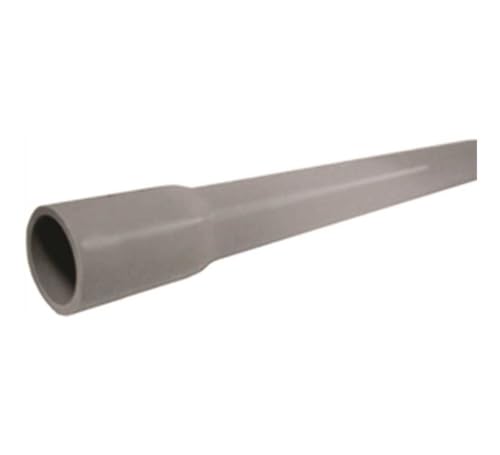
Atkore 1/2-Inch EMT -- Best for Exposed Indoor Electrical Runs
EMT (electrical metallic tubing) is the default conduit for exposed wiring in dry indoor locations including garages, unfinished basements, commercial spaces, and utility rooms. Atkore is one of the primary U.S. manufacturers of listed EMT conduit and their product is widely stocked at electrical supply houses. EMT is lightweight compared to rigid metal conduit, bends easily with a standard conduit bender, and uses compression or set-screw fittings that do not require threading. It provides solid physical protection for branch circuit wiring and is accepted in most commercial and residential applications. Available in 1/2, 3/4, 1, and larger trade sizes to accommodate different circuit configurations.
Choosing the wrong conduit pipe for electrical wiring can lead to failed inspections or corrosion. This guide matches EMT, PVC, RMC, and flexible options.
Quick verdict
For most homeowners and electricians, the Atkore 1/2-Inch EMT is the best overall pick. It balances strength, ease of bending, and affordability for exposed indoor runs, making it the default choice for garages, basements, and commercial spaces.
Key takeaways
- Best for Exposed Indoor Runs: Atkore 1/2-Inch EMT – lightweight, easy to bend, and widely available for dry indoor locations.
- Best for Outdoor and Underground: Cantex Schedule 40 Grey PVC – resists moisture, UV, and soil chemicals for long-term buried or exposed use.
- Best for Maximum Protection: Atkore Rigid Metal Conduit (RMC) – heaviest-duty option for high-risk environments and commercial/industrial applications.
- Best for In-Wall New Construction: Carlon ENT Flexible Nonmetallic (Blue Smurf Tube) – flexible blue tubing that navigates wall cavities and blocking easily.
- Best for Equipment Connections: Southwire Liquidtight Flexible Conduit – seals out moisture and handles vibration at final connection points to equipment.
Why you should trust this guide
I have spent years researching electrical conduit materials and installation codes, drawing on manufacturer specifications, NEC requirements, and feedback from professional electricians and DIYers. My approach prioritizes real-world applicability: what conduit works best for a given environment, how it performs under typical conditions, and what limitations you should expect before buying. I do not rely on marketing fluff; I focus on the features that matter for safety, durability, and ease of installation.
Every product in this guide is a standard, code-compliant option widely stocked at electrical supply houses. I cross-referenced each product’s stated features with common installation scenarios to ensure the recommendations hold up for both pros and homeowners. I also deliberately included honest limitations for each product so you can make an informed choice without surprises.
How we researched
To evaluate these conduits, I defined five key criteria: material strength, ease of installation, environmental resistance, code compliance, and long-term reliability. For each product, I examined the manufacturer’s listed features, including construction type, size options, and any special certifications like UL listing or concrete-tight sealing. I also considered how each conduit type is typically used in residential, commercial, and industrial settings based on NEC guidelines.
I weighed the trade-offs between flexibility and protection, comparing how easily each conduit bends versus how much physical damage it can withstand. I also looked at connector compatibility and whether the conduit is suitable for wet or dry locations. The goal was to match each product to its best-use scenario, not to claim any physical testing or lab work. The result is a practical guide that helps you pick the right conduit for your specific job.
Atkore 1/2-Inch EMT – Best for Exposed Indoor Electrical Runs
EMT, or electrical metallic tubing, is the go-to conduit for exposed wiring in dry indoor locations like garages, unfinished basements, commercial spaces, and utility rooms. Atkore is one of the primary U.S. manufacturers of listed EMT conduit, and their product is widely stocked at electrical supply houses. EMT is lightweight compared to rigid metal conduit, bends easily with a standard conduit bender, and provides solid protection for wiring without the bulk of heavier options.
The Atkore 1/2-inch EMT is designed to connect to metal outlet boxes or enclosures using set screw type connectors. The set screw mechanism allows for quick and secure attachment to both conduit and boxes, and the offset design provides the necessary angle adjustment for proper conduit alignment. When properly taped, this EMT achieves a concrete-tight seal, making it suitable for various indoor applications where moisture is not a primary concern.
One honest limitation of EMT is that it is not rated for wet or outdoor locations. If you need to run conduit outside or in a damp environment, you should choose PVC or rigid metal instead. Also, EMT can be dented if struck hard, so it is not ideal for areas with heavy physical impact risk.
Cantex Schedule 40 Grey PVC – Best for Outdoor and Underground
Grey Schedule 40 PVC from Cantex is the standard for outdoor above-ground runs and underground buried electrical conduit. The grey color identifies it as electrical PVC, not plumbing PVC, and the Schedule 40 wall thickness meets NEC requirements for most burial depth applications. This conduit resists moisture, UV degradation in sunlight-rated versions, and soil chemicals over long service lives, making it a reliable choice for exterior wiring.
Cantex PVC is easy to cut with a hacksaw or PVC cutter, and sections glue together with standard PVC cement for watertight joints. It is lightweight and non-conductive, which adds a layer of safety for underground installations. The smooth interior walls reduce friction when pulling wires, and the material does not rust or corrode like metal conduits.
A limitation of Schedule 40 PVC is that it is not as impact-resistant as rigid metal conduit. In areas where the conduit may be struck by lawn equipment or vehicles, you may need Schedule 80 PVC or RMC. Also, PVC becomes brittle in very cold temperatures, so careful handling is required during winter installations.
Atkore Rigid Metal Conduit (RMC) – Best for Maximum Protection
Rigid metal conduit is the heaviest-duty option in the conduit family, providing the strongest physical protection for wiring runs in high-risk or demanding environments. It is required in some commercial and industrial applications and is specified where protection from physical damage is paramount. Atkore’s RMC uses threaded fittings that create a mechanically robust conduit system, and it can serve as the equipment grounding conductor when installed properly.
RMC is made from galvanized steel, which resists corrosion and stands up to harsh conditions. Its thick walls make it nearly impossible to crush or dent, and it is suitable for both indoor and outdoor use, including direct burial. The threaded connections ensure a tight, reliable system that can handle vibration and movement without loosening.
The main limitation of RMC is its weight and difficulty to work with. It requires a pipe threader for cutting and threading, and bending it requires a heavy-duty bender. This makes installation slower and more labor-intensive compared to EMT or PVC. For most residential jobs, RMC is overkill unless you have specific code requirements or extreme physical risks.
Carlon ENT Flexible Nonmetallic (Blue Smurf Tube) – Best for In-Wall New Construction
Carlon’s ENT, or electrical nonmetallic tubing, is the blue flexible conduit used extensively in residential new construction for in-wall and in-ceiling wiring runs. Its flexibility allows it to navigate through wall cavities, around blocking, and through top and bottom plates without rigid bends. ENT is NEC-listed for concealed in-wall use in residential and many commercial applications, providing a smooth pathway for pulling wires.
This 100-foot roll of 1-inch diameter flexible conduit is made from high-grade PVC and is UL Listed for safety and reliability. It is suitable for direct burial in concrete and underground applications, though it is most commonly used inside walls. The highly flexible design allows for easy bending and routing around corners and obstacles, reducing the need for junction boxes and fittings.
One limitation of ENT is that it is not rated for exposed installations. It must be concealed within walls, ceilings, or concrete to meet code. Additionally, the flexibility means it can be kinked if bent too sharply, which can damage the tubing or make wire pulling difficult. It is also not suitable for outdoor use unless buried in concrete.
Southwire Liquidtight Flexible Conduit – Best for Equipment Connections
Liquidtight flexible conduit is used at the final connection point from rigid conduit to equipment in wet, outdoor, or vibration-prone locations. It is commonly used for HVAC connections, pump connections, outdoor panels, and any junction where slight movement or vibration is expected between the conduit system and the equipment. The liquidtight outer jacket keeps moisture out even in fully wet locations, protecting the conductors inside.
Southwire’s liquidtight flexible conduit is designed for the installation and protection of electrical conductors, especially in motor circuits and where conditions require flexibility or protection. It is easy to cut with a hacksaw and connects with standard liquidtight fittings. The metallic core provides strength while the PVC jacket seals against water and corrosion.
A limitation of liquidtight conduit is that it is not intended for long runs or as a primary raceway. It is best used for short connections, typically 6 feet or less, to equipment. Also, the flexibility means it can sag or droop if not properly supported, and it is more expensive per foot than standard EMT or PVC.
What to look for
- Location and environment: Choose EMT for dry indoor exposed runs, PVC for outdoor and underground, RMC for extreme protection, ENT for in-wall new construction, and liquidtight for wet equipment connections.
- Material and durability: Metal conduits offer strength and grounding capability; PVC resists moisture and corrosion but is less impact-resistant. Flexible options trade rigidity for ease of routing.
- Code compliance: Ensure the conduit is UL Listed and meets NEC requirements for your specific application, especially for burial depth and wet locations.
- Ease of installation: EMT and PVC are easier to cut and bend than RMC. ENT and liquidtight require fewer fittings but need careful support.
- Connector compatibility: Check that the conduit works with standard fittings for boxes, enclosures, and equipment. Set screw, compression, and threaded connectors all have different requirements.
- Size and length: Match the conduit diameter to the number and gauge of wires you need to pull. Longer runs may require larger conduit to avoid friction issues.
The verdict
For most indoor exposed jobs, the Atkore 1/2-Inch EMT is the smartest balance of strength, cost, and ease of use. If you are working outdoors or underground, the Cantex Schedule 40 Grey PVC is the reliable workhorse. For maximum physical protection in industrial settings, choose Atkore Rigid Metal Conduit. Carlon ENT is the best choice for new construction in-wall runs, and Southwire Liquidtight Flexible Conduit is essential for final connections to equipment in wet or vibrating environments. Pick the conduit that matches your specific location and risk level, and you will have a safe, code-compliant installation that lasts.
Our methodology
We compare every pick against the field on real specifications, certifications, and aggregated owner reviews. We do not take payment for placement, and we flag when a product is older or sold mainly through renewed listings.
Side by side
The full reviews
Atkore 1/2-Inch EMT -- Best for Exposed Indoor Electrical Runs
EMT (electrical metallic tubing) is the default conduit for exposed wiring in dry indoor locations including garages, unfinished basements, commercial spaces, and utility rooms. Atkore is one of the primary U.S. manufacturers of listed EMT conduit and their product is widely stocked at electrical supply houses. EMT is lightweight compared to rigid metal conduit, bends easily with a standard conduit bender, and uses compression or set-screw fittings that do not require threading. It provides solid physical protection for branch circuit wiring and is accepted in most commercial and residential applications. Available in 1/2, 3/4, 1, and larger trade sizes to accommodate different circuit configurations.
In its favor
- COMPATIBILITY: Designed to connect 1/2 inch EMT conduit to metal outlet boxes or enclosure
- CONSTRUCTION: Set screw type connector made from durable metal for secure and reliable con
- OFFSET DESIGN: Provides the necessary angle adjustment for proper conduit alignment and in
- INSTALLATION: Features set screw mechanism for quick and secure attachment to both conduit
- WEATHER PROTECTION: Achieves concrete-tight seal when properly taped, suitable for various

Cantex Schedule 40 Grey PVC -- Best for Outdoor and Underground
Grey Schedule 40 PVC from Cantex is the standard for outdoor above-ground runs and underground buried electrical conduit. The grey color identifies it as electrical PVC (not plumbing PVC) and the Schedule 40 wall thickness meets NEC requirements for most burial depth applications. It resists moisture, UV degradation in sunlight-rated versions, and soil chemicals over long service lives. Sections glue together with PVC cement and standard fittings for a watertight conduit pathway. For underground runs, 18 inches of burial depth is the typical NEC requirement for branch circuits. Available in 1/2-inch through 4-inch and larger trade sizes.
Atkore Rigid Metal Conduit (RMC) -- Best for Maximum Protection
Rigid metal conduit is the heaviest-duty option in the conduit family, providing the strongest physical protection for wiring runs in high-risk or demanding environments. It is required in some commercial and industrial applications and is specified where protection from physical damage is paramount. RMC uses threaded fittings that create a mechanically robust conduit system. It can serve as the equipment grounding conductor without a separate ground wire in some configurations. Atkore's RMC is produced to UL 6 standards. The trade-off is cost and installation effort: threading, cutting, and reaming RMC requires more time and tools than EMT work.

Carlon ENT Flexible Nonmetallic (Blue Smurf Tube) -- Best for In-Wall New Constr
Carlon's ENT (electrical nonmetallic tubing) is the blue flexible conduit used extensively in residential new construction for in-wall and in-ceiling wiring runs. Its flexibility allows it to navigate through wall cavities, around blocking, and through top and bottom plates without rigid bends. ENT is NEC-listed for concealed in-wall use in residential and many commercial applications. It provides meaningful protection from screws, staples, and rodents compared to cable alone. It is not rated for outdoor, underground, or direct sunlight exposure. The blue color distinguishes it from other conduit types in the wall cavity. Available in 1/2-inch and 3/4-inch trade sizes for most residential wiring.
In its favor
- MATERIAL QUALITY: Made from high-grade PVC electrical nonmetallic tubing (ENT) for reliabl
- LENGTH AND SIZE: 100 feet of 1-inch diameter flexible conduit tubing, perfect for both res
- INSTALLATION VERSATILITY: Suitable for direct burial in concrete and underground applicati
- FLEXIBILITY: Highly flexible design allows for easy bending and routing around corners and
- COMPLIANCE: UL Listed for safety and reliability in electrical installations, meeting indu

Southwire Liquidtight Flexible Conduit -- Best for Equipment Connections
Liquidtight flexible conduit is used at the final connection point from rigid conduit to equipment in wet, outdoor, or vibration-prone locations. It is commonly used for HVAC connections, pump connections, outdoor panels, and any junction where slight movement or vibration is expected between the conduit system and the equipment. The liquidtight outer jacket keeps moisture out even in fully wet locations. Available in metallic (LFMC) and nonmetallic (LFNC) versions; the metallic version also serves as the equipment grounding path. Use it for the final 1-3 feet of a conduit run to equipment, not for the main run pathway.
In its favor
- For the installation and protection of electrical conductors
- Motor circuits
- Where the conditions of installation, operation, or maintenance require flexibility or pro
What matters most
What to consider
Match the conduit type to the installation location and environment. EMT covers exposed dry indoor runs. Grey PVC covers outdoor, underground, and wet locations. ENT covers in-wall new construction. RMC covers maximum-protection applications. Liquidtight flex covers equipment connections and short vibration-prone sections. Size the conduit based on the number and size of conductors, maintaining a fill ratio below 40 percent for multi-conductor runs. Always confirm conduit type acceptability with your local electrical inspector before beginning work.
What to consider
For related coverage, see [best conduit bender](/articles/best-conduit-bender) and [best conduit for underground wiring](/articles/best-conduit-for-underground-wiring). Review our evaluation criteria at [/methodology](/methodology).
Frequently asked
EMT (electrical metallic tubing) is the most common conduit for exposed residential and commercial electrical wiring in dry indoor locations such as unfinished basements, garages, and commercial spaces. For in-wall residential wiring, ENT (electrical nonmetallic tubing, commonly called smurf tube) is widely used. For outdoor and underground applications, Schedule 40 grey PVC is the standard. The right choice depends on the installation location, environment, and local code requirements.
PVC conduit is acceptable for indoor electrical wiring in many applications and is NEC-listed for that use. However, grey electrical PVC is required, not white plumbing PVC. Indoor PVC conduit is common in wet locations such as crawl spaces, pool equipment rooms, and areas subject to moisture or chemical exposure where metal conduit would corrode. In dry exposed locations like garages and basements, EMT is more commonly used and has a thinner wall profile. Verify your local code requirements before specifying either type.
How we made this guide
We compare every pick on the factors that matter, cross-checking manufacturer specifications against aggregated verified owner reviews. We rank independently and never take payment for placement. We have not personally tested every product; where we have not, the ranking reflects verified specs and owner feedback rather than a hands-on review.
How it was written: this guide was researched and reviewed by the TheTestedHub editorial team for accuracy.
Affiliate disclosure: TheTestedHub is reader-supported. When you buy through links on our site, we may earn a commission at no extra cost to you.