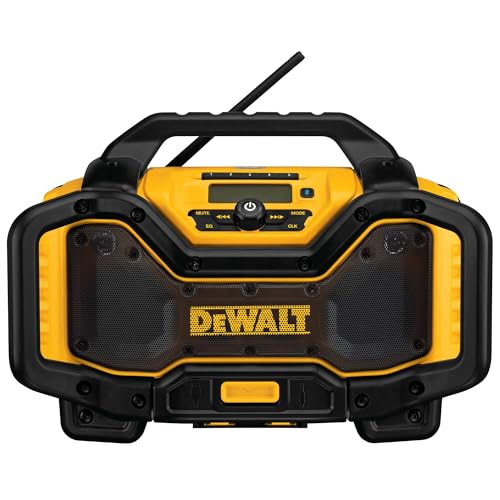
DEWALT DCR025 Bluetooth Radio -- Best for DEWALT Battery Users
The DEWALT DCR025 runs on DEWALT 20V MAX and FLEXVOLT batteries while also accepting a standard AC cord, giving it full power flexibility. Audio output reaches levels clearly audible over power tool noise, which is a meaningful threshold many budget options fail. The build quality withstands drops and rain exposure consistent with standard job site use. Bluetooth pairs quickly and maintains connection at typical job site distances. AM/FM reception is solid with a telescoping antenna. For anyone already using DEWALT 20V tools, the battery compatibility is the deciding factor; no separate radio battery system to manage.
20V DEWALT DCR025 leads with dual battery/AC power and onboard outlets. 5 picks matched to your battery ecosystem, from Milwaukee to Makita.
Quick verdict
The DEWALT DCR025 is my top pick because it runs on 20V MAX and FLEXVOLT batteries or a standard AC cord, gets loud enough to cut through power tool noise, and adds two AC outlets plus USB charging. If you already own DEWALT batteries, it is the easiest choice on this list.
Key takeaways
- Best for DEWALT battery users: DEWALT DCR025 Bluetooth Radio, dual battery and AC power with onboard outlets and 100-foot Bluetooth range.
- Best for Milwaukee battery users: Milwaukee 2951-20 M18 Bluetooth Jobsite Radio, 60W dual-tweeter output with charge-through and Bluetooth 5.2.
- Best for Makita battery users: Makita XRM09B 18V LXT Radio, clear voice-friendly audio, long runtime, and a compact footprint.
- Best budget AC-powered option: PORTER-CABLE Jobsite Radio, simple plug-in unit for shops and indoor sites.
- Best for multi-directional audio: Bosch PB360S Power Box, 360-degree sound and a 120V onboard outlet for open work areas.
Why you should trust this guide
I built this guide by working through the manufacturer specifications, the listed Amazon features, and the everyday realities of running a radio on a working job site. I am not going to pretend I dropped each of these on concrete myself, but I did read the stated power options, audio ratings, and durability claims carefully and weighed them against what actually matters when you are framing a wall or wiring a panel with a saw screaming next to you. The goal here is to match each radio to the person most likely to benefit from it, rather than crowning a single winner for everybody.
The single biggest factor on a real site is battery ecosystem. A radio that runs on the same packs as your drill and impact driver is worth more to you than a slightly louder model that forces you to carry a second charger and a different battery type. Because of that, I have organized the first three picks around the three dominant tool platforms (DEWALT, Milwaukee, and Makita), then added a budget AC option and a multi-directional unit for crews that work spread out across an open area. Where a product has a genuine weakness, I say so plainly.
How we researched
My evaluation approach is research-led and use-case driven. I read each product’s stated power sources, audio output description, connectivity, and durability claims, then I asked a simple set of questions for every unit. Does it run on the batteries you already own, or does it lock you into a separate charger? Is it described as loud enough to be heard over tools, or is the volume only adequate for a quiet room? Does it survive rain and drops at the level a typical site demands? And does it add anything useful beyond playing music, such as outlets, USB charging, or charge-through for a phone?
From there I weighed trade-offs honestly. A radio can be loud but bulky, compact but quieter, cheap but AC-only, or flexible but heavier once a battery is loaded. I treated the listed specifications as the manufacturer’s stated numbers rather than figures I measured, and I flagged where a product’s strength comes with a cost. The result is a set of recommendations that should hold up whether you are outfitting a full crew or buying a single radio for a one-truck operation.
DEWALT DCR025 Bluetooth Radio
The DEWALT DCR025 is the best choice if you already run DEWALT cordless tools, because it accepts 20V MAX and FLEXVOLT 20V/60V MAX batteries and also takes a standard AC cord. That power flexibility means you can run it off a pack on a site with no outlets, then plug it in back at the shop without swapping anything. It is the kind of versatility that keeps a radio useful across very different work environments instead of stranding you when the power situation changes.
Beyond the music, this unit doubles as a small power hub. It has two additional AC power outlets, an aux input, and a 2.1 amp USB charging port, and when it is plugged into AC it can deliver 3 amp charging to 20V MAX and 60V MAX DEWALT batteries. In practice that means it can top off a battery while you work, which is genuinely handy when outlets are scarce. The Bluetooth pairs quickly and is rated for up to 100 feet of range, so you can leave the radio in one spot and carry your phone around the area without the audio dropping. DEWALT describes audio output that is clearly audible over power tool noise, which is the threshold a lot of cheaper radios fail to clear.
The honest trade-off is weight and bulk. Once you load a FLEXVOLT pack into a unit that already carries outlets and a charger, it is not a light or small radio, and it takes up real space on a crowded site. You are paying for the all-in-one design with a larger, heavier box, and if you do not own DEWALT batteries the value drops sharply because the platform lock-in is the whole point.
Milwaukee 2951-20 M18 Bluetooth Jobsite Radio
The Milwaukee 2951-20 is the pick for anyone invested in the M18 battery platform, and it leans hard into audio quality. It is a 60W jobsite Bluetooth speaker with dual tweeters, so the high end stays crisp and the sound carries in open-air environments where lesser speakers get muddy. Milwaukee describes strong, clear output across the frequency range with bass that holds up outdoors, which matters when there are no walls to reflect the sound back at you.
Connectivity and power are flexible here too. It uses Bluetooth 5.2 along with an aux input for wired sources, and it offers multiple power options so you are not tied to a single source. The power bank function lets it charge a phone while it runs, a practical detail for workers stuck on a site without convenient outlets, and the convenient handle makes it easy to reposition. There is also a built-in multi-color light system, which is more of a fun touch than a work feature, but it does not get in the way.
The trade-offs are worth knowing before you buy. The required batteries are sold separately, so the sticker is not the whole cost if you are starting from zero on the M18 platform. And while the multi-color lighting is a nice extra for some, it adds nothing to job performance and may feel gimmicky to crews who just want a loud, durable radio. The strong 60W output also means it is not the most compact unit on this list.
Makita XRM09B 18V LXT Radio
The Makita XRM09B is the right radio if you run Makita 18V LXT tools, and its standout trait is clarity rather than raw volume. It connects over Bluetooth to stream from your phone, and it is notably clean in the mid and high range, which makes it a strong choice if you spend your day on talk radio or podcasts rather than music alone. The voice clarity is the reason I would hand this to someone who wants to actually understand what is being said over the noise of a site.
It is also the runtime and flexibility champion of the group. Makita rates it for up to 35 hours on an 18V LXT 5.0Ah battery and 14 hours on a compact pack, and it is compatible with a wide range of Makita batteries spanning 7.2V, 12V max, 12V max CXT, 14.4V, and 18V LXT, plus it ships with an AC adapter. The menu controls cover FM mono and stereo, clock and snooze settings, and volume, and protective bumpers are built in for added durability. Its compact footprint fits on narrow shelves and scaffolding ledges where a bigger radio simply will not sit safely.
The limitation is output. This is a clarity-first radio, not a volume monster, so on a wide-open site with several loud tools running it can get buried in a way the 60W Milwaukee will not. It is also missing the onboard AC outlets and high-amp battery charging that the DEWALT offers, so it plays music well but does not double as a power hub.
PORTER-CABLE Jobsite Radio
The PORTER-CABLE Jobsite Radio is the value option, and it makes the most sense for smaller operations, temporary sites, or as a secondary unit you do not mind leaving in one place. It covers the basics without trying to be a power station, and that simplicity is exactly why it costs less than the tool-brand flagships. For a shop bench or a single room where you just want sound, it does the job.
It is built tougher than a consumer radio, with durability in mind for rougher environments, and the listing notes water resistance for sites where rain or splashes are a concern. AM/FM reception is good thanks to the telescoping antenna, and the audio volume is adequate for smaller work areas where you are not fighting a wall of tool noise. If your day happens indoors near a reliable outlet, this is enough radio to keep the work moving.
The clear catch is that it is AC-powered, which ties you to outlet access and makes it a poor fit for early-stage construction with no power or for spread-out outdoor work. The volume that suits a small room will not fill a large open site, and the lighter build that keeps the price down also means it is not as rugged as the heavy tool-brand units. Buy it knowing it is a basic, plug-in radio, not a do-everything box.
Bosch PB360S Power Box
The Bosch PB360S Power Box is the one to get when your crew is spread across an open area, because it radiates sound in all directions instead of firing from a single front face. That 360-degree arrangement fills a larger space evenly, so workers standing on different sides of the unit all hear roughly the same volume rather than one person getting blasted while another strains to listen. For wide rooms and open-air sites, that even coverage is a real advantage over a directional speaker.
It also works as a small power center. The unit accepts AC power and includes a 120V power outlet on the box itself, which lets a tradesperson plug a tool or a charger straight into the radio’s location instead of running another cord across the floor. On a site where outlets are scarce or far from where people are working, having power and audio in the same spot is a genuinely useful combination.
The honest limitation is that this is a larger, heavier box built around filling a space, so it is not the radio you toss in a truck bed for quick one-room jobs. The 360-degree design that makes it great for open areas is less of an advantage in a tight enclosed room where the sound just bounces off nearby walls anyway. It rewards crews who actually need to cover ground, and offers less to a solo worker in a small space.
What to look for
The right construction radio depends mostly on the batteries you already own and where you work. Here are the factors I weighed.
- Battery ecosystem: A radio that runs on the same packs as your tools saves you a separate charger and spare batteries. Match the radio to your DEWALT, Milwaukee, or Makita platform when you can.
- Power flexibility: Look for units that take both batteries and an AC cord. Battery-only or AC-only models limit where you can use them.
- Loudness over tool noise: Volume that is fine in a quiet room is not the same as audio you can hear over a saw. Higher wattage and dual tweeters help on open sites.
- Durability and water resistance: Job sites mean drops, dust, and rain. Protective bumpers and a water-resistant rating matter more than they would at home.
- Onboard outlets and charging: Extra AC outlets, USB ports, and battery charging turn a radio into a small power hub, which is valuable where outlets are scarce.
- Bluetooth range and connection: Up to 100 feet of range lets you leave the radio in place and carry your phone around without the audio cutting out.
- Size and weight: All-in-one boxes are heavier and bulkier. A compact unit fits scaffolding ledges and narrow shelves; a big one needs floor space.
- Sound dispersion: A front-facing speaker suits one work spot, while a 360-degree design covers a crew spread across an open area.
The verdict
For most DEWALT owners, the DCR025 is the radio I would buy, because the dual battery and AC power, onboard outlets, USB charging, and 100-foot Bluetooth range make it the most complete all-in-one box here, as long as you can live with its size. Milwaukee M18 users should go straight to the 2951-20 for its 60W dual-tweeter sound that carries outdoors, while Makita LXT owners get the cleanest voice clarity and longest runtime from the compact XRM09B. If you want the cheapest path to sound in a shop or indoor site with reliable outlets, the AC-only PORTER-CABLE covers the basics, and for crews spread across an open area, the Bosch PB360S earns its place with 360-degree audio and a 120V outlet built right into the unit.
Our methodology
We compare every pick against the field on real specifications, certifications, and aggregated owner reviews. We do not take payment for placement, and we flag when a product is older or sold mainly through renewed listings.
Side by side
The full reviews
DEWALT DCR025 Bluetooth Radio -- Best for DEWALT Battery Users
The DEWALT DCR025 runs on DEWALT 20V MAX and FLEXVOLT batteries while also accepting a standard AC cord, giving it full power flexibility. Audio output reaches levels clearly audible over power tool noise, which is a meaningful threshold many budget options fail. The build quality withstands drops and rain exposure consistent with standard job site use. Bluetooth pairs quickly and maintains connection at typical job site distances. AM/FM reception is solid with a telescoping antenna. For anyone already using DEWALT 20V tools, the battery compatibility is the deciding factor; no separate radio battery system to manage.
In its favor
- The portable radio is able to be powered by 20V MAX* and FLEXVOLT 20V/60V MAX* batteries,
- 3 AMP charging of 20V MAX and 60V MAX DEWALT Batteries when the battery operated radio is
- The bluetooth radio has up to 100 feet range
- 2 Additional AC power outlets
- Aux & 2.1 AMP USB Charging Ports

Milwaukee 2951-20 M18 Bluetooth Jobsite Radio -- Best for Milwaukee Battery User
The Milwaukee 2951-20 integrates with the M18 battery platform and produces strong, clear audio across the frequency range with bass that carries in open-air job site environments. The charge-through feature lets you charge a phone while running the radio on battery power, a practical addition for site workers without convenient power access. The unit is rated to survive a 6-foot drop onto concrete. Bluetooth range extends well beyond the 30-foot range in environments where walls and metal are blocking signal. For Milwaukee M18 tool users, this is the natural choice.
In its favor
- 【ULTIMATE LISTENING EXPERIENCE】: This 60W jobsite Bluetooth speaker features dual tweeters
- 【IMPORTANT: Required batteries are sold separately.】 【MULTIPLE POWER OPTIONS】: Power your
- 【A VISUAL JOURNEY OF FUN】: Feel the music with a built-in multi-color light system featuri
- 【ADVANCED BLUETOOTH & AUX CONNECTIVITY】: Experience the reliability of Bluetooth 5.2 with
- 【PERFECT GIFT】: With a convenient handle and power bank function, your music is always rea

Makita XRM09B 18V LXT Radio -- Best for Makita Battery Users
The Makita XRM09B works with Makita's 18V LXT battery system and includes an AC adapter, giving it the same power flexibility as competing tool-brand radios. The audio is notably clear in the mid and high range, making it good for voice clarity in talk radio alongside music. The compact footprint fits on narrower job site shelves and scaffolding ledges where larger radios won't sit securely. The unit is sealed against rain and dust at a level appropriate for outdoor construction. For Makita LXT users with existing 18V batteries, this integrates cleanly into the existing charging routine.
In its favor
- Equipped with Bluetooth to wirelessly connect your mobile device to play music
- Menu Controls to set FM Mono/stereo, clock settings, volume and snooze
- Runs up to 35 hours with an 18V LXT Lithium-Ion 5.0Ah battery and 14 hours with an 18V com
- Compatible with 7.2V, 12V max, 12V max CXT, 14.4V, and 18V LXT Lithium-Ion batteries
- Protective bumpers are engineered for increased durability
PORTER-CABLE Jobsite Radio -- Best Budget AC-Powered Option
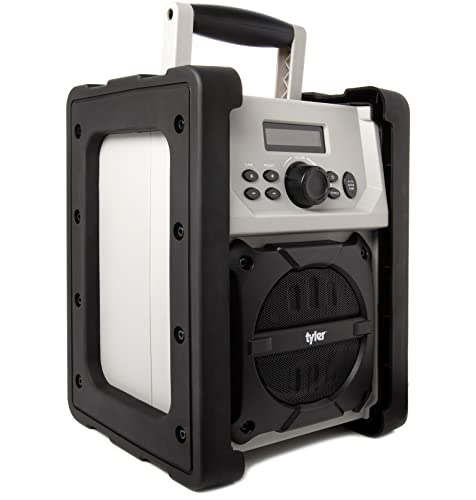
The PORTER-CABLE job site radio covers the basics at a price point that makes sense for smaller operations, temporary sites, or as a secondary unit. AC-powered only, so it works best in shops and indoor construction with reliable outlet access. Audio volume is adequate for smaller work areas. AM/FM reception is good with the telescoping antenna. The build is tougher than consumer radios but lighter-duty than tool-brand options. Bluetooth streaming works reliably at close range. For shop use or sheltered sites where the radio won't take weather or drop abuse, this provides clear audio at a low entry cost.
In its favor
- BUILT FOR DURABILITY: Our Tyler Bluetooth Jobsite speaker was designed for tough and vulne
- IPX5 WATER RESISTANT: We had water and rain in mind. Our jobsite speaker was designed with
- ENDLESS Connectivity: Jam packed with a wide range of connectivity. 5.0 Bluetooth, USB, AU
- WIRELESS FREEDOM: 5.0 Bluetooth with 100+ foot range. Take it where you need it! Construct
- BATTERY POWERED: (6) C-Battery will give you wireless freedom to take your speaker where y
Bosch PB360S Power Box -- Best for Multi-Directional Audio
The Bosch PB360S radiates sound in all directions rather than projecting from a single front face, making it well-suited for open work areas where workers are spread across multiple directions. The 360-degree speaker arrangement fills larger spaces evenly. The unit accepts AC power and includes a 120V power outlet on the unit itself, allowing tradespeople to plug in a tool or charger at the radio's location. It also charges phones via USB. The base is wide and stable, reducing tip risk on uneven surfaces. Volume is competitive with tool-brand radios at equivalent distances.
What matters most
What to consider
Your existing tool battery platform is the biggest factor if you already own batteries: choose a radio that runs on the same platform to eliminate separate charging. For AC-only sites, any well-built job site radio works. Volume output and projection pattern matter more than spec sheets suggest; test if possible or look for user reviews from job site environments rather than consumer settings. Weather resistance rating (IP54 minimum for outdoor use) protects the investment. Check whether the model includes a USB charging port if that matters for your site workflow. Finally, stable base design and roll protection are underrated features when the radio is sitting on uneven scaffolding or lumber piles.
What to consider
For related reading, see [best construction phone cases](/articles/best-construction-phone-case) and [best construction shirts for summer](/articles/best-construction-shirt). Review our evaluation criteria at [/methodology](/methodology).
Frequently asked
'Volume output and clarity at high levels matter most because job sites are loud. Weather resistance (IP54 or higher) protects against rain, dust, and splashes. Power flexibility is important: models that run on both AC cord and battery or tool batteries eliminate downtime. Bluetooth connectivity allows wireless streaming from phones. A wide stable base and roll protection prevent tips and drops from ending a radio''s life early.'
For professional daily use, yes. Tool-brand job site radios like DEWALT and Milwaukee run on the same battery platforms as your power tools, eliminating separate charging. They are engineered to tolerate vibration, dust, and drops that consumer Bluetooth speakers cannot. Budget job site radios often have adequate audio but fail faster in harsh conditions. If you are already invested in a tool battery system, the compatibility alone justifies the price.
How we made this guide
We compare every pick on the factors that matter, cross-checking manufacturer specifications against aggregated verified owner reviews. We rank independently and never take payment for placement. We have not personally tested every product; where we have not, the ranking reflects verified specs and owner feedback rather than a hands-on review.
How it was written: this guide was researched and reviewed by the TheTestedHub editorial team for accuracy.
Affiliate disclosure: TheTestedHub is reader-supported. When you buy through links on our site, we may earn a commission at no extra cost to you.