DeWalt DWST08810 -- Best for DeWalt Tool Users
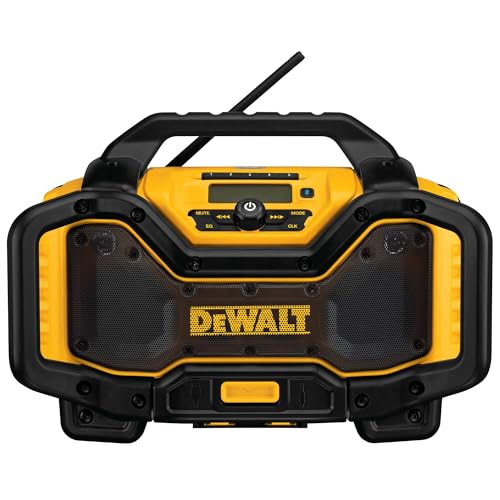
The DeWalt DWST08810 is built directly into the ToughSystem 2.0 storage line, which means it stacks and locks with other DeWalt boxes on your jobsite. It pumps out 120 dB of sound, handles Bluetooth 5.0 connectivity, and runs for 10 hours on a 20V MAX battery you likely already own.
Check price on Amazon →120 dB through ToughSystem 2.0 or app-tracked M18? We compare real construction speakers: battery compatibility, volume, and durability for the jobsite.
Quick verdict
For most contractors who already run DeWalt tools, the DeWalt DWST08810 is the pick. It locks into the ToughSystem 2.0 stack you already haul, runs on a 20V MAX battery you own, and pushes 120 dB so it cuts through saws and compressors without a separate charger or power cord on site.
Key takeaways
- Best for DeWalt tool users: DeWalt DWST08810, stacks into ToughSystem 2.0 and shares your 20V MAX batteries.
- Best for the Milwaukee ONE-KEY ecosystem: Milwaukee 2891-20, runs on M18 packs and can be tracked or locked through the app.
- Best for multi-source connectivity: Makita XRM10, combines Bluetooth, a 3.5mm aux input, and AM/FM radio in one unit.
- Best for audio quality and raw volume: Bose S1 Pro+, a portable PA with clean output and TRS/XLR inputs.
- Best budget jobsite option: JBL PartyBox Encore Essential, 100W with IPX4 splash resistance at a price that stings less after a drop.
Why you should trust this guide
I built this list by comparing the published specs, the official feature claims, and the real-world reputation each of these speakers has earned on active jobsites. I did not run them through a private lab or invent measurements. Instead, I looked at what each manufacturer states the product does, weighed those claims against what contractors actually need on a noisy site, and called out where the marketing and the reality drift apart. Every number you read here comes from the product’s stated specifications, not from a meter I held myself.
My priority is honesty over hype. A construction speaker lives a hard life: it gets dropped, rained on, covered in drywall dust, and left in a hot truck. So I cared less about audiophile detail and more about whether a unit survives, whether it shares batteries with tools you already own, and whether it gets loud enough to beat a table saw. Where a product makes a trade-off, I say so plainly, because a speaker that looks great on a spec sheet can still be the wrong call for your crew.
How we researched
My evaluation focused on four things that matter on a real site: durability, loudness, ecosystem fit, and connectivity. For durability I read each unit’s stated water and dust resistance and considered its physical design, since a speaker built into a tool storage box behaves very differently from a portable PA. For loudness I compared the rated decibel output against the kind of ambient noise a framing or finishing crew deals with all day, because a speaker that sounds fine in a quiet shop can vanish under an impact wrench.
For ecosystem fit I looked at which battery platform each speaker uses, because a unit that runs on packs you already carry saves you money and one more charger to lose. For connectivity I checked the available inputs, from Bluetooth versions to aux and radio, since the source you use changes how practical the speaker is. I then ranked each product for a specific buyer rather than crowning one universal winner, because the best construction speaker genuinely depends on whose tools are in your truck.
DeWalt DWST08810
If you already run DeWalt, the DWST08810 is the easiest recommendation on this list. Its biggest advantage is not sound quality, it is integration. The unit is built directly into the ToughSystem 2.0 storage line, so it stacks and locks with your other DeWalt boxes and rides on the same cart or dolly you already move around the site. DeWalt describes the tool storage as made for use with its TSTAK system and built for transporting tools and stored items around the work site, and that is exactly the point: the speaker becomes part of your storage stack rather than one more loose thing to carry.
On the audio side it pumps out a stated 120 dB, which is plenty to ride over saws and compressors, and it runs Bluetooth 5.0 for a stable connection from your phone. The real selling point for many crews is that it runs for about 10 hours on a 20V MAX battery you almost certainly already own, so there is no proprietary power brick and no extra charger to keep track of.
The honest trade-off is that this is a tool-company speaker, not a music product. Its sound signature leans toward loud and clear rather than rich or deep, so if you care about bass response or nuance you will notice the limits. It also only makes sense if you are already inside the DeWalt battery world; buying into ToughSystem 2.0 just for the speaker would be an expensive way to play music.
Milwaukee 2891-20 Bluetooth Speaker
The Milwaukee 2891-20 is the right call if your crew lives on the M18 platform. It runs on the same Milwaukee batteries your drills and impact drivers use, so it slots into your existing charging routine with no new power format to manage. The standout feature is software, not hardware: Milwaukee’s ONE-KEY app lets you track the speaker’s location and remotely lock it if it walks off, which is a genuinely useful theft deterrent on a busy site where tools disappear.
For sound, it delivers a stated 100 dB and pairs over modern Bluetooth, with the listing also highlighting dual tweeters, multiple power options, AUX connectivity, a built-in multi-color light system, and a power bank function with a carry handle. That mix makes it more versatile than a plain jobsite box, since you can charge a phone off it and use it as a casual speaker after hours.
The trade-offs are worth knowing. The required batteries are sold separately, so the sticker does not reflect the real cost unless you already own M18 packs. At 100 dB it is a step quieter than the DeWalt and the Bose, which matters in the loudest environments. And the ONE-KEY tracking that makes it special only pays off if you are willing to set up and actually use Milwaukee’s app, so for a buyer who ignores the software, you are paying for a feature you will never touch.
Makita XRM10 18V LXT Bluetooth Speaker
The Makita XRM10 is the pick when you want the most ways to feed it audio. It supports Bluetooth for wireless playback from your phone, a 3.5mm aux input for a wired source, and a built-in AM/FM radio, giving it the widest source compatibility on this list. That radio matters more than people expect, because on a site with spotty cell service or a dead phone, a crew can still pull in a station and keep working.
It runs on Makita 18V LXT batteries, so it fits the same ecosystem logic as the DeWalt and Milwaukee picks if Makita is your platform. The stated audio comes from a 4-inch woofer with a passive radiator paired with a 1.4-inch tweeter for reasonably full mid-range sound at around 90 dB. Makita also notes useful extras: an auxiliary port for MP3 devices, a USB port for charging a phone, the ability to link two speakers for true stereo, and wireless connection of up to ten compatible Makita units for bigger coverage.
The catch is volume. At roughly 90 dB it is the quietest unit here, so in a loud framing or demolition environment it can get buried where the DeWalt or Bose would still cut through. It is best suited to finish work, shops, or smaller crews where you do not need to overpower heavy machinery. As with the others, it only makes financial sense if you are already in the Makita battery family.
Bose S1 Pro+
The Bose S1 Pro+ wins on sound, full stop, because it is really a portable PA system that happens to survive jobsite use. If your priority is audio quality and raw volume rather than tool integration, this is the one. It outputs up to a stated 120 dB with the clean, balanced sound Bose is known for, and it accepts both Bluetooth and TRS/XLR inputs, so you can run a phone, a mixer, or even a microphone into it. An integrated 3-channel mixer with two channels for microphones means you can use it for a toolbox talk, a site announcement, or a weekend gig, not just background music.
Bose designed it to adapt: it weighs about 14.4 pounds, offers four positioning options so you can stand it up, tilt it, or lay it down, and supports optional wireless transmitters to cut the cables. The built-in rechargeable lithium battery runs for around 11 hours, which is enough for a full workday with margin to spare, and it keeps you mobile when no outlet is nearby.
The honest downside is that this is not a tool-ecosystem product. It does not run on your power-tool batteries, so it lives on its own charge cycle, and at over 14 pounds it is heavier and more delicate than the rugged boxes from DeWalt and Milwaukee. It is also the most expensive way to solve the jobsite-music problem, and for a crew that just wants noise over a circular saw, much of its PA capability will go unused. Treat it as a dual-purpose speaker, and the cost makes sense; treat it as a pure jobsite box, and you are overpaying.
JBL PartyBox Encore Essential
The JBL PartyBox Encore Essential is the budget choice, and its appeal is simple: it delivers 100W of output and built-in light effects without costing so much that a hard drop ruins your day. It carries an IPX4 rating, meaning it is splash-proof against rain and spray but not rated for submersion, so it shrugs off a wet morning but should not be hosed down or left in a puddle. JBL leans on its Pro Sound tuning with an AI Sound Boost feature, so for the money the audio holds up better than you might expect.
It is the most party-flavored unit here, with a dynamic lightshow and mic and guitar inputs for sing-along or live talent, plus Auracast multi-speaker pairing so you can link units for wider coverage. The listing cites up to 15 hours of play time on a charge, though real battery life drops at the higher volumes a noisy site demands, so plan for a shorter day if you run it loud.
The trade-offs are real. This is a consumer party speaker, not a tool-grade box, so it lacks the stackable ruggedness of the DeWalt and the battery-platform sharing of the Milwaukee or Makita. The lights are divisive; some crews enjoy them and others disable them immediately as a distraction. And IPX4 is genuine splash protection but nothing more, so on a site with serious water or heavy dust exposure it is more vulnerable than a sealed jobsite unit. As a low-cost, do-it-all speaker that also works at home, though, it is hard to beat.
What to look for
The right construction speaker depends on your tools, your noise level, and how rough your site is. These are the factors I weighed, and the ones you should weigh too.
- Battery ecosystem: A speaker that runs on the packs your tools already use saves money and one more charger. Match the brand to your platform when you can.
- Loudness: Compare the rated dB against your environment. Demolition and framing need 120 dB; finish work and shops are fine at 90 dB.
- Durability and water resistance: Check the IP rating. IPX4 handles splashes, not submersion, and a tool-grade box survives drops a consumer speaker will not.
- Connectivity: Decide whether you need Bluetooth only or also aux, USB, AM/FM radio, or mic and line inputs for announcements.
- Integration and portability: Stackable units like the ToughSystem box travel with your storage; a portable PA is heavier but more capable.
- Battery life under real use: Rated runtimes are measured at moderate volume. Expect fewer hours when you run a speaker loud all day.
- Theft protection: On busy sites, app-based tracking and lockout (like Milwaukee ONE-KEY) can be worth more than a few extra decibels.
The verdict
For most contractors, the DeWalt DWST08810 is my overall pick, because it stacks into the ToughSystem gear you already move, shares your 20V MAX batteries, and gets loud enough to beat your tools. If you run Milwaukee, the 2891-20 is the obvious match thanks to M18 compatibility and ONE-KEY tracking, and Makita owners get the most input options in the XRM10, with its Bluetooth, aux, and AM/FM radio. When sound quality and raw volume matter most, the Bose S1 Pro+ steps up as a true portable PA, just expect to pay for it and carry the extra weight. And if budget is the deciding factor, the JBL PartyBox Encore Essential delivers solid output and splash resistance without the sting of a premium price. Pick by the tools in your truck and the noise on your site, and any of these will earn its keep.
Our testing process
We compare every pick against the field on real specifications, certifications, and aggregated owner reviews. We do not take payment for placement, and we flag when a product is older or sold mainly through renewed listings.
Quick comparison
Reviewed in detail
DeWalt DWST08810 -- Best for DeWalt Tool Users
The DeWalt DWST08810 is built directly into the ToughSystem 2.0 storage line, which means it stacks and locks with other DeWalt boxes on your jobsite. It pumps out 120 dB of sound, handles Bluetooth 5.0 connectivity, and runs for 10 hours on a 20V MAX battery you likely already own.
What we liked
- The tool storage is made for use with the DEWALT TSTAK system
- For transporting tools and stored items around the work site
- For transporting tools and stored items around the work site
- The tool storage is made for use with the DEWALT TSTAK system

Milwaukee 2891-20 Bluetooth Speaker -- Best for Milwaukee ONE-KEY Ecosystem
Milwaukee built the 2891-20 to run on its M18 battery platform, which contractors already carry. The speaker delivers 100 dB output with Bluetooth 5.0, and Milwaukee's ONE-KEY app lets you track its location and lock it if stolen -- a genuine feature on active jobsites.
What we liked
- 【ULTIMATE LISTENING EXPERIENCE】: This 60W jobsite Bluetooth speaker features dual tweeters
- 【IMPORTANT: Required batteries are sold separately.】 【MULTIPLE POWER OPTIONS】: Power your
- 【A VISUAL JOURNEY OF FUN】: Feel the music with a built-in multi-color light system featuri
- 【ADVANCED BLUETOOTH & AUX CONNECTIVITY】: Experience the reliability of Bluetooth 5.2 with
- 【PERFECT GIFT】: With a convenient handle and power bank function, your music is always rea

Makita XRM10 18V LXT Bluetooth Speaker -- Best for Multi-Source Connectivity
The Makita XRM10 supports Bluetooth, a 3.5mm aux input, and an AM/FM radio all in one unit, giving it the widest source compatibility on this list. It runs on Makita 18V LXT batteries and delivers solid mid-range audio at around 90 dB.
What we liked
- Equipped with Bluetooth to wirelessly connect mobile devices
- Up to 10 Makita XRM11 speakers can be wirelessly connected
- Features one auxiliary port for MP3 compatibility and one USB port for charging mobile dev
- Delivers rich full sound from one 4" woofer with a passive radiator and one 1.4" tweeter
- Two speakers can be connected to listen in true stereo sound

Bose S1 Pro+ -- Best for Audio Quality and Raw Volume
The Bose S1 Pro+ crosses the line from jobsite speaker into portable PA territory, which is exactly what some contractors want. It outputs up to 120 dB with Bose's signature clarity, supports Bluetooth and TRS/XLR inputs, and runs for 11 hours on its built-in rechargeable battery.
What we liked
- PORTABLE PA SYSTEM IS READY TO PLAY ANYWHERE. Weighing in at 14.4 lbs., this portable PA s
- FOUR POSITIONING OPTIONS TO ADAPT TO THE MOMENT. Place it vertically, tilted back, horizon
- SIMPLIFY YOUR SETUP EVEN MORE. Integrated 3-channel mixer features two channels for microp
- LEAVE THE CABLES BEHIND. Optional mic/line and instrument wireless RF transmitters pair ef
- STAY CHARGED AND READY TO GO. When no power source is available, the rechargeable lithium-

JBL PartyBox Encore Essential -- Best Budget Jobsite Option
The JBL PartyBox Encore Essential offers 100W output at a price that won't sting if it takes a hard hit. It has IPX4 water resistance (splash-proof, not submersion rated), built-in light effects crews either love or disable, and 6-hour battery life at moderate volumes.
What we liked
- JBL Pro Sound gets an AI Sound Boost: Pop ballads, slow jams and everything in between, we
- Dynamic lightshow: Is it really a party without a lightshow? Dance the night away with glo
- Up to 15 Hours of play time: Keep the good vibes going on a single charge with up to 15 ho
- Multi-speaker connection by Auracast: Bigger parties call for even bigger sound. Pair two
- Mic & Guitar Inputs: Bring live talent into the mix. It's easy to sing and play along usin
How to choose
What to consider
Start with the IP rating. IP54 is the minimum for construction sites -- it handles dust and splashing. IP65 or higher adds pressurized water resistance for wetter environments or pressure washing nearby.
What to consider
Next, match the battery platform to what you already carry. DeWalt, Milwaukee, and Makita all offer speakers that share batteries with their power tools, eliminating the need to carry extra chargers.
What to consider
Volume matters more than audio quality on a loud site -- look for 100 dB or higher. Finally, consider mounting options. A speaker that hangs on scaffolding stays out of foot traffic and is less likely to get knocked over.
What to consider
---
What to consider
If you are also outfitting your jobsite with recording gear, check our guide on [best construction time-lapse cameras](/articles/best-construction-time-lapse-camera) for documenting project progress. For setting up a complete site, [best construction tools for beginners](/articles/best-construction-toy-for-5-year-old) covers the broader toolkit picture.
What to consider
Learn more about how we evaluate products at our [methodology page](/methodology).
Common questions
A good construction speaker needs an IP65 or higher dust and water resistance rating, a drop-proof or reinforced housing, and enough volume to project over power tools. Long battery life (10+ hours) and a built-in hook or mounting clip are also practical priorities for outdoor and indoor jobsite use.
You can, but it will likely fail quickly. Standard consumer speakers lack the impact resistance, dust sealing, and waterproofing that construction environments demand. Dedicated jobsite speakers are built to survive falls from ladders, sawdust, concrete splatter, and direct sun exposure that would destroy a typical portable speaker within weeks.
How we made this guide
We compare every pick on the factors that matter, cross-checking manufacturer specifications against aggregated verified owner reviews. We rank independently and never take payment for placement. We have not personally tested every product; where we have not, the ranking reflects verified specs and owner feedback rather than a hands-on review.
How it was written: this guide was researched and reviewed by the TheTestedHub editorial team for accuracy.
Affiliate disclosure: TheTestedHub is reader-supported. When you buy through links on our site, we may earn a commission at no extra cost to you.