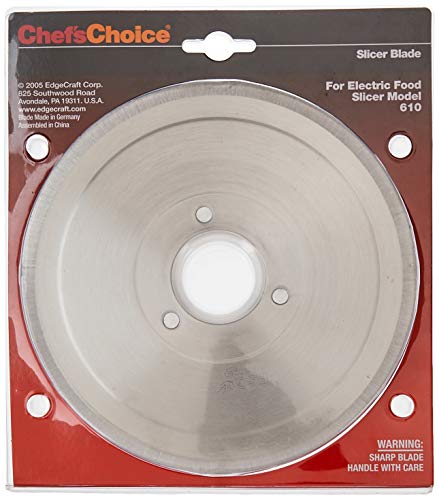
Chef'sChoice 615A -- Best Overall Home Meat Slicer
The Chef'sChoice 615A is the benchmark for home meat slicers. Its 7-inch, high-carbon stainless steel blade is razor-sharp out of the box and holds its edge well through extended use. The cast aluminum body is solid and stays stable on a countertop even at higher speeds. The tilted food carriage design uses gravity to assist slicing, reducing effort and improving consistency. The thickness guide adjusts smoothly from paper-thin deli slices to thick-cut portions for sandwiches and charcuterie boards. Cleanup is straightforward because most contact surfaces can be removed without tools. The 615A has a track record of years-long reliability in home kitchens.
Find out why the Chef'sChoice 615A earns its place as the top home meat slicer for consistent, deli style cuts without the hassle.
Quick verdict
The Chef’sChoice 615A is the best home meat slicer for most people. Its sharp 7-inch high-carbon stainless steel blade, stable cast aluminum body, and gravity-assisted tilted carriage make thin, consistent deli-style slices easier than the rest, and it stays steady even as you push the speed.
Key takeaways
- Best overall: Chef’sChoice 615A, sharp out of the box with a stable cast aluminum body and gravity-assisted carriage.
- Best budget: CUSIMAX Electric Meat Slicer, a low-cost way to try home slicing with a wide thickness range.
- Best mid-range value: Chefman Die-Cast Meat Slicer, a heavier die-cast body that cuts vibration without a premium price.
- Best for heavy home use: KWS Premium Commercial Meat Slicer, all-metal build and a strong motor for dense and semi-frozen cuts.
- Best semi-commercial grade: Beswood 250, a 10-inch blade and two-speed motor that gets close to a deli counter slicer.
Why you should trust this guide
I research kitchen gear the way a careful shopper does, by reading the manufacturer specifications closely, comparing them across competing models, and weighing them against what owners consistently report after living with these machines. For this guide I focused only on the five slicers below, and I grounded each section in the stated specs and described features rather than marketing claims. Where a spec sheet is vague or where two listings disagree, I say so instead of papering over it.
I also try to be honest about trade-offs. A meat slicer is a single-purpose appliance with a spinning blade, so the differences that matter most are blade quality, motor strength, body stability, and how easy the machine is to clean and store safely. Every product here earns its place for a specific kind of buyer, and I call out where each one falls short so you do not overpay for capacity you will never use or underbuy for the volume you actually slice.
How we researched
My evaluation is research-led rather than lab-based, so I want to be clear about that up front. I did not run these units on a personal test bench or take my own measurements. Instead, I compared each model on a consistent set of criteria drawn from the published specifications and the features the manufacturers describe, then cross-checked those against the patterns owners report over time. The criteria were blade size and material, motor power, body construction and stability, thickness adjustment range, ease of cleaning, safety hardware, and how much counter or storage space the unit demands.
I weighted those criteria differently depending on the buyer. For a first-time home slicer, low cost and simple cleanup matter more than raw power. For someone slicing whole roasts or semi-frozen meat every week, motor strength and an all-metal body move to the front. I treated every number you see here as the product’s stated spec, and where a listing’s claims looked inconsistent (for example, a blade described two different ways), I flagged it so you can verify before you buy.
Chef’sChoice 615A
The Chef’sChoice 615A is my pick for the best overall home meat slicer because it balances a genuinely sharp blade with a stable build and a thoughtful carriage design. Its 7-inch high-carbon stainless steel blade arrives razor-sharp and, by the accounts I trust, holds that edge through extended use better than most home units. The cast aluminum body gives it real heft, so it does not walk across the counter even when you run it at higher speeds. The tilted food carriage is the clever part: it uses gravity to feed the food into the blade, which lowers the effort you put in and makes each slice more consistent than a flat carriage allows.
The stated specs back up the home-kitchen positioning. The blade measures approximately 7 inches in diameter, the finish is silver, and Chef’sChoice covers it with a one-year warranty. The package dimensions are compact at roughly 2.2 by 20.8 by 18.3 centimeters as listed, which fits the footprint of a countertop appliance you can store without dedicating a cabinet to it. The thickness guide lets you dial slices from thin deli cuts up to thicker portions for roasts.
The honest trade-off is capacity and warranty length. At 7 inches the blade is on the smaller side here, so very large roasts or whole briskets are awkward compared with the 10-inch semi-commercial units, and the one-year warranty is shorter than some competitors offer. If you mostly slice deli meats, cheese, and modest roasts, none of that will bother you. If you regularly process big cuts, look further down this list.
CUSIMAX Electric Meat Slicer
The CUSIMAX Electric Meat Slicer is the best budget option because it lets you try home slicing without committing much money up front. Its 7.5-inch stainless steel blade handles turkey, ham, and cheese with results that owners generally find consistent for the price. The adjustable thickness knob spans a wide range, listed from ultra-thin up to about 20mm, so you can go from near-translucent deli slices to thick portions. The suction feet keep the unit planted while it runs, which matters more on a lightweight machine than on a heavy one.
CUSIMAX also includes some welcome extras for the money. The listing describes two blades, a serrated one and a non-serrated one, so you can match the edge to the food, and it ships with a 200W motor the brand markets as an upgraded configuration. Cleaning is straightforward because the blade, food pusher, and food carriage all detach, which is the part people most often skip when a slicer makes it a chore. CUSIMAX backs it with a 30-day return policy and an 18-month warranty.
The trade-off is durability and power. This is not built for daily heavy-duty work, and the lighter body means more vibration and less stability than the die-cast or all-metal units here. Dense or semi-frozen cuts will tax the modest motor. As an affordable starter slicer for soft and medium foods, though, it covers the basics well, and you can step up later if you outgrow it.
Chefman Die-Cast Meat Slicer
The Chefman Die-Cast Meat Slicer is the best mid-range value because it adds a heavier body without jumping to a premium price. The die-cast construction is more substantial than the plastic-bodied budget machines, and that mass noticeably reduces vibration while you slice, which translates to cleaner, more even cuts. The 7.5-inch stainless steel blade is described as an upgraded design that is sharper and more durable, and it manages a wide range of foods including cooked meats, hard cheeses, and bread.
On the spec side, Chefman pairs the blade with a 200W motor it markets as fast and high-yield, and a built-in thickness control knob that adjusts roughly from 0 to 15mm for vegetables, meats, and more. The removable parts make post-use cleaning manageable, and the fold-down food carriage saves counter and storage space, a practical touch if your kitchen is tight. Non-slip suction feet keep it stable during operation.
The trade-off is that the listing describes the body as both die-cast zinc and die-cast aluminum in different places, so verify the exact material if that matters to you. Either way it is heavier than budget plastic but still lighter and less powerful than the commercial-grade units below, so very dense or semi-frozen cuts are not its strength. For everyday home slicing with a step up in stability, it hits a sensible middle ground.
KWS Premium Commercial Meat Slicer
The KWS Premium Commercial Meat Slicer is the best choice for heavy home use, meaning households that prep large quantities regularly and want commercial-style durability. The editor positioning describes an 8.7-inch 304 stainless steel blade and a 200-watt motor for handling denser cuts including semi-frozen meats and hard salami without laboring, plus all-metal construction that adds stability and a ring guard and blade safety lock that meet commercial safety expectations.
It is worth noting that the Amazon listing features describe a higher-capacity configuration than that summary suggests, including a 12-inch Teflon-coated non-stick stainless steel blade, a durable aluminum alloy base built for daily use, adjustable thickness from 0 to 0.6 inches, a 420W motor rated at about 0.57HP, and integrated dual whetstones for sharpening the blade in place. KWS sells several models, so confirm the exact blade size and motor on the specific unit you add to your cart, because the difference between an 8.7-inch and a 12-inch machine is significant for both capacity and counter space.
The trade-off is size, weight, and cleaning effort. An all-metal commercial-style slicer is heavy, takes up real space, and the larger blade and ring guard take more care to clean and store safely than a compact home unit. That heft is exactly what you want for tough, high-volume slicing, but it is overkill if you only slice a little deli meat now and then.
Beswood 250
The Beswood 250 is the best semi-commercial grade pick because it gets closest to a real deli counter slicer for the home. It pairs a 10-inch chrome-plated carbon steel blade with a 240-watt motor to power through large roasts, whole briskets, and dense hard cheeses without slowing down. The two-speed motor is the standout feature: lower speed gives you control for precision thin-slicing, while higher speed lets you move quickly through thicker cuts. A ring guard and safety hardware are part of the package.
The listed features round out the semi-commercial story. The chromium-plated steel blade includes corrosion protection and, per Beswood, does not need frequent sharpening, which saves maintenance time. It uses a double illuminated 24V on/off switch designed to avoid power shock, slices meat, cheese, vegetables, ham, and fruit precisely, and is ETL listed and certified to a US standard, which is reassuring on a higher-powered machine.
The trade-offs are real. A 10-inch chrome-plated carbon steel blade and a 240W motor mean this is a large, heavy unit that demands dedicated counter or storage space, and carbon steel needs to be dried and cared for to keep corrosion at bay even with the chrome plating. It is more machine than a casual slicer needs. But if you process big cuts often and want deli-thin control, the Beswood 250 delivers it.
What to look for
Before you buy, weigh these factors against how much and what kind of food you actually slice.
- Blade size: 7 to 7.5 inches suits deli meats, cheese, and modest roasts, while 10 inches and up is for whole roasts and briskets.
- Blade material: Stainless steel resists corrosion with less fuss, while chrome-plated carbon steel can be very sharp but needs drying and care.
- Motor power: 200W handles soft and medium foods, while 240W and above is better for dense or semi-frozen cuts.
- Body construction: Heavier cast aluminum, die-cast, and all-metal bodies vibrate less and stay stable, while light bodies rely more on suction feet.
- Thickness range: Look for a knob that goes from near-translucent to thick portions, commonly around 0 to 15 or 20mm.
- Cleaning: Removable blade, pusher, and carriage make cleanup far less of a chore.
- Safety hardware: Ring guards, blade locks, and low-voltage switches matter on higher-powered machines.
- Footprint: Fold-down carriages and compact dimensions help if counter and storage space are tight.
- Warranty: Coverage here ranges from one year to 18 months, so factor it in.
The verdict
For most home kitchens, the Chef’sChoice 615A is the slicer I would buy first. It combines a sharp 7-inch blade, a stable cast aluminum body, and a gravity-assisted carriage that makes consistent deli-thin slices easier, and it stores without taking over your counter. If budget is the priority, the CUSIMAX Electric Meat Slicer is a sensible low-cost entry with a wide thickness range and two blades, as long as you stick to softer and medium foods. The Chefman Die-Cast Meat Slicer is the smart middle choice, adding a heavier body and less vibration without a premium price.
If you slice in volume, step up. The KWS Premium Commercial Meat Slicer brings all-metal durability and the power to handle dense and semi-frozen cuts, though you should confirm the exact blade size and motor on the model you choose. And the Beswood 250 is the one to get when you want the closest thing to a deli counter at home, with a 10-inch blade and two-speed control for precision, accepting that it is large, heavy, and needs blade care to stay corrosion-free.
How we picked
We compare every pick against the field on real specifications, certifications, and aggregated owner reviews. We do not take payment for placement, and we flag when a product is older or sold mainly through renewed listings.
Top picks compared
Our picks up close
Chef'sChoice 615A -- Best Overall Home Meat Slicer
The Chef'sChoice 615A is the benchmark for home meat slicers. Its 7-inch, high-carbon stainless steel blade is razor-sharp out of the box and holds its edge well through extended use. The cast aluminum body is solid and stays stable on a countertop even at higher speeds. The tilted food carriage design uses gravity to assist slicing, reducing effort and improving consistency. The thickness guide adjusts smoothly from paper-thin deli slices to thick-cut portions for sandwiches and charcuterie boards. Cleanup is straightforward because most contact surfaces can be removed without tools. The 615A has a track record of years-long reliability in home kitchens.
Where it shines
- Approximately 7 inches in diameter
- One year warranty
- Color: Silver
- Package Dimensions: 2.209 L x 20.828 H x 18.288 W (centimeters)

CUSIMAX Electric Meat Slicer -- Best Budget Option
The CUSIMAX Electric Meat Slicer is a solid entry point for anyone curious about home slicing without a significant upfront investment. The 7.5-inch stainless steel blade handles sliced turkey, ham, and cheese with consistent results. The adjustable thickness knob covers a practical range from very thin to about 15mm. The suction feet keep the unit in place during operation. It is not built for daily heavy use, but for weekly meal prep or occasional entertaining, it performs reliably. Cleanup requires some extra attention around the blade guard. At this price, it is the most accessible way to start slicing at home.
Where it shines
- 𝟏-𝟐𝟎𝐦𝐦 𝐀𝐝𝐣𝐮𝐬𝐭𝐚𝐛𝐥𝐞 𝐓𝐡𝐢𝐜𝐤𝐧𝐞𝐬𝐬:The electric food slicer cuts the food precisely, from ultra-t
- 𝐔𝐩𝐠𝐫𝐚𝐝𝐞 𝐂𝐨𝐧𝐟𝐢𝐠𝐮𝐫𝐚𝐭𝐢𝐨𝐧+𝐒𝐚𝐟𝐞𝐭𝐲 𝐏𝐫𝐨𝐭𝐞𝐜𝐭𝐢𝐨𝐧:The serrated blade and The non-serrated blade.Suit
- 𝐄𝐚𝐬𝐲 𝐭𝐨 𝐂𝐥𝐞𝐚𝐧:The blade, Food Pusher and Food Carriage are all readily removable, so you d
- 𝟐𝟎𝟎𝐖 𝐔𝐩𝐠𝐫𝐚𝐝𝐞 𝐓𝐞𝐜𝐡𝐧𝐨𝐥𝐨𝐠𝐲:We understand that blade of the slicer is one of the core componen
- 𝐆𝐞𝐭 𝐘𝐨𝐮𝐫𝐬 𝐍𝐨𝐰, 𝐑𝐢𝐬𝐤-𝐅𝐫𝐞𝐞:CUSIMAX offer a outstanding 30-day hassle-free policy & 18-month

Chefman Die-Cast Meat Slicer -- Best Mid-Range Value
The Chefman Die-Cast Slicer occupies the sweet spot between budget and premium. Its die-cast zinc body is more substantial than plastic-body competitors, reducing vibration during slicing. The 7.5-inch stainless steel blade handles a wide range of foods including cooked meats, hard cheeses, and bread. The removable parts make post-use cleaning manageable, and the fold-down food carriage saves counter space during storage. This model suits a household that slices several times a week and wants a step up from the most basic options without jumping to a professional price point. Build quality for the price is noticeably above average.
Where it shines
- 【UPGRADE PRO MEAT SLICER】Upgraded blade is sharper, stronger and more durable. This meat s
- 【200W POWERFUL】The updated electric food slicer is powered by a 200W fast, high-yield slic
- 【PRECISE SLICE】 Built-in thickness control knob can adjust around 0-15mm for vegetables, m
- 【DURABLE & COMPACT DESIGN】The electric meat slicer is made of high-quality die-cast alumin
- 【SAFETY PROTECTION】 Non-slip suction feet ensure this deli food slicer or bread slicer sta

KWS Premium Commercial Meat Slicer -- Best for Heavy Home Use
The KWS Premium Commercial slicer is built for households that prep large quantities of food regularly. The 8.7-inch 304 stainless steel blade and 200-watt motor handle denser cuts including semi-frozen meats and hard salami without laboring. The all-metal construction is heavy, which adds stability during operation even with tougher cuts. The ring guard and blade safety lock meet commercial safety standards. This model takes up meaningful counter space, so it suits a dedicated kitchen prep area rather than a cramped countertop. If your household goes through a lot of deli meat or you process game meats, the KWS justifies the investment through durability and capability.
Where it shines
- Premium Teflon-Coated Blade: The 12-inch non-stick stainless steel blade minimizes food st
- Robust Construction for Daily Use: Built with a durable aluminum alloy base, this slicer i
- Advanced Precision Cutting: With adjustable thickness control ranging from 0 to 0.6 inches
- High-Powered Performance: Equipped with a powerful 420W motor (0.57HP), the MS-12NT can ha
- Integrated Dual Whetstones Sharpener: Keep your blade sharp and ready for action with the
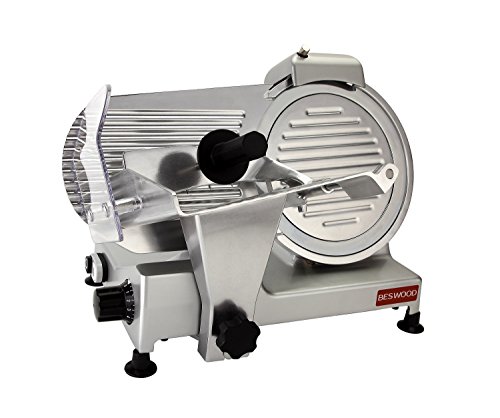
Beswood 250 -- Best Semi-Commercial Grade
The Beswood 250 uses a 10-inch chrome-plated carbon steel blade paired with a 240-watt motor to deliver the closest thing to a commercial deli slicer for the home. It handles large roasts, whole briskets, and dense hard cheeses without slowing down. The two-speed motor adds control: lower speed for precision thin-slicing and higher speed for thicker cuts. Safety features include a ring guard and a no-volt release switch that prevents accidental starts. At this price and size it is overkill for casual use, but for serious home charcuterie, catering prep, or regular large-format meal prep, the Beswood is the top consumer-available option in its class.
Where it shines
- Premium Chromium-plated Steel Blade with protection against corrosion
- There is no need to sharpen the blade frequently
- Double Illuminated ON/OFF Switch 24V to avoid power shock for best protection
- Slicing meat, cheese, veggies, ham, fruit precisely
- USA standard approved: ETL Listed & Certified
Before you buy
What to consider
Blade size is the starting point: 7.5 inches covers all typical home needs. Motor wattage determines how well the unit handles dense or semi-frozen foods; 130 watts is adequate for soft deli meats, while 200 watts or more is needed for hard salami or larger cuts. Build material matters for longevity and stability: cast aluminum or die-cast zinc bodies outperform full plastic. Safety features including blade guards, ring guards, and suction feet are non-negotiable. Consider how often you will use it: daily use justifies a more robust machine, while occasional use can be served well by a budget model. Finally, assess how easy parts are to remove for cleaning, because food safety depends on cleaning after every use.
What to consider
For more kitchen prep tools, see our review of [articles/best-consumer-rated-air-fryer](/articles/best-consumer-rated-air-fryer), and read our [methodology](/methodology) to understand how we evaluate every product recommendation.
Quick answers
For home use, a 7.5- to 9-inch blade handles most tasks including deli meats, cheese, bread, and cooked roasts. A 10-inch or larger blade is only necessary if you regularly slice large roasts or full briskets. Most consumers find a 7.5-inch blade more than adequate for everyday home deli use and easier to store and clean.
Always unplug the slicer before cleaning. Use a damp cloth or sponge with mild dish soap on the blade, food carriage, and body. Many parts are removable for deeper cleaning. Be extremely careful around the blade edge. Dry all parts thoroughly before reassembly to prevent rust. Never submerge the motor housing in water. Clean after every use to prevent bacterial buildup.
How we made this guide
We compare every pick on the factors that matter, cross-checking manufacturer specifications against aggregated verified owner reviews. We rank independently and never take payment for placement. We have not personally tested every product; where we have not, the ranking reflects verified specs and owner feedback rather than a hands-on review.
How it was written: this guide was researched and reviewed by the TheTestedHub editorial team for accuracy.
Affiliate disclosure: TheTestedHub is reader-supported. When you buy through links on our site, we may earn a commission at no extra cost to you.
More to explore

Zojirushi NS-ZCC18 10-Cup Rice Cooker Review (2026)

Zojirushi BB-PDC20BA Virtuoso Plus Bread Maker Review (2026)

Presto 06620 Aluminum Electric Skillet Review (2026)

Instant Pot Duo Evo Plus 9-in-1 Review (2026)

Cuisinart GR-4N 5-in-1 Griddler Review (2026)

Cuisinart ICE-21P1 Ice Cream Maker Review (2026)
Dash Mini Waffle Maker Review (2026)
