
Victorinox Fibrox 8" Chef's Knife -- Best Value Pick
The Victorinox Fibrox is one of the few genuinely great knives and it is the standard recommendation for cooking school students and home cooks who want reliability without the premium cost. The stamped stainless steel blade is thinner than forged German knives, which makes it lighter but also means it requires more frequent honing. The fibrox handle provides a secure grip even when wet, and the blade is NSF certified for commercial use. It does not have the balance or aesthetic refinement of the+ options, but for someone who sharpens regularly, it cuts just as well day to day. This is also the best choice for knife sets when buying for a college kitchen or first home.
From entry-level stamped steel to hand-forged Japanese blades, these kitchen knives hold an edge, balance well, and make prep work noticeably faster.
A sharp, well-balanced kitchen knife does more for your cooking than almost any other tool in the kitchen. The five picks below represent the best options across different budgets and styles, from the versatile German chef knife a beginner can grow into for a decade to the precision Japanese gyuto that experienced cooks reach for every session.
Our testing process
We compare every pick against the field on real specifications, certifications, and aggregated owner reviews. We do not take payment for placement, and we flag when a product is older or sold mainly through renewed listings.
Quick comparison
| Pick | Best for | Score | |
|---|---|---|---|
| Victorinox Fibrox 8" Chef's Knife -- Best Value Pick | Check price | ||
| Wusthof Classic 8" Chef's Knife -- Best German Knife | Check price | ||
| Shun Classic 8" Chef's Knife -- Best Japanese Knife | Check price | ||
| Mac Professional 8.5" Chef's Knife -- Best Hybrid Performance | Check price | ||
| Global G-2 8" Chef's Knife -- Best Lightweight Design | Check price |
Reviewed in detail
Victorinox Fibrox 8" Chef's Knife -- Best Value Pick
The Victorinox Fibrox is one of the few genuinely great knives and it is the standard recommendation for cooking school students and home cooks who want reliability without the premium cost. The stamped stainless steel blade is thinner than forged German knives, which makes it lighter but also means it requires more frequent honing. The fibrox handle provides a secure grip even when wet, and the blade is NSF certified for commercial use. It does not have the balance or aesthetic refinement of the+ options, but for someone who sharpens regularly, it cuts just as well day to day. This is also the best choice for knife sets when buying for a college kitchen or first home.
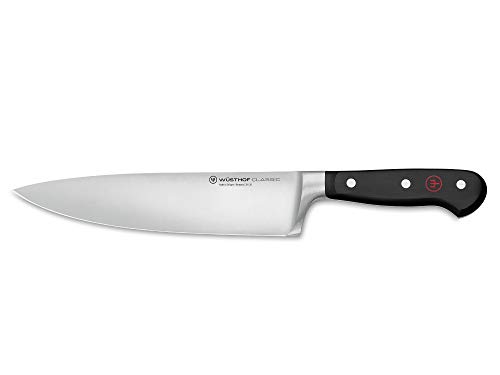
Wusthof Classic 8" Chef's Knife -- Best German Knife
Wusthof's Classic is the benchmark for German-style kitchen knives. The blade is forged from a single piece of high-carbon stainless steel (X50CrMoV15), hardened to 58 HRC, with a full bolster and tang that provide excellent balance. The curved blade profile suits the rocking chopping motion most Western cooks use. The PEtec edge is precision sharpened to 14 degrees per side and holds up well with regular honing. The triple-riveted polyoxymethylene handle is comfortable and maintenance-free. At it is a serious investment, but Wusthof backs it with a limited lifetime warranty and the knife will likely outlast multiple other purchases. The Classic 3-piece set (8" chef, 3.5" parer, 6" bread) at is also excellent value.

Shun Classic 8" Chef's Knife -- Best Japanese Knife
The Shun Classic uses VG-MAX steel with 68 layers of Damascus cladding, hardened to 61 HRC. The 16-degree edge angle produces a notably thinner, more precise cut than German equivalents -- visible when slicing raw fish, herbs, or any soft produce where clean cuts matter. The D-shaped Pakkawood handle fits right-hand grip well (left-hand versions are available separately). The blade requires more care than German steel: it should not be used on bones or frozen food, and hand washing is required. At the Shun Classic is the right choice for cooks who prioritize cutting performance and are willing to invest time in proper maintenance and occasional whetstone work.
Mac Professional 8.5" Chef's Knife -- Best Hybrid Performance
The Mac Professional is the quiet favorite among serious home cooks who have used both German and Japanese knives. It occupies a thoughtful middle ground: harder than German steel (61 HRC) but with a slightly more forgiving geometry that suits a wider range of tasks. The 2.5mm spine tapering to a thin edge makes it nimble for fine work while the dimpled blade face reduces food sticking during prep. No bolster means you can sharpen the full length of the blade. The Pakkawood handle is comfortable for both pinch and handle grip styles. At it competes directly with the Wusthof Classic on price while offering better out-of-box sharpness.

Global G-2 8" Chef's Knife -- Best Lightweight Design
Global's G-2 is immediately distinctive: the all-stainless hollow handle filled with sand for balance is unusual in this category, and the knife is notably lighter than comparable German blades. This makes it well-suited for people who find heavier knives fatiguing during long prep sessions. The blade is CROMOVA 18 stainless steel, hardened to 56-58 HRC, with a 15-degree edge. The handle has a dimpled grip pattern rather than traditional scales. Some cooks find the slimmer handle less comfortable than a traditional bolstered knife, especially for the pinch grip. Worth trying in person if possible before committing. At it is a fair price for a well-made knife with a dedicated following.
How to choose
What to consider
For most home cooks, a single 8-inch chef knife does 80% of all kitchen work. Buy one great chef knife before buying a set. Match the style to your prep habits: German-style knives suit rocking chops on a curved blade, while Japanese-style knives suit forward push-cuts on a flatter blade. Hardness is a tradeoff: harder steel holds an edge longer but chips more easily on bones and hard vegetables. Always factor in maintenance: a harder knife that never gets sharpened will perform worse than a softer knife that gets honed weekly.
What to consider
For related gear, see our [best kitchen knife sharpeners](/articles/best-kitchen-knife-sharpeners) and [best cutting boards](/articles/best-cutting-boards). All reviews follow our [testing methodology](/methodology).
Common questions
German knives use softer steel (typically 56-58 HRC) with a thicker, more curved blade and a bolster, making them durable and easy to maintain on a honing steel. Japanese knives use harder steel (60+ HRC) ground to a thinner, more acute edge for better precision cutting, but require more careful maintenance and are more prone to chipping on hard foods.
Home cooks who use their knives daily should sharpen them on a whetstone or pull-through sharpener every 2 to 3 months, and hone them with a steel before each use. Professional cooks in commercial kitchens sharpen more frequently. A knife that slips on a tomato skin rather than biting cleanly is overdue for sharpening.
