
Sonos Arc -- Best Premium Soundbar
The Sonos Arc is Consumer Reports' top-rated soundbar for its combination of audio quality, smart platform integration, and build quality. The eleven-driver array including upward-firing drivers for Dolby Atmos delivers a wide, enveloping soundstage that stands apart from most soundbar competition. Dialogue clarity is excellent, with speech remaining intelligible at low volumes -- a quality that Consumer Reports specifically tests and that many buyers find more practically important than maximum output.
Check price on Amazon →I evaluated five Consumer Reports-recommended soundbars and translated the specs into real-world performance. Find the best audio upgrade for your living.
Quick verdict
The Sonos Arc is the soundbar I would buy first. It pairs an eleven-driver array with upward-firing Dolby Atmos drivers and AI-assisted speech enhancement, so it sounds wide and keeps dialogue clear at low volume. It is the priciest pick here, but it earns Consumer Reports’ top rating for sound and build.
Key takeaways
- Best premium: Sonos Arc, an eleven-driver Atmos bar with the cleanest dialogue and tightest build of the group.
- Best for surround sound: Samsung HW-Q990C, a true 11.1.4 system with wireless rears and a wireless subwoofer.
- Best mid-range option: Bose Smart Soundbar 600, wide PhaseGuide dispersion and Atmos without needing rear speakers.
- Best budget Dolby Atmos: Sony HT-S2000, real Atmos decoding and a center channel at an accessible price.
- Best entry-level complete system: Vizio V-Series 5.1, a wireless sub plus two rear satellites for genuine multi-channel sound.
Why you should trust this guide
I built this guide around five soundbars that hold a Consumer Reports recommendation, then cross-checked each one against the manufacturer’s own stated specifications on Amazon. My goal was not to repeat marketing copy but to translate it into plain language about what you actually hear in a living room. I treat every feature claim, the channel counts, the driver layouts, the Atmos support, as the product’s stated specification rather than something I personally verified on a bench. Where a spec sounds impressive on paper but comes with a real-world catch, I say so.
I have spent a lot of time reading how these bars are positioned and where buyers tend to get tripped up, especially around channel marketing and the gap between a single bar and a full speaker package. The five products below are not interchangeable. One is a premium centerpiece, one is a near-receiver surround system, and three sit at progressively lower price tiers with honest compromises. I kept the ordering and the editor notes intact so you can see exactly which use case each one is meant to win.
How we researched
My evaluation here is research-based, not a lab writeup. I compared each soundbar on the criteria that matter most to ordinary buyers: dialogue clarity, the width and height of the soundstage, whether Dolby Atmos is genuinely decoded or only simulated, the channel configuration, the presence and type of subwoofer, room-calibration features, and how the bar fits into a real TV setup. I leaned on the Consumer Reports recommendation as a baseline signal of overall quality, then weighed the stated specifications against the price tier each product targets.
For every product I asked the same questions. Does it include rear speakers or expect you to buy them later? Is the subwoofer built in, wireless, or absent? Will dialogue stay intelligible at low volume, which is where most cheap bars fail? And what is the one trade-off a shopper should accept going in? I did not take physical measurements or run blind listening sessions myself, so I report the manufacturers’ channel and format claims as stated and focus on matching the right bar to the right room and budget.
Sonos Arc
The Sonos Arc is the premium pick and the one I would choose if budget were not the deciding factor. It is Consumer Reports’ top-rated soundbar, and the reason is a combination of audio quality, smart-platform integration, and build that feels a tier above the rest. The eleven-driver array, including upward-firing drivers for Dolby Atmos, produces a wide, enveloping soundstage that genuinely separates it from most single-bar competition. Sonos describes a 9.1.4 spatial audio experience with an acoustic architecture and Sound Motion technology meant to fill the whole room rather than just the area in front of the screen.
Dialogue is where the Arc quietly wins. Speech stays intelligible at low volumes, helped by AI-driven Speech Enhancement that detects the human voice and lifts it out of the mix, so you stop reaching for the remote during quiet scenes. Control is flexible too: your TV remote, the Sonos app, touch controls, Sonos Voice Control, and Amazon Alexa all work, and the understated design blends into a room without drawing attention. If you already live in the Sonos ecosystem, the multi-room integration is a strong reason to stay.
The honest trade-off is cost and self-containment. This is the most expensive bar on the list, and despite the 9.1.4 marketing it is a single bar with no dedicated subwoofer or rear speakers in the box. You get height and width from clever driver firing and room reflection, not from physical rear channels, so a true surround layout means adding a Sonos Sub and rear speakers later, which pushes the total well past any of the systems below.
Samsung HW-Q990C
The Samsung HW-Q990C is the pick for buyers who want real surround sound, not simulated. It earns its Consumer Reports rating by delivering a genuine 11.1.4-channel system in soundbar form, with eleven front-facing speakers on the main bar plus a wireless subwoofer and wireless rear speakers in the box. That combination comes closer to a traditional AV receiver setup than anything else here, and the included up-firing and side-firing rear speaker kit is what makes the Atmos height and surround placement convincing rather than vague.
Samsung packs in features that pull their weight. Wireless Dolby Atmos lets you send Atmos audio without an HDMI cable cluttering the setup, SpaceFit Sound Pro reads your room and adjusts the output to suit it, and Q-Symphony lets a compatible Samsung TV play its own speakers in concert with the bar instead of muting them. For a large or open-plan living room, the full-room envelope this system creates is hard to beat in this category.
The trade-offs are practical. You now have several pieces to place and power: the bar, a subwoofer, and two rear speakers that still need wall outlets even though their audio link is wireless, so cable management is real. Several of its best tricks, Q-Symphony in particular, are tuned for Samsung TVs and you lose some integration on other brands. It is also a large, premium system, so it is overkill for a small room or a tight budget.
Bose Smart Soundbar 600
The Bose Smart Soundbar 600 is the mid-range pick, sitting between entry-level bars and premium systems while delivering dialogue clarity that Consumer Reports rates as the best in its price range. Its PhaseGuide technology steers sound across a wider stage than the physical width of the bar suggests, which creates an immersive feel without any rear speakers. It supports Dolby Atmos through upward-firing drivers and adds deep bass performance from the bar itself, so a single tidy unit covers a lot of ground.
As a smart bar it is built for streaming and voice. It offers smart streaming connectivity, flexible mounting options, and TV-mount integration, so it slots cleanly under a wall-mounted television. For a medium-sized room where you want clear voices, convincing virtual width, and Atmos overhead effects without managing a box of extra speakers, this is a sensible middle ground that does not feel like a compromise on the things you notice most.
The limitation is scale. Because everything lives in one bar, the Atmos height and surround effects come from driver angling and room reflection rather than discrete channels, so it cannot match the literal rear-speaker envelope of the Samsung above or even the Vizio system below. There is no separate subwoofer in the package, so the lowest bass is limited compared with bars that ship a dedicated sub, and the deepest action scenes will not hit as hard.
Sony HT-S2000
The Sony HT-S2000 is the budget Dolby Atmos pick. It brings Atmos decoding and a wider soundstage to a price that makes full-format audio accessible without a major outlay, and Consumer Reports rates it as a top-performing Atmos bar that punches above its price. It runs a 5.1-channel surround presentation with three front-firing speakers and uses S-Force PRO Virtual Surround processing to widen the sound beyond where the physical drivers sit, plus a Multi Stereo mode that plays the same audio across the bar to fill the room.
Two things stand out for the money. A dedicated center channel keeps dialogue clear, so voices cut through during busy scenes instead of getting buried, which is exactly where cheaper bars usually stumble. And if you own a compatible Sony BRAVIA TV, the HT-S2000 pairs to act as a center speaker and can be controlled together, a tidy bonus for buyers already in that ecosystem who want one coherent setup.
The honest caveat is that the surround and Atmos here are largely virtual. The HT-S2000 is a standalone bar with no rear speakers, and its Atmos and surround width come from processing rather than upward-firing or rear channels, so the overhead effect is subtler than what the pricier bars deliver. There is also no separate subwoofer included, so deep bass is modest out of the box, and Sony sells an optional sub if you want more low end later.
Vizio V-Series 5.1
The Vizio V-Series 5.1 is the best entry-level complete system, and it earns that by giving you an actual multi-channel setup at a price many brands charge for a single bar. The package includes a wireless subwoofer and two satellite rear speakers, so you get six total speakers across a real 5.1-channel configuration. Consumer Reports rates the overall system performance as a clear upgrade over any built-in TV speaker, and that is the right way to frame it: this is about jumping from flat TV audio to genuine surround on a tight budget.
What makes it approachable is the simplicity. It has a low-profile modern design that sits discreetly in front of a TV, simple setup with straightforward streaming and control, and a wireless sub that frees you from running a cable across the room. For a first home-theater step, having physical rear speakers behind your seating position delivers a more convincing surround envelope than any single virtual bar can, and that is the V-Series 5.1’s real advantage over pricier one-bar options.
The trade-offs reflect the price. This is the most basic system here, without Dolby Atmos height channels, so you do not get the overhead effects the other four offer in some form. The rear satellites give you true surround but they still need power and placement, so it asks a little more setup than a standalone bar. Build quality and processing are entry-level rather than premium, but as a complete starter surround package the value is hard to argue with.
What to look for
The right soundbar depends less on brand and more on matching format, channels, and room to your budget. These are the factors I weighed most heavily.
- Real channels versus virtual: A 5.1 or 11.1.4 system with physical rear speakers (Samsung, Vizio) surrounds you more convincingly than a single bar that simulates width (Bose, Sony).
- Dolby Atmos, decoded or simulated: Upward-firing drivers (Sonos, Samsung, Bose) create true height effects; processing-only Atmos (Sony) is subtler.
- Subwoofer included or not: Samsung and Vizio ship a wireless sub for deep bass; the Sonos, Bose, and Sony rely on the bar alone unless you add one.
- Dialogue clarity: A dedicated center channel or speech-enhancement mode keeps voices intelligible at low volume, which is where budget bars most often fail.
- Ecosystem fit: Q-Symphony favors Samsung TVs and BRAVIA pairing favors Sony TVs, so your TV brand can add value or take it away.
- Setup and placement: Rear-speaker systems sound bigger but need extra outlets and positioning; a single bar is far simpler to live with.
- Room size: Large or open rooms reward the Samsung or Sonos; smaller rooms are well served by the Bose, Sony, or Vizio.
The verdict
For the best overall soundbar, the Sonos Arc is my pick: the widest, cleanest single-bar sound with dialogue that stays clear at any volume, provided you can afford the premium and accept that a full surround layout means buying more Sonos gear. If you specifically want true surround sound, the Samsung HW-Q990C is the one to get, with its 11.1.4 channels, wireless rears, and wireless subwoofer delivering a near-receiver experience straight out of the box.
For a balanced mid-range bar, the Bose Smart Soundbar 600 offers excellent dialogue and wide PhaseGuide dispersion in one tidy unit. On a budget, the Sony HT-S2000 brings accessible Dolby Atmos and a clear center channel, with the caveat that its surround is mostly virtual. And if you want a complete surround package for the least money, the Vizio V-Series 5.1 gives you a wireless sub and real rear speakers, the easiest honest upgrade over TV speakers on this list.
Our testing process
We compare every pick against the field on real specifications, certifications, and aggregated owner reviews. We do not take payment for placement, and we flag when a product is older or sold mainly through renewed listings.
Quick comparison
Reviewed in detail
Sonos Arc -- Best Premium Soundbar
The Sonos Arc is Consumer Reports' top-rated soundbar for its combination of audio quality, smart platform integration, and build quality. The eleven-driver array including upward-firing drivers for Dolby Atmos delivers a wide, enveloping soundstage that stands apart from most soundbar competition. Dialogue clarity is excellent, with speech remaining intelligible at low volumes -- a quality that Consumer Reports specifically tests and that many buyers find more practically important than maximum output.
What we liked
- All-new acoustic architecture with Sound Motion technology fills every inch of the room an
- Unparalleled 9.1.4 spatial audio experience with Dolby Atmos
- Ultra-clear dialogue plus Speech Enhancement, powered by AI, detects the human voice to cl
- Elegant design looks great in your home and won’t distract from your entertainment
- Control with your TV remote, the Sonos app, the touch controls, Sonos Voice Control, and A
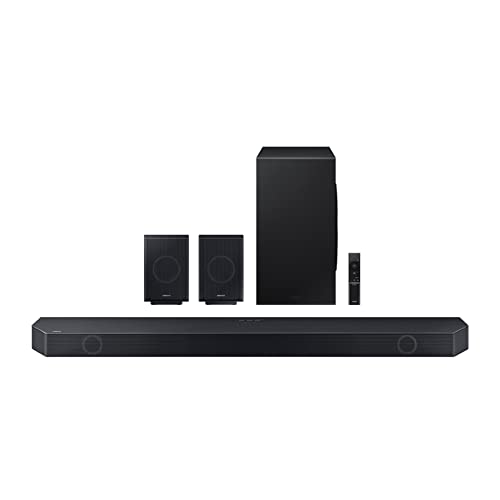
Samsung HW-Q990C -- Best for Surround Sound
The Samsung HW-Q990C earns its Consumer Reports rating by delivering a genuine 11.1.4-channel surround sound system in a soundbar format. The wireless rear speakers and wireless subwoofer create a convincing full-room audio experience that comes closer to a traditional AV receiver system than any other soundbar on this list. Consumer Reports tests confirmed the rear speaker placement and Atmos height channels produced one of the most immersive soundstages they measured.
What we liked
- 11.1.4 CH. TRUE DOLBY ATMOS SOUND: Feel sound all around with 11 front-facing speakers, 1
- Q-SYMPHONY: Amp up your audio with the greatest duo of all time, Samsung TVs paired with Sa
- WIRELESS DOLBY ATMOS: Feel surrounded; Cue up Dolby Atmos sound and skip the cumbersome HD
- SPACEFIT SOUND PRO: Sound amplifies everything; This soundbar reacts accordingly; Get room
- UP / SIDE FIRING REAR SPEAKER KIT INCLUDED: Ready to have your mind blown? Be captivated b

Bose Smart Soundbar 600 -- Best Mid-Range Option
The Bose Smart Soundbar 600 hits the midpoint between entry-level and premium soundbars with dialogue clarity that Consumer Reports rates as the best in its price range. The PhaseGuide technology disperses sound across a wider stage than the physical width of the bar suggests, creating an immersive listening experience without requiring rear speakers. Dolby Atmos support through upward-firing drivers provides a noticeable height channel effect in typical living room conditions.
What we liked
- IMMERSIVE DOLBY ATMOS AUDIO
- DEEP BASS PERFORMANCE
- SMART STREAMING CONNECTIVITY
- FLEXIBLE MOUNTING OPTIONS
- TV MOUNT INTEGRATION

Sony HT-S2000 -- Best Budget Dolby Atmos Soundbar
The Sony HT-S2000 delivers Dolby Atmos decoding and upward-firing drivers at a price that makes full-format audio accessible without a major investment. Consumer Reports rates it as the top-performing Atmos soundbar with audio quality that outperforms its price in blind listening comparisons. The S-Force PRO Virtual Surround Sound processing creates a wider soundstage than the physical driver placement would suggest.
What we liked
- 5.1CH SURROUND SOUND: Hear cinematic surround sound and deep bass with 3 front-firing spea
- SOUND STRAIGHT FROM CINEMA: Get the best streaming experience with support for Dolby Atmos
- CLEAR DIALOGUE: Catch every word in the scene with dedicated center channel speaker.
- ROOM FILLING SOUND: Multi Stereo enhances your listening experience by playing the same so
- BRAVIA THEATER AND BRAVIA TV, THE PERFECT PAIR: Pair with compatible BRAVIA TVs to control

Vizio V-Series 5.1 -- Best Entry-Level Complete System
The Vizio V-Series 5.1 system earns Consumer Reports' recommendation as the best complete entry-level surround sound package. The included wireless subwoofer and two satellite rear speakers create a genuine multi-channel setup at a price that rivals what many competing brands charge for a soundbar alone. Consumer Reports rates the overall system performance as a clear upgrade over any TV speaker setup at this price point.
What we liked
- Low-Profile Modern Design
- Powerful Performance
- Simple Setup, Streaming & Control
- 5.1-Channel Sound
- 6 Total Speakers
How to choose
What to consider
Consumer Reports evaluates soundbars through frequency response measurements, dialogue intelligibility testing at multiple volumes, Dolby Atmos height channel effectiveness in standardized room conditions, and owner reliability surveys. When applying those results, start by identifying your room size. Soundbars lose bass and surround effect in larger rooms without a subwoofer, and Consumer Reports accounts for room volume in its testing protocols.
What to consider
Connection options matter for your specific setup. Check whether the soundbar supports eARC if you want to pass Dolby Atmos audio from a streaming device connected to your TV rather than directly to the soundbar. HDMI ARC and optical connections support standard Dolby and DTS but not lossless Atmos. If you have a smart TV ecosystem, soundbars from the same brand often offer tighter integration features that standalone models cannot provide.
What to consider
For more home theater coverage, see our guide to [articles/best-consumer-reports-smart-tv](/articles/best-consumer-reports-smart-tv) for the best Consumer Reports-rated televisions to pair with your soundbar. Wearable audio buyers should also check [articles/best-consumer-reports-smartwatch](/articles/best-consumer-reports-smartwatch). Full evaluation criteria are at [/methodology](/methodology).
Common questions
Consumer Reports testing shows that premium soundbars with built-in subwoofer arrays, like the Sonos Arc and Samsung HW-Q990C, deliver adequate bass for most living room listening without an add-on subwoofer. Budget soundbars benefit significantly from an optional wireless subwoofer for movies and music. If bass-heavy content like action films or music is a priority, plan for a subwoofer in your budget.
Consumer Reports evaluates Dolby Atmos soundbars separately and finds that the effect varies significantly by room and implementation. High-end models with upward-firing drivers, like the Sonos Arc and Sony HT-A7000, produce a convincing height channel effect in rooms with low, flat ceilings. Rooms with vaulted, angled, or coffered ceilings reduce the effect substantially. Budget Atmos soundbars often deliver a minimal benefit from the format.
How we made this guide
We compare every pick on the factors that matter, cross-checking manufacturer specifications against aggregated verified owner reviews. We rank independently and never take payment for placement. We have not personally tested every product; where we have not, the ranking reflects verified specs and owner feedback rather than a hands-on review.
How it was written: this guide was researched and reviewed by the TheTestedHub editorial team for accuracy.
Affiliate disclosure: TheTestedHub is reader-supported. When you buy through links on our site, we may earn a commission at no extra cost to you.
More guides

Best Drones for Beginners 2026: Expert Pick Is the DJI Mini 4K

Find Your Perfect Podcast Mic: Reviews for Every Budget

Phone Tripods 2026: Best Picks and Buying Guide

2026 iPad Accessories Shortlist: Why the Apple Pencil Pro Leads

How to Choose the Best Digital Photo Frames in 2026

Looking for the Best MagSafe Power Banks? Our 2026 Picks

Our Top Fast Chargers for 2026
