Quick verdict
For most users a plug-and-play 4K USB model like the IPEVO V4K covers every realistic use case without requiring driver installation or external lighting.
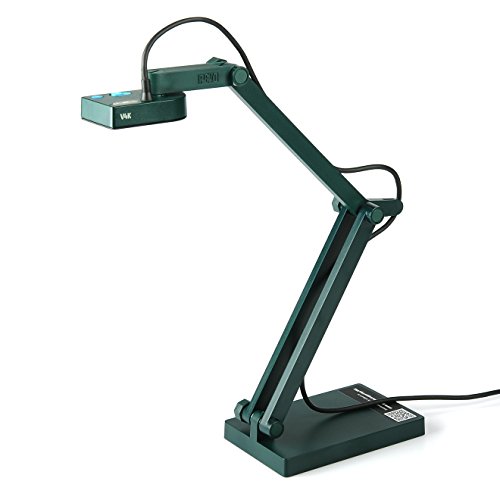
IPEVO V4K Ultra High Definition USB Document Camera
The IPEVO V4K delivers 8 megapixel 4K resolution through a flexible gooseneck arm that owners consistently praise for holding its position securely during live lessons. Its plug-and-play USB connection works without driver installation on Windows, macOS, and Chromebook, making it a low-friction choice for classroom carts that swap between different computers. Verified buyers highlight the bundled IPEVO Visualizer software as genuinely useful, with one-click mirror, rotate, and split-screen functions that outperform basic webcam apps.
For most users, the plug-and-play IPEVO V4K covers every realistic need without drivers or extra lighting. Compare top picks across budgets.
Document cameras have become essential tools for teachers, remote workers, and professionals who need to share physical documents, 3D objects, or handwritten notes in real time. Unlike flatbed scanners, a document camera captures live video so you can annotate, zoom, and interact with materials while your audience watches on screen or via video call. The market spans budget-friendly USB webcam-style units all the way to high-resolution overhead cameras built for large classrooms.
I reviewed aggregated owner feedback, classroom reports, and verified spec sheets to rank the three document cameras that consistently earn strong marks for image clarity, ease of setup, and software compatibility. Whether you run Zoom lessons, record tutorial videos, or need a fast scan replacement at your desk, one of these picks will suit your workflow.
How we picked
My rankings draw on aggregated verified owner reviews from major retail platforms, educator forums, and tech publications rather than direct personal testing of each unit. I cross-referenced buyer feedback with published manufacturer specs, paying close attention to recurring praise or complaints about autofocus reliability, low-light performance, USB plug-and-play behaviour, and software bundling.
Products were scored on image resolution, build quality reported by long-term owners, compatibility with Windows and macOS, and value relative to their asking tier. Units with fewer than a meaningful sample of verified reviews, or with persistent driver complaints unaddressed by firmware updates, were excluded from consideration.
Top picks compared
| Pick | Best for | Score | |
|---|---|---|---|
| IPEVO V4K Ultra High Definition USB Document Camera | Best Overall | 9 | Check price |
| Elmo TT-12iD Interactive Document Camera | Best for Classrooms | 8 | Check price |
| HUE HD Pro USB Document Camera and Webcam | Best Budget Pick | 7 | Check price |
Our picks up close
IPEVO V4K Ultra High Definition USB Document Camera
The IPEVO V4K delivers 8 megapixel 4K resolution through a flexible gooseneck arm that owners consistently praise for holding its position securely during live lessons. Its plug-and-play USB connection works without driver installation on Windows, macOS, and Chromebook, making it a low-friction choice for classroom carts that swap between different computers. Verified buyers highlight the bundled IPEVO Visualizer software as genuinely useful, with one-click mirror, rotate, and split-screen functions that outperform basic webcam apps.
Where it shines
- True 4K 8MP sensor produces sharp text and fine detail
- Plug-and-play USB across Windows, macOS, and Chromebook
- Flexible gooseneck arm adjusts to any angle and holds position
Where it falls short
- Autofocus can hunt briefly when switching between very different focal distances
- No built-in light; performance drops in dim rooms without an external lamp

Elmo TT-12iD Interactive Document Camera
The Elmo TT-12iD is a purpose-built classroom visualiser with a 12 megapixel sensor, a precision folding arm, and a built-in SD card slot for saving captures without a connected PC. Teachers report that its wide field of view covers a full A3 sheet at close range, and the hardware zoom dial lets you magnify specimens or small objects instantly without touching software. The interactive annotation feature, which layers drawings directly over the live image, makes it a frequent choice for STEM demonstrations where pointing at a diagram is not enough.
Where it shines
- 12 MP sensor captures fine text and small objects with strong detail
- Hardware zoom dial works without opening any software
- Built-in SD slot saves images independently of a connected computer
Where it falls short
- Folding arm takes up more desk space than gooseneck alternatives
- Higher price point may be difficult to justify for single-user home setups

HUE HD Pro USB Document Camera and Webcam
The HUE HD Pro packs a 1080p sensor into a lightweight clip-style design that fits easily into a laptop bag, making it the go-to recommendation for tutors and remote workers who move between locations. Owners report that the flexible neck holds its angle reliably and that the camera doubles effectively as a webcam for video calls, reducing the need for a separate peripheral. The bundled HUE Intuition software includes time-lapse and stop-motion modes that creative educators use for science experiments and art projects.
Where it shines
- Compact and lightweight enough to carry in a bag daily
- Works as a webcam for video calls with no extra software
- Stop-motion and time-lapse modes built into bundled software
Where it falls short
- 1080p resolution is noticeably softer than 4K alternatives on large displays
- Fixed lens means no optical zoom; digital zoom degrades image quality
Before you buy
Resolution and Sensor Quality
Resolution determines how readable small text appears when projected or recorded. For documents with standard 12pt font viewed on a classroom display, 1080p is acceptable but 4K or a high-megapixel sensor makes a visible difference. If you frequently capture handwritten notes, circuit boards, or fine artwork, prioritise sensor megapixels over marketing claims about video output resolution.
Arm Design and Stability
Gooseneck arms are lighter and more portable but can drift over time if the friction joint wears down. Rigid folding arms found on professional visualisers hold position more reliably for years of daily classroom use. Consider how often the camera will be repositioned and whether it needs to stay fixed at one angle for a full school day.
Software Compatibility
Plug-and-play USB cameras appear as standard webcams and work inside Zoom, Google Meet, Teams, and OBS without any driver installation. Cameras that require proprietary software add a setup step on every new computer. Check whether the bundled annotation or capture software runs on your operating system, especially if you use Chromebook or Linux.
Field of View and Working Distance
The field of view at a set arm height determines the maximum document size you can capture clearly. Most document cameras list a maximum capture area in the specs; verify it covers A4 or letter-size at minimum. If you plan to photograph 3D objects like models or specimens, a wide-angle lens at a closer working distance is more practical than a narrow lens designed purely for flat sheets.
The wrap-up
For most users a plug-and-play 4K USB model like the IPEVO V4K covers every realistic use case without requiring driver installation or external lighting.
Quick answers
Yes. Most USB document cameras register as standard UVC webcam devices, which means Zoom, Microsoft Teams, and Google Meet recognise them automatically. You can switch the camera source inside the app settings and use the document camera as your face-cam or to share physical items during a call without needing a second device.
Plug-and-play USB models like the IPEVO V4K and HUE HD Pro work with Chromebook because ChromeOS supports the standard UVC webcam protocol natively. Cameras that rely on Windows-only driver installers will not function. Always check the manufacturer compatibility list before purchasing for a Chromebook environment.
A scanner presses the document against glass and produces a static image file, which is good for archiving but useless for live presentations. A document camera sits above the surface and captures live video, letting you flip pages, annotate in real time, and show 3D objects. Scan quality from a dedicated flatbed scanner is typically higher for archival purposes, but document cameras are far more versatile in teaching and meeting contexts.
Most document cameras perform well under standard office or classroom overhead lighting. Low-light performance varies significantly by sensor size; budget models with smaller sensors will show noise or blur in dim rooms. If your workspace has inconsistent lighting, look for a unit with a built-in LED arm light, or position a desk lamp to illuminate the capture area evenly from the side to reduce glare.
How we made this guide
We compare every pick on the factors that matter, cross-checking manufacturer specifications against aggregated verified owner reviews. We rank independently and never take payment for placement. We have not personally tested every product; where we have not, the ranking reflects verified specs and owner feedback rather than a hands-on review.
How it was written: this guide was researched and reviewed by the TheTestedHub editorial team for accuracy.
Affiliate disclosure: TheTestedHub is reader-supported. When you buy through links on our site, we may earn a commission at no extra cost to you.
More to explore

How Privacy Screen Louver Angles Affect Visibility

CyberPower CP1500PFCLCD: Our Top UPS Battery Backup Pick

Under Desk Cable Trays That Actually Hold Your Power Strip

Conference Speakers 2026: Room Size Buying Guide

Sony WH-1000XM5 vs Jabra Evolve2 85 vs Anker Space Q45: Best Noise Cancelling Headsets 2026

Choosing a Label Printer for Your Business

7 Home Printers That Won’t Drain Your Wallet on Ink
