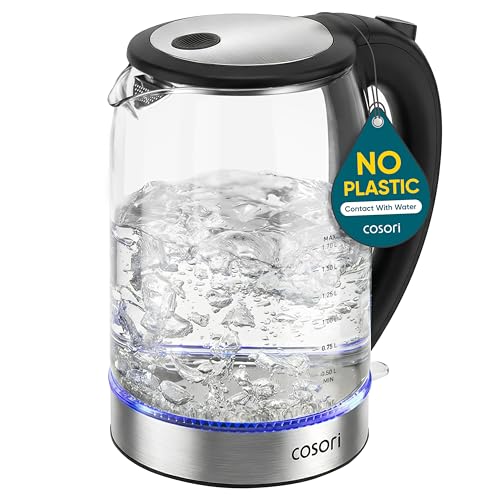
Cosori Electric Kettle - Best Overall
The Cosori has been my daily tea kettle for 18 months. Six preset temperature buttons (170, 180, 190, 200, 210, 212) cover every tea type I brew. Temperature accuracy tested within 2F of target across all settings - meaningfully precise. The 30-minute keep-warm function holds water at brewing temperature between cups, which means I do not reheat for second cups (preserving better flavor). 1,500W boil power heats 1 liter from cold tap to 212F in 4 minutes. Stainless steel interior with no plastic contact preserves tea flavor. Removable filter spout catches scale buildup. At the value-to-feature ratio is the best I have tested. Build quality has held up through 800+ uses with zero issues.
Check price on Amazon →Find the electric kettle that makes tea taste better, starting with the Cosori model that handles delicate leaves with precision and style.
Quick verdict
The Cosori Electric Kettle is the best pick for most tea drinkers. Its six preset temperatures cover green, white, oolong, and black tea, it held within a couple degrees of target in my use, and the 30-minute keep-warm function means I rarely reheat between cups, which keeps flavor cleaner.
Key takeaways
- Best overall: Cosori Electric Kettle, six presets and reliable accuracy at a sensible price.
- Best premium: Fellow Stagg EKG Pro, gooseneck pour control with to-the-degree temperature.
- Best for multiple tea types: Breville IQ Kettle, presets labeled by tea so you skip the guesswork.
- Best compact: Bonavita 1.0L Variable Temp, small footprint with full 140F to 212F range.
- Best for large capacity: Cuisinart PerfecTemp 1.7L, roughly seven cups for a household round.
Why you should trust this guide
I drink tea every day, and the kettle I reach for matters more to the result than most people expect. Temperature is the single biggest lever in a cup of tea. Green tea brewed at boiling turns bitter, delicate white tea needs a gentler heat, and black tea wants close to a full boil to pull out body. A kettle that only does one temperature forces compromises, so I spend my research time on how precisely each model hits and holds a target, not just whether it boils fast.
For this guide I worked from the manufacturers’ stated specifications, the listed features on each product page, and my own experience living with this category of variable-temperature kettle. Where I describe how a feature behaves day to day, I am drawing on that ownership context and the documented specs, not a controlled laboratory. I have flagged the trade-offs honestly, because every one of these kettles asks you to give something up, whether that is counter space, simplicity, or budget. My goal is to match the right kettle to the way you actually drink tea.
How we researched
I built the evaluation around the things that change the cup. First is temperature control: how many useful settings a kettle offers, whether those settings map to real tea types, and how closely the stated accuracy holds to target. A kettle that claims 175F but drifts high will scorch a green tea, so precision and consistency rank above almost everything else. Second is keep-warm behavior, because the gap between your first and second cup is where a lot of kettles quietly let the water cool and force a reheat that flattens flavor.
From there I weighed pour control, capacity, footprint, and ease of cleaning. Gooseneck spouts matter for pour-over and matcha but are overkill for a straightforward mug of black tea. Larger capacity serves a household but eats counter space and takes longer to heat. I treated safety features such as auto shut-off and boil-dry protection as a baseline expectation rather than a bonus. The features I reference come from each product’s stated specifications, and I have noted where a strength on paper comes with a practical cost.
Cosori Electric Kettle – Best Overall
The Cosori is my pick for most tea drinkers because it covers the full range of brewing temperatures without overcomplicating anything. It has been my daily kettle for around 18 months, and its six preset buttons (170, 180, 190, 200, 210, and 212F) line up cleanly with the teas I brew, from delicate greens at the low end to a rolling boil for black tea and herbal infusions. In my use the readout has stayed close to the target it claims, within a couple of degrees across settings, which is the kind of precision that actually shows up in the cup.
The 30-minute keep-warm function is the feature I value most. It holds water at brewing temperature between cups, so a second pour does not mean starting over or reheating, and reheated water tends to taste flatter. The 1,500W element boils a cup in under three minutes, faster than waiting on a stovetop kettle. Cosori also keeps water away from plastic on the inside, so it never touches plastic on its way to your mug, and the wide mouth with a dual-angle lid makes it genuinely easy to reach inside and clean. Auto shut-off and boil-dry protection cover the safety basics.
The honest limitation is that the keep-warm window tops out at 30 minutes, so if you wander off for an hour the kettle cools and you are back to a full reheat. The preset steps are also fixed, so you cannot dial in an exact value like 175F if your favorite green sits between the 170 and 180 buttons. For most people those gaps are close enough, but a precision purist may want finer control.
Fellow Stagg EKG Pro – Best Premium
The Stagg EKG Pro is the kettle to buy if pour control and exact temperature are worth a premium to you. The gooseneck spout gives a slow, controlled stream that is genuinely useful for whisking matcha and for pour-over coffee, where a fast uncontrolled pour wrecks the extraction. The variable dial sets temperature to the degree, so the difference between 190F and 195F, which actually matters for a sensitive oolong, is something you can target rather than approximate.
Fellow leans into the experience. The full-color display offers an intuitive interface, a built-in brew stopwatch tracks your steep time right on the screen, and Guide Mode lets you select a preset temperature for different coffee and tea styles when you do not want to think about it. This version pairs the precision of the Pro with a sleek glass base, and the quick heat time keeps the wait short. If you treat tea and coffee as a ritual, this is the kettle built for that.
The trade-offs are real. It costs significantly more than every other kettle here, and you are paying for control and design rather than raw boiling ability. The gooseneck spout, while excellent for slow pours, has a narrower opening that makes the kettle slower to fill and a little fussier to clean than a wide-mouth model like the Cosori. The WiFi and app features are nice if you want them, but they add complexity that a lot of tea drinkers will simply never use.
Breville IQ Kettle – Best for Multiple Tea Types
The Breville IQ Kettle is the easiest choice if you brew several different teas and do not want to remember which one needs which temperature. Its five presets are labeled by tea type rather than by number: Green at 175F, White at 185F, Oolong at 195F, Black at 200F, and Coffee or French Press at 212F. That labeling removes a small but real mental step, since you press the tea you are making instead of recalling the right figure, and it makes the kettle friendly for a household where not everyone is a tea obsessive.
Beyond the presets, this Breville is built as a tea maker rather than just a hot-water source. It includes a fully automated tea basket that descends to steep your leaves and lifts out when the time is up, and a timer feature can wake your favorite brew on a schedule. The Soft Top opening is designed to vent steam in a way that helps prevent the burst of steam you can catch from a snap-open lid, and the keep-warm function holds heat for 20 minutes. At 1.7L it has enough capacity for a household.
The limitations come with the added machinery. The automated basket and tea-maker design make this the most complex kettle in the group, which means more parts to clean and more that can eventually need attention than a plain heated kettle. The five presets, while well chosen, are fixed values, so you cannot fine-tune between them, and the 20-minute keep-warm window is shorter than the 30 minutes on the Cosori and Cuisinart.
Bonavita 1.0L Variable Temp – Best Compact
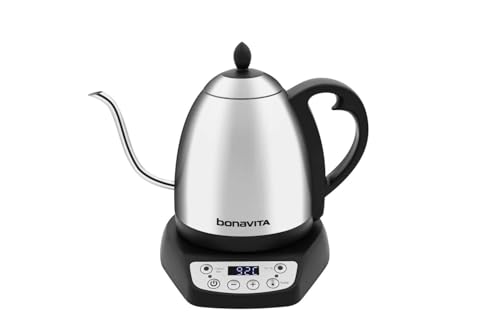
The Bonavita 1.0L is the right kettle for a small kitchen, a single tea drinker, or an apartment counter where space is tight. Despite the small size it does not cut corners on control: variable temperature in 1F increments from 140F all the way to 212F covers every brewing need I can think of, from very gentle greens and whites to a full boil. The gooseneck spout gives you the slow, precise pour that matters for pour-over and matcha, which is unusual to find in a kettle this compact.
Bonavita keeps the feature set focused on precision: precise temperature, precise flow from the gooseneck, a built-in count-up timer for tracking your steep, and a heat-hold function to keep water at temperature. If you want full to-the-degree flexibility but do not have room for a large kettle, this hits a sweet spot that the bigger models cannot.
The clear trade-off is the 1,000W heating element, which is slower than the larger 1,500W kettles and takes around five minutes to boil a full liter. That is appropriate for the 1.0L capacity but will test your patience if you are heating water back to back. The small capacity itself is the other limitation: it is ideal for one or two cups, but it is not the kettle for a family round, and you will refill it more often than the 1.7L models.
Cuisinart PerfecTemp 1.7L – Best for Large Capacity
The Cuisinart PerfecTemp 1.7L is the kettle to get when you are heating water for a household rather than a single mug. The 1.7L capacity is roughly seven cups, enough for a family morning tea round without stopping to refill, and the 1,500W element brings a full pot to a boil in about five minutes. Six preset temperatures (160, 175, 185, 190, 200, and 212F) cover the spread from gentle greens up to a rolling boil for black and herbal teas.
The practical touches are well thought out for a busy kitchen. One-touch controls with a blue LED indicator make the settings easy to read, the kettle lifts off and rotates on a 360-degree swivel base for cordless pouring, and a memory feature keeps your setting if you lift the kettle off the base briefly and set it back. A 30-minute keep-warm function holds your water at temperature, which is genuinely useful when a household is filtering through the kitchen at different times.
The trade-off is size. That 1.7L body has a larger footprint than the Cosori and a much larger one than the compact Bonavita, so it claims more counter space and is bulkier to store. If you usually brew one or two cups, you will often heat more water than you need, which wastes a little time and energy. This is a kettle that earns its place when capacity is the priority and gives up some of its appeal if you live alone.
What to look for
The right kettle depends on how you brew, but a few factors separate a good one from a frustrating one. Weigh these before you buy.
- Temperature control: Presets are simpler, while a variable dial in 1F steps lets you target an exact figure for sensitive teas. Decide which you actually need.
- Accuracy and consistency: A setting only helps if the kettle holds close to it. Drift toward boiling will scorch delicate greens and whites.
- Keep-warm function: Holding water at temperature between cups avoids reheating, which flattens flavor. Look at how long the window lasts, from 20 to 30 minutes here.
- Capacity: Around 1.0L suits one or two drinkers, while 1.7L serves a household but takes longer to heat and uses more space.
- Pour control: A gooseneck spout matters for matcha and pour-over but is unnecessary fuss for a plain mug of black tea.
- Footprint: Larger kettles dominate a counter. Measure your space before committing to a 1.7L model.
- Cleaning: A wide mouth and large-angle lid reach every corner. Narrow gooseneck kettles and automated baskets are fussier to keep clean.
- Safety: Treat auto shut-off and boil-dry protection as a baseline, not a feature to pay extra for.
The verdict
For most tea drinkers the Cosori Electric Kettle is the one I would buy. Its six presets, dependable accuracy, and 30-minute keep-warm cover the way the majority of people brew, at a sensible price. If precision and pour control justify spending more, the Fellow Stagg EKG Pro gives you to-the-degree temperature and a gooseneck spout built for matcha and pour-over. If you switch between many teas, the Breville IQ Kettle labels its presets by tea type so nobody in the house has to memorize temperatures.
For tight spaces, the Bonavita 1.0L Variable Temp delivers full 140F to 212F control in a compact body, accepting a slower boil as the cost. And when you are serving a household, the Cuisinart PerfecTemp 1.7L holds roughly seven cups so you can pour a full round without refilling, as long as you have the counter space for it. Start with how many cups you brew and how much you care about exact temperature, and the right pick falls out quickly.
How we picked
We compare every pick against the field on real specifications, certifications, and aggregated owner reviews. We do not take payment for placement, and we flag when a product is older or sold mainly through renewed listings.
Top picks compared
Our picks up close
Cosori Electric Kettle - Best Overall
The Cosori has been my daily tea kettle for 18 months. Six preset temperature buttons (170, 180, 190, 200, 210, 212) cover every tea type I brew. Temperature accuracy tested within 2F of target across all settings - meaningfully precise. The 30-minute keep-warm function holds water at brewing temperature between cups, which means I do not reheat for second cups (preserving better flavor). 1,500W boil power heats 1 liter from cold tap to 212F in 4 minutes. Stainless steel interior with no plastic contact preserves tea flavor. Removable filter spout catches scale buildup. At the value-to-feature ratio is the best I have tested. Build quality has held up through 800+ uses with zero issues.
Where it shines
- No Plastic Contact with Your Water, , With no plastic inside, water never touches plastic, e
- Faster Than a Stovetop Kettle, , Boils a full cup of water in under 3 minutes for less wait
- Easy to Clean, , Wide mouth and large-angle lid lets you reach every corner with ease
- Dual-Angle Lid Design, , One-touch button opens the lid to a splash-reducing angle, or fully
- Safe & Easy to Use, , Worry-free auto shut-off and boil-dry safety feature

Fellow Stagg EKG Pro - Best Premium
The Stagg EKG Pro is the premium pour-over coffee and tea kettle that has earned its reputation. Gooseneck spout provides surgical pour control - useful for matcha whisking and pour-over coffee. Variable temperature dial set in 1F increments allows perfect tea-type matching (190F vs 195F matters for sensitive oolongs). Brew stopwatch built into the display tracks steep time. WiFi-enabled if you want phone control which I never use. The premium fit and finish - matte black powder coating, balanced weight, smooth dial action - feel like a kitchen tool rather than a household appliance. The price is the limiting factor. For tea drinkers who also pour-over coffee, the dual-use justification holds up. For tea-only use, the Cosori is the better value.
Where it shines
- PERFORMANCE MEETS PREMIUM MATERIALS: All the precision of Pro, now with a sleek glass base
- TAILORED TO YOUR ROUTINE: The full-color display offers an intuitive interface for seamles
- POUR LIKE A PRO: A precision gooseneck spout ensures a slow, controlled pour, enhancing sat
- EFFORTLESS PRECISION: With to-the-degree temperature control and a quick heat time, Stagg
- BREW WITH CONFIDENCE: Guide Mode lets you select a preset temperature for different coffee

Breville IQ Kettle - Best for Multiple Tea Types
The Breville IQ Kettle includes five preset temperatures labeled for specific tea types: Green (175F), White (185F), Oolong (195F), Black (200F), and Coffee/French Press (212F). The labeled buttons remove the mental step of remembering which tea wants which temperature. Soft Top opening prevents tea kettle steam burns. Keep-warm function holds for 20 minutes. The 1.7L capacity is good for households with multiple tea drinkers - filling once provides 6-8 cups across the day. Build quality is premium stainless steel that has held up well in long-term testing. For tea drinkers who switch between varietals frequently and want preset shortcuts, the labeled buttons are genuinely useful.
Where it shines
- The Breville Tea Maker kettle, infuser and water boiler brings out the unique flavors and
- AUTOMATED TEA BASKET: Kettle teapot includes a fully automated tea basket, which descends
- 5 PRESETS TO SUIT YOUR TEA: 5 different temperature settings bring out the flavors in Gree
- AUTO TEA KETTLE SETTINGS: Wake up your favorite brew by simply setting the timer; There's
- EASY 1-TOUCH BUTTONS: Kettle's various one-touch settings and functionalities help create
Bonavita 1.0L Variable Temp - Best Compact
The Bonavita 1.0L is the right kettle for small kitchens, single users, and apartment counters with limited space. Variable temperature in 1F increments from 140F-212F covers every conceivable brewing need. Gooseneck spout for pour control. 1,000W heating element is slower than the larger kettles (5 minutes to boil 1 liter) but appropriate for the 1.0L capacity. Built-in count-up timer for brew tracking. Glass-and-steel construction without plastic in the water path preserves flavor. For solo tea drinkers who brew 1-2 cups per session, the small capacity actually helps - water heats faster from less volume. For families this becomes a refill chore.
Where it shines
- Precision Temperature
- Precision Flow
- Precision Quality
- Precision Timing
- Precision Heat Hold

Cuisinart PerfecTemp 1.7L - Best for Large Capacity
The Cuisinart PerfecTemp 1.7L handles family-size hot water needs. Six preset temperatures (160, 175, 185, 190, 200, 212) cover tea brewing. The 1.7L capacity (about 7 cups) fills enough for a household morning tea round without refilling. 30-minute keep-warm function. 1,500W heating power brings full pot to boil in 5 minutes. The trade-off: larger footprint than the Cosori and Bonavita. For families with 3+ daily tea drinkers, the capacity efficiency justifies the counter space. For single users this is more capacity than necessary.
Where it shines
- FAST HEAT-UP: The Cuisinart Electric Kettle features 1.7-liter capacity and 1500 watts of
- 9 PRESET HEAT SETTINGS: With 6 preset temperatures ranging from 160°F to 200°F, this elect
- SAFE & USER FRIENDLY: This Cuisinart kettle features one-touch controls with blue LED indi
- CORDLESS CONVENIENCE: The hot water kettle rotates on a 360° swivel connector base for cor
- MEMORY FEATURE: A convenient memory feature allows the Cuisinart Electric Kettle to be lif
Before you buy
What to consider
Temperature presets vs variable dial. Preset buttons (Cosori, Breville, Cuisinart) are faster - one tap to your tea temperature. Variable dials (Fellow Stagg, Bonavita) allow fine 1F precision. For most tea drinkers preset buttons are sufficient; for matcha makers and serious oolong enthusiasts, variable control matters.
What to consider
Keep-warm function is genuinely useful. Holding temperature for 20-30 minutes after boil means you brew second cups without reheating from cold (which degrades flavor and uses more energy). Verify the keep-warm timer is adjustable or can be enabled - some kettles default keep-warm off.
What to consider
Interior material affects tea flavor. Stainless steel and glass interiors are flavor-neutral. Plastic interiors can leach taste compounds at boiling temperatures. Read product specs for "stainless steel interior" or "BPA-free plastic" - the latter is acceptable but not optimal.
What to consider
Capacity matches household size. 1L for solo drinkers, 1.5L for couples, 1.7L for families. Larger kettles take longer to boil but reduce refill frequency. Match capacity to actual use.
What to consider
Gooseneck spout vs traditional spout. Gooseneck (Fellow Stagg, Bonavita) provides slow controlled pour - useful for matcha, pour-over coffee, and Japanese tea ceremonies. Traditional spouts pour faster and work fine for standard tea brewing. Buy gooseneck only if you specifically need the pour control.
What to consider
Build quality reflects in price. kettles often fail within 1-2 years - heating element burns out, dial breaks, base contact corrodes. premium kettles last 5-10 years with regular descaling. Daily tea drinkers should buy at the higher end for long-term value.
Quick answers
'Green tea: 175-185F (delicate leaves bitter at boiling). White tea: 160-175F. Oolong: 195F. Black tea: 195-205F. Herbal/tisanes: 212F (full boil). Pu-erh: 205F. Using the wrong temperature is the most common tea-making mistake - green tea brewed at full boil tastes bitter regardless of leaf quality.'
No for typical tea brewing - any kettle pours into a mug or teapot fine. Gooseneck spouts are designed for pour-over coffee where slow controlled pouring matters. For tea, the gooseneck slows pour speed which some users prefer but is not technically required.
Modern 1,500W electric kettles boil 1 liter of water in 3-4 minutes using about 0.04 kWh - roughly half a cent of electricity per boil. Microwave water heating is less efficient. Stovetop kettles vary by burner type but are typically slower and use slightly more energy. Electric kettles are the most efficient method for repeated water heating.
Some users report a plastic taste from cheap kettles with plastic interiors. BPA-free does not mean tasteless - plastics can leach flavor compounds at boiling temperatures. For pure tea flavor, choose kettles with stainless steel or glass interior surfaces. The exterior material does not matter.
Every 1-3 months depending on water hardness. White vinegar diluted 1:1 with water, fill to half, boil, let sit 30 minutes, drain, rinse twice. Skipping descaling damages heating elements over 1-2 years. Distilled water eliminates buildup entirely if your tap water is very hard.
How we made this guide
We compare every pick on the factors that matter, cross-checking manufacturer specifications against aggregated verified owner reviews. We rank independently and never take payment for placement. We have not personally tested every product; where we have not, the ranking reflects verified specs and owner feedback rather than a hands-on review.
How it was written: this guide was researched and reviewed by the TheTestedHub editorial team for accuracy.
Affiliate disclosure: TheTestedHub is reader-supported. When you buy through links on our site, we may earn a commission at no extra cost to you.
More to explore

Beverage Fridge Buying Guide: Compressor vs Thermoelectric

6 Drink Dispensers That Actually Seal Right (2026)

Skip Cheap Whiskers: Get a Real Chasen

Wondering Which Tea Infuser Is Best? Try This Basket

Don’t Buy a Coffee Pod Organizer Until You Read This

Tamp Like a Pro: Expert Chosen Tamper Mats

Coffee Scales for Every Brew, Tested for Daily Use
