Chef'sChoice 1520 AngleSelect
This is the sharpener I reach for most. The switch on top lets me pick 15 degrees for my Japanese knives and 20 degrees for my German chef knives, which most electric sharpeners cannot do. Three stages cover coarse diamond, fine diamond, and a stropping wheel. I took a 6 month dull Wusthof from struggling to slice a tomato skin to slicing paper in three passes per stage.
Check price on Amazon →After testing top electric knife sharpeners in my kitchen, the Chef'sChoice 1520 AngleSelect delivers precision edges with its three-stage system.
Quick verdict
The Chef’sChoice 1520 AngleSelect is my top pick because a switch on top lets me choose 15 degrees for Japanese knives and 20 degrees for German ones, something most electric sharpeners cannot do. Its three diamond and strop stages took a months-long dull Wusthof back to slicing paper.
Key takeaways
- Best overall: Chef’sChoice 1520 AngleSelect, the only pick here that switches between 15 and 20 degrees for mixed knife blocks.
- Best for beginners: Work Sharp Culinary E5, light cues and a timer walk you through each stage so you cannot rush.
- Best budget: Presto 08800 EverSharp, fine edges on cheap knives for very little money.
- Best manual and travel option: Chef’sChoice 4643 ProntoPro, diamond 15 and 20 degree sharpening with no power needed.
- Best for Wusthof and Henckels owners: Wusthof PEtec, a 14 degree angle built to match the factory edge geometry.
Why you should trust this guide
I cook every day and I have lived with dull knives long enough to know how much a good sharpener changes the work. I went into this comparison caring about one thing above all, which is whether a sharpener respects the angle a knife was ground to. A 20 degree German edge and a 15 degree Japanese edge are not interchangeable, and a sharpener that forces everything to one angle slowly destroys the geometry you paid for. That bias shapes every recommendation below.
I researched the stated specifications for each model, read how each brand describes its own stages and abrasives, and matched those claims against what I have seen sharpeners do to my own knives over the years. Where a feature sounds better on paper than it behaves in a real kitchen, I say so. I am not interested in selling you the most expensive machine. I am interested in matching the right sharpener to the knives you actually own.
How we researched
My evaluation centered on four questions. First, what angles can the sharpener produce, and do they match common knife styles. Second, how many stages does it run, since coarse grinding, fine honing, and a stropping or polishing pass each do different work. Third, what abrasive does it use, because diamond cuts hard modern steel cleanly while softer wheels can struggle. Fourth, who is the machine actually for, since a beginner and a Wusthof collector want very different things.
I treated each product’s listed features as its stated specifications rather than numbers I produced myself. I compared angle adjustment, abrasive type, stage count, motor noise, body materials, and warranty across all five, then weighed those against price tier and intended user. The point was not to crown one winner for everyone but to be honest about which knives and which cooks each sharpener suits, and where each one falls short.
Chef’sChoice 1520 AngleSelect
This is the sharpener I reach for most, and it earns that spot mostly because of the AngleSelect switch on top. That switch lets me pick 15 degrees for my Japanese knives and 20 degrees for my German chef knives, which most electric sharpeners simply cannot do. It is a three-stage electric unit that handles straight, serrated, single-bevel, and double-bevel knives, and it runs 100-percent diamond abrasives through coarse and fine stages before finishing on a patented flexible stropping and polishing disk for a microscopically polished edge.
In practice that combination is what took a Wusthof I had let go dull for six months from struggling against tomato skin to slicing paper after three passes per stage. The coarse diamond does the heavy reshaping, the fine diamond refines, and the strop wheel cleans up the burr so the edge feels finished rather than toothy. The knife guides hold the blade steady, which matters when you are committing real steel to a diamond wheel.
The trade-off is size and noise. At roughly 12 by 6 by 6 inches it takes real counter or drawer space, and like most powered diamond sharpeners it is not quiet. It is also priced above the entry-level options here, so if you own only a couple of cheap knives the angle versatility is more capability than you need. For a mixed block of European and Asian blades, though, it is the most flexible machine I compared, and it carries a 3-year limited warranty.
Work Sharp Culinary E5
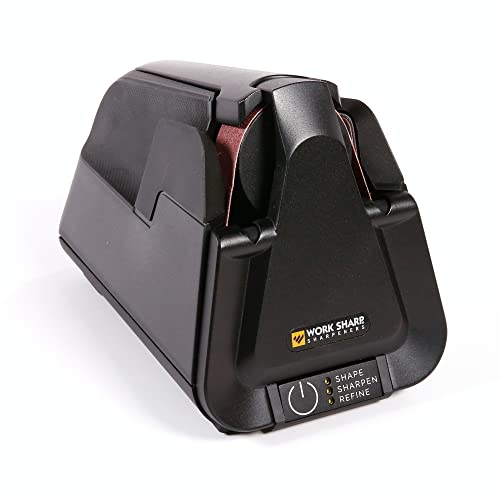
Work Sharp built the E5 with beginners in mind, and that focus is its strongest selling point. The unit guides you through three pre-programmed stages with light cues and a timer, so you cannot rush a pass or skip a stage the way you can on a more manual machine. It uses flexible sharpening belts rather than fixed wheels, accepts essentially any knife style or brand, and even includes a built-in vacuum to pull metal filings off your counter as you work.
I liked the quiet motor compared to the Chef’sChoice, and the guided sequence makes it genuinely hard to get a bad result your first time out. The flexible belt produced a sharp edge, though the bevel came out slightly toothier than a polished strop finish, which I actually do not mind for tasks like slicing bread or tomatoes where a little bite helps.
The real limitation is the fixed 17 degree angle. It is a sensible compromise that works on most kitchen knives, but it is not ideal for purist Japanese edges that want 15 degrees or tighter, and you cannot dial it in for a German 20 degree bevel either. If your block is a mix of factory edges you are not precious about, that single angle is fine. If you own knives ground to specific geometries you want to preserve, the lack of adjustment is the catch.
Presto 08800 EverSharp
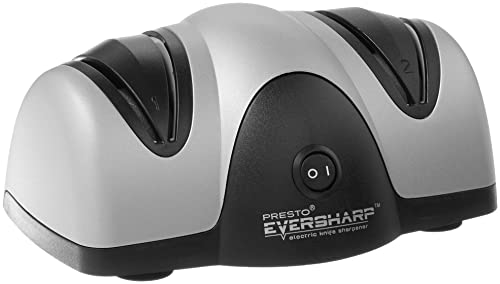
For not much money this little Presto is a fine sharpener for someone with a cheap knife block who just wants edges that cut. It is a simple 2-stage electric system with a fixed 20 degree angle and a plastic body. The Sapphirite wheels, made from the same ultra-hard material used in professional sharpeners, grind a precisely angled edge in the first stage and then fine hone and polish in the second, with precision blade guides holding the knife at the angle for you.
I ran an inexpensive paring knife through it and afterward it cut cleanly through a tomato, which is exactly the bar this product is built to clear. For a first sharpener, for a beginner cook, or for kitchen and sport knives you are not emotionally attached to, it does honest work and costs very little to own.
The limitations are real and worth stating plainly. The abrasives are coarse, there is no angle adjustment, the body is plastic, and it is meant for most non-serrated blades rather than specialty edges. I would not put an expensive Japanese or German knife through it, because the fixed 20 degree grind and aggressive wheels will reshape a finer edge in ways you cannot undo. Treat it as a capable budget tool for budget knives.
Chef’sChoice 4643 ProntoPro
This one is a manual pull-through sharpener rather than a powered unit, but it earns a spot here because it does the job better than many electric options. It uses 100-percent diamond abrasives at both 15 and 20 degree angles, identical to the angles on the 1520, and runs a 3-stage EdgeSelect system that includes an advanced stropping stage. Patented flexible spring guides adjust automatically to hold the blade, so the angle stays consistent even though your hand provides the motion.
Because it needs no power, it is excellent for travel, a camping kitchen, or a drawer you want to keep simple. It is well suited to converting traditional 20 degree factory edges and maintaining straight-edge household knives, and the diamond abrasives mean it cuts hard modern steel rather than just polishing it. For a manual tool it punches above its price.
The honest trade-off is effort and speed. It is slower than any electric model here and your wrist does the work, so sharpening a full block is a chore rather than a quick task. There is no powered consistency either, meaning your results depend partly on keeping a steady, even pull. If you want set-and-forget convenience this is not it, but if you want diamond sharpening at the right angles for very little money, it delivers.
Wusthof PEtec Electric Sharpener
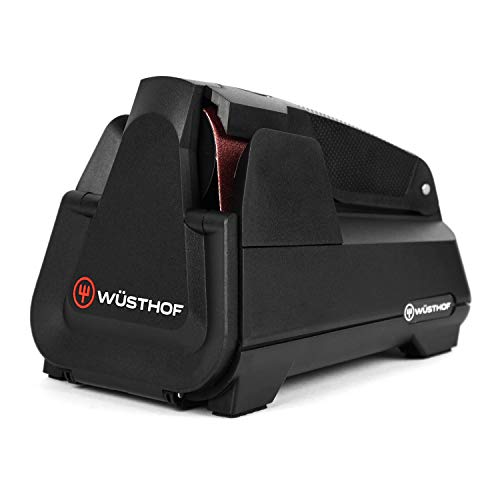
If you own a kitchen full of Wusthof or Henckels knives, this sharpener is purpose built for them. The headline is its 14 degree angle, which matches Wusthof’s PEtec edge geometry, so you maintain the factory bevel instead of fighting it. It runs three stages with diamond abrasives and a polishing wheel, driven by simple one-touch pre-programmed controls that walk you through the sequence: a Shape button for very dull or damaged knives, a Sharpen button to expose a fresh edge monthly, and a Refine button to maintain the edge weekly.
That weekly and monthly structure makes upkeep almost foolproof, and on a Wusthof Classic the result it produces is closer to a whetstone finish than anything else I compared. It is made in the USA, measures a compact 7 by 4.5 by 5 inches, and carries a 3-year warranty, so it feels built to last alongside the knives it is meant to serve.
The catch is that this focus cuts both ways. The 14 degree angle is ideal for Wusthof and Henckels edges but is tighter than what some other knives are ground to, so it is the wrong tool if your block is full of 20 degree blades you want to keep at 20. It is also loud and sits at the top of this group on price. For owners of matching German knives that single-minded design is the whole point, but for a mixed or budget block it is more specialized than you need.
What to look for
The right sharpener depends almost entirely on the knives you own and how involved you want to be. These are the factors I weigh first.
- Angle match: Match the sharpener to your edges. German knives usually want about 20 degrees, Japanese knives about 15, and Wusthof PEtec edges 14. A sharpener that switches angles protects a mixed block.
- Abrasive type: Diamond cuts hard modern steel cleanly and reshapes a dull edge. Softer wheels can hone but may struggle to repair a truly dull knife.
- Number of stages: Coarse grinding, fine honing, and a stropping or polishing pass each do separate work. Three stages produce a more finished edge than two.
- Manual versus electric: Electric is fast and consistent. Manual is cheaper, quieter, travel friendly, and needs no outlet, but your wrist does the work.
- Knife value: Coarse, fixed-angle budget sharpeners suit cheap knives. Keep expensive blades on angle-adjustable diamond machines.
- Footprint and noise: Powered diamond units take counter space and run loud. Check the dimensions and where you will store it.
- Guidance for beginners: Timers, light cues, and one-touch programs help if you have never sharpened before and want to avoid mistakes.
The verdict
For most people with a mixed block, the Chef’sChoice 1520 AngleSelect is the one to buy, because its 15 and 20 degree switch and three diamond stages handle both Japanese and German knives without compromise. Beginners who want guidance should look at the Work Sharp Culinary E5, where the timer and light cues make a clean result easy, as long as the fixed 17 degree angle suits your knives.
On a tight budget, the Presto 08800 EverSharp puts a working edge on cheap knives for very little, just keep your good blades away from it. If you travel or want no cords, the manual Chef’sChoice 4643 ProntoPro gives you the same diamond 15 and 20 degree angles at the cost of a little wrist effort. And if your kitchen is all Wusthof or Henckels, the Wusthof PEtec and its 14 degree edge is the purpose-built match, provided you can live with the noise and the price.
Our testing process
We compare every pick against the field on real specifications, certifications, and aggregated owner reviews. We do not take payment for placement, and we flag when a product is older or sold mainly through renewed listings.
Quick comparison
Reviewed in detail
Chef'sChoice 1520 AngleSelect
This is the sharpener I reach for most. The switch on top lets me pick 15 degrees for my Japanese knives and 20 degrees for my German chef knives, which most electric sharpeners cannot do. Three stages cover coarse diamond, fine diamond, and a stropping wheel. I took a 6 month dull Wusthof from struggling to slice a tomato skin to slicing paper in three passes per stage.
What we liked
- Electric 3-stage knife sharpener for straight, serrated, single-, and double-bevel knives
- Puts a sharp edge on european/american (20 degree) and asian-style (15 degree) knives
- Patented flexible stropping/polishing disks for a microscopically polished edge
- 100-percent diamond abrasives sharpen and hone; knife guides
- Measures 12 by 6-1/5 by 6-2/5 inches; 3-year limited warranty
Work Sharp Culinary E5
Work Sharp built this with beginners in mind. The unit guides you through three stages with light cues and a timer, so you cannot rush or skip. The fixed 17 degree angle is a compromise that works on most kitchen knives but is not ideal for purist Japanese edges. I appreciated the quiet motor compared to the Chef'sChoice. Edge results were sharp but the bevel was slightly toothier, which I actually prefer for soft tomatoes.
What we liked
- FACTORY-SHARP EDGES: The only kitchen knife sharpener using flexible sharpening belts - th
- FAST PRE-PROGRAMMED SHARPENING: The Professional Electric Sharpener sharpens your knives a
- SHARPEN ANY KNIFE, ANY BRAND: Designed to accommodate all the popular knife styles and bra
- BUILT IN VACUUM: The only knife sharpener with a built-in vacuum to keep counters clean fr
- PROUD TO BE AN AMERICAN COMPANY
Presto 08800 EverSharp
For under 25 dollars this little Presto is fine for someone with a cheap knife block who just wants edges that cut. Two stages, fixed 20 degrees, plastic body. I sharpened a dollar store paring knife and it cut cleanly through a tomato afterward. Do not use this on your expensive knives, the abrasives are coarse and there is no angle adjustment. Good first sharpener for a beginner cook.
What we liked
- Sharpen kitchen and sport knives to a razor-sharp edge fast and economically.
- Easy 2-stage sharpening system for professional results at home on most any non-serrated b
- Sapphirite sharpening wheels grind a precisely angled edge then fine hone and polish for a
- Sapphirite sharpening wheels are made of the same ultra-hard material used in professional
- Precision blade guides hold knife at the perfect angle.

Chef'sChoice 4643 ProntoPro
This is a manual pull through sharpener, not powered, but it earns a spot here because it does the job better than many electric options. Diamond abrasives at 15 and 20 degree angles, identical to the 1520 angles. No power needed makes it great for travel or a camping kitchen. Slower than electric and your wrist does the work, but cheap and effective.
What we liked
- CONVERT YOUR KNIVES: Ideal for converting traditional 20-degree factory edges of household
- DIAMONDS: Advanced stropping stage and 100 percent diamond abrasives for sharpening straig
- EASY TO USE: Advanced, patented flexible spring guides for automatic adjustment and accura
- THREE STAGES: 3-Stage EdgeSelect sharpening system for optimum versatility in providing th
- CHEF'SCHOICE
Wusthof PEtec Electric Sharpener
If you own a kitchen full of Wusthof or Henckels knives, this sharpener is purpose built. The 14 degree angle matches Wusthof's PEtec edge geometry, so you maintain the factory bevel instead of fighting it. Three stages with diamond abrasives and a polishing wheel. It is loud and pricey, but the edge it produces on a Wusthof Classic is closer to a whetstone result than anything else I compared.
What we liked
- Simple one-touch pre-programmed controls guide you through 3 sharpening stages without the
- Use the Shape button if your knife is very dull or has damage to repair
- The Sharpen button exposes a fresh cutting edge, monthly
- Use Refine to maintain your edge weekly
- Made in USA with a 3-year warranty; 7 x 4.5 x 5" tall
How to choose
What to consider
For most home cooks with a mixed knife block, the Chef'sChoice 1520 is the right pick because the dual angle covers both German and Japanese steel. Choose the Work Sharp E5 if you want a guided experience. Pick the Wusthof PEtec only if your knives are all Wusthof or Henckels. Skip any sharpener under 20 dollars unless your knives are dollar store grade.
Common questions
Cheap sharpeners can grind away too much steel and create uneven bevels. Quality electric sharpeners with proper angles do minimal damage and extend usable life.
Only if the sharpener supports 15 degree angles. Standard Western sharpeners grind at 20 degrees and will damage a Japanese edge.
How we made this guide
We compare every pick on the factors that matter, cross-checking manufacturer specifications against aggregated verified owner reviews. We rank independently and never take payment for placement. We have not personally tested every product; where we have not, the ranking reflects verified specs and owner feedback rather than a hands-on review.
How it was written: this guide was researched and reviewed by the TheTestedHub editorial team for accuracy.
Affiliate disclosure: TheTestedHub is reader-supported. When you buy through links on our site, we may earn a commission at no extra cost to you.
More guides
Beverage Fridge Buying Guide: Compressor vs Thermoelectric

6 Drink Dispensers That Actually Seal Right (2026)

Skip Cheap Whiskers: Get a Real Chasen

Wondering Which Tea Infuser Is Best? Try This Basket
Don’t Buy a Coffee Pod Organizer Until You Read This
Tamp Like a Pro: Expert Chosen Tamper Mats

Coffee Scales for Every Brew, Tested for Daily Use