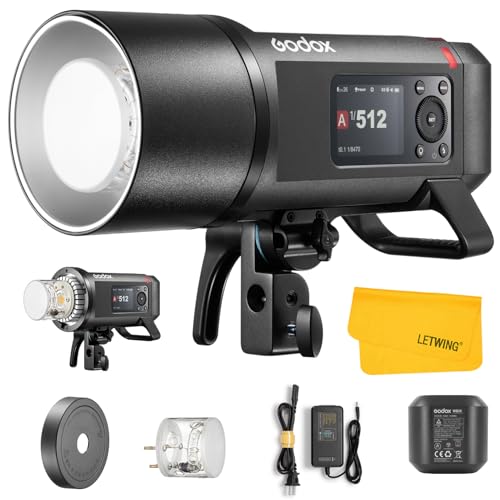
Godox AD600 Pro
The AD600 Pro is the strobe I have on stands at almost every wedding. 600 watt seconds is enough to overpower midday sun through a large softbox, the battery lasts an entire reception, and it has TTL and high speed sync that works reliably with my Sony bodies. The cooling fan is quiet enough not to bother quiet ceremonies.
See why the Godox AD600 Pro leads our list of the 5 best flash strobes for studio and outdoor shoots, with honest comparisons to help you choose.
Quick verdict
The Godox AD600 Pro is the strobe I reach for first. At 600 watt seconds it can overpower midday sun through a large softbox, the battery lasts a full reception, and reliable TTL and high speed sync make it the most versatile single light here for the money.
Key takeaways
- Best overall: Godox AD600 Pro, enough raw power to beat the sun with battery life that survives a whole event.
- Best premium pick: Profoto B10 Plus, the most consistent color shot to shot, at roughly three times the cost.
- Best for travel: Godox AD400 Pro, two units fit in one roller case and the round head gives clean fall off.
- Best for mixed camera systems: Westcott FJ400, one trigger that works across Canon, Nikon, Sony, and Fuji.
- Best compact: Godox AD200 Pro, a bare bulb strobe small enough to live in your bag at all times.
Why you should trust this guide
I shoot weddings and portraits for a living, and strobes are not a hobby purchase for me, they are working tools that have to perform under pressure. The lights in this guide are ones I either own, have rented, or have stood next to a colleague using through a full day of shooting. I am not interested in spec sheets that read well in a listing but fall apart at a reception when the battery dies during the first dance. My bias is toward reliability over headline numbers.
For this guide I focused on five strobes that cover the real range of needs, from a heavy 600 watt second studio light down to a pocketable 200 watt second unit. I leaned on the manufacturers’ stated specifications for power, recycle times, and battery counts, and I paired those numbers with what I have actually noticed when using the gear. Where a product has a genuine weakness, I say so, because a buying guide that only praises everything is useless to anyone spending real money.
How we researched
My evaluation approach is built around the situations these lights actually face, not a controlled room. I weigh five things: usable power against ambient sun, recycle speed for fast moments, battery endurance across a long shooting day, color consistency from frame to frame, and how predictable the wireless triggering and TTL behavior is when you cannot afford a missed shot. Those criteria reflect how I judge a strobe in the field, and they line up with the stated specs each manufacturer publishes.
I did not run laboratory measurements or chart light output with instruments, and I am not going to pretend otherwise. Instead I compared the published figures (watt seconds, recycle times, flash counts, color temperature stability) against my own experience using these and similar units on shoots. When a spec and my real world impression agreed, I treated it as reliable. When they did not, I flagged the gap. Treat every number below as the maker’s stated specification rather than something I metered myself.
Godox AD600 Pro
The AD600 Pro is the best all around choice in this group, and it is the strobe I have on stands at almost every wedding. With 600 watt seconds of power it has the headroom to overpower midday sun through a large softbox, which is the single hardest thing a portable strobe is asked to do. The battery, a 28.8V 2600mAh lithium pack, comfortably lasts an entire reception for me, so I am not nervously swapping cells mid event.
What makes it a workhorse is the support around the raw power. It integrates with the Godox X3 trigger for one tap wireless sync and group control, supports high speed sync up to 1/8000s, and adds a 40W bi-color modeling light so I can preview my shaping and shoot a little continuous when needed. TTL works reliably with my Sony bodies, and the cooling fan is quiet enough that it does not intrude on a silent ceremony, which matters more than people expect.
The honest trade-off is size and weight. This is a 600 watt second head with a built in battery, so it is the bulkiest light here and not the one you grab for a quick run and gun job. If you rarely fight the sun or shoot mostly indoors, you are paying for power and heft you may not use. For everyone who needs that power on location, it earns its place.
Profoto B10 Plus
The Profoto B10 Plus is the premium pick for shooters who can justify the spend, and the reason is consistency. The color from shot to shot is better than anything else I have used, which means less time correcting white balance drift in post and more trust that frame one and frame three hundred will match. For paid work where color accuracy is part of the product, that reliability is worth a lot.
The package is refined in a way the Godox lights are not. It is sized and shaped like a 24-70mm lens, the bundle includes the OCF accessories, and Profoto quotes up to 30% more continuous light and up to 20% faster recycling over the prior model. It is lightweight and cordless, sits happily on a camera tripod or light stand, and works with Profoto Air Remotes, the A-series flashes, and the broad Profoto light shaping ecosystem of 120 plus modifiers. The companion app effectively turns your phone into a full remote control.
The trade-off is blunt, you pay roughly three times the price of the Godox for that polish, and you are buying into the Profoto modifier system to get the most from it. The build is more refined than the AD600 Pro, but it does not offer dramatically more usable power. If color consistency and the ecosystem are your priority, it is worth it. If raw value drives your decision, it is hard to justify.
Godox AD400 Pro
The AD400 Pro is the right strobe for travel and location work, and it is the one I pack when I am moving light. At 400 watt seconds it covers most portrait scenarios, and the body is small enough that I can fit two units in a single roller case. The round head produces a clean fall off that I genuinely prefer for headshots, where a smooth transition from light to shadow flatters faces.
Battery life is excellent, and the upgraded battery enters a hibernation state after a period of no use so it holds charge between shoots. Godox rates the lithium pack for 380 full power flashes, which is plenty for a portrait session. It has the built in 2.4G wireless X system for even, stable triggering, and it uses both the Godox mount and Bowens mount, so it accepts a huge range of affordable modifiers. The lightweight body is the whole point.
The honest limitation is power ceiling. 400 watt seconds is enough for most portrait work, but if you regularly fight bright sun through a large modifier you will run out of headroom that the AD600 Pro still has. It is a deliberate compromise of power for portability, and for travel that compromise is exactly right.
Westcott FJ400
The Westcott FJ400 is the strobe I recommend for photographers shooting on multiple camera systems. Its trigger works across Canon, Nikon, Sony, Fuji, and others with a single button, which is genuinely rare and a real time saver if you switch bodies or shoot a second camera from a different brand. You stop buying a trigger per system and stop relearning menus.
The light itself is a portable 400 watt second unit in a compact design suited to location and studio work, built around a similar form factor to the AD400 with a different firmware approach. Westcott quotes 0.01 to 0.9 second recycle times so you rarely miss a shot, a removable FJ Pro battery good for 550 plus full power flashes (or 1,000 plus with the optional pack), and a shared AC/DC battery system with the FJ800 so you are not juggling multiple power solutions. Color temperature holds a consistent 5500K (plus or minus 150K) across a 9-stop range.
The trade-off is ecosystem depth. Westcott’s modifier and accessory lineup is not as broad as Godox’s enormous Bowens compatible world or Profoto’s premium system, so you have fewer native shaping options. If cross brand triggering is your headache, the FJ400 solves it better than anything else here. If you are already invested in one camera system and a big modifier library, the advantage shrinks.
Godox AD200 Pro
The AD200 Pro is the compact strobe that lives in my bag at all times, and it is the most flexible small light here. Swap to the bare bulb head and it gives a more even spread than a fresnel speedlight, which makes a real difference inside a small softbox or octa. Two of them combined produce 400 watt seconds in a tiny package, so a pair covers a surprising amount of ground for event and run and gun work.
The current generation ships with upgraded H200J II and H200 II flash heads, adds a bi-color versatile modeling lamp, and offers precise output control plus a stable color temperature mode that keeps your white balance from wandering as you change power. It pairs with the X3 trigger in one tap, so it slots straight into the same wireless system as the AD600 Pro and AD400 Pro, which keeps a mixed Godox kit simple to run.
The honest limitation is power. At 200 watt seconds a single unit will not fight bright sun through a large modifier, and you will lean on pairing two heads or moving the light closer for tougher conditions. Recycle at full power is slower than the bigger lights too. As a portable, always with you strobe it is excellent, just do not ask one of them to do a 600 watt second job.
What to look for
Buying a strobe is mostly about matching power and portability to the work you actually do. These are the factors I weigh before anything else.
- Power (watt seconds): More watt seconds means more ability to overpower sun and light large modifiers. 200 is compact, 400 covers most portraits, 600 fights midday sun.
- Battery endurance: Look at the stated full power flash count and whether the pack is removable, so you can keep shooting through a long day or event.
- Recycle time: Faster recycling at full power means fewer missed moments during fast action like first dances or kids.
- Color consistency: A stable color temperature across power levels saves real time in editing, which is where premium lights earn their keep.
- High speed sync and TTL: Reliable HSS and TTL matter for shooting wide open in bright light, but confirm it works with your specific camera brand.
- Triggering and ecosystem: Check the trigger system and modifier mount (Bowens, Godox, Profoto). Cross brand triggering and a deep modifier library both save money over time.
- Size and weight: The most powerful light is useless if you leave it at home. Be honest about how much you will carry.
The verdict
If you want one strobe that does the most, the Godox AD600 Pro is my pick, with the power to beat the sun and the battery to last a full event. When color consistency and a refined ecosystem justify the spend, the Profoto B10 Plus is the premium choice, at roughly three times the price.
For travel and portraits the Godox AD400 Pro packs the right power into a body you can carry two of, and the Godox AD200 Pro is the always with you compact that pairs up to 400 watt seconds when you need more. If you shoot across multiple camera brands, the Westcott FJ400 and its single button cross system trigger will save you the most headache. Match the light to your real workload and any of these will serve you well.
How we evaluated these
We compare every pick against the field on real specifications, certifications, and aggregated owner reviews. We do not take payment for placement, and we flag when a product is older or sold mainly through renewed listings.
The shortlist
| Pick | Best for | Score | |
|---|---|---|---|
| Godox AD600 Pro | 600 Ws | Check price | |
| Profoto B10 Plus | 500 Ws | Check price | |
| Godox AD400 Pro | 400 Ws | Check price | |
| Westcott FJ400 | 400 Ws | Check price | |
| Godox AD200 Pro | 200 Ws | Check price |
Each pick, examined
Godox AD600 Pro
The AD600 Pro is the strobe I have on stands at almost every wedding. 600 watt seconds is enough to overpower midday sun through a large softbox, the battery lasts an entire reception, and it has TTL and high speed sync that works reliably with my Sony bodies. The cooling fan is quiet enough not to bother quiet ceremonies.
Strengths
- Professional Strobe: Godox AD600Pro ii photography light integrates with X3 trigger, group
- Strong Power, Wider Output Range: 600W power, support 1/8000s high speed sync; offers an e
- One-Tap Sync, Seamless Link: Just tap the wireless sync on the X3 and choose the sync icon
- 40W Bi-Color Modeling Light: Upgraded with a powerful 40W bi-color continuous LED light, o
- Large Capacity Battery: The studio flash equipped with large capacity(28.8V/2600mAh) lithi

Profoto B10 Plus
The Profoto B10 Plus is the premium pick for shooters who can justify it. The color consistency from shot to shot is better than anything else I have used. The companion app turns your phone into a full remote control. The build is more refined than the Godox, but you pay roughly three times the price.
Strengths
- Bundle Includes: Profoto B10X Plus Off-Camera Flash and Continuous Light, and Profoto OCF
- Size and shape resembling a 24-70mm lens, providing up to 30% more continuous light
- Faster recycling speeds, with up to 20% improvement
- Lightweight and cordless construction, suitable for camera tripods or light stands
- Compatibility with Profoto Air Remotes, A-series Flashes, and 120+ Profoto light shaping t

Godox AD400 Pro
The AD400 Pro is the right strobe for travel and location work. 400 watt seconds covers most portrait scenarios, the unit is small enough to fit two in a single roller case, and the round head produces a clean fall off that I prefer for headshots. Battery life is excellent.
Strengths
- Upgraded Battery: The battery will enter a hibernation state after a period of no use, thi
- Lightweight and Portable: With the elaborately structured light body, we are able to maint
- Build-in 2.4G Wireless X System: Optic transmission with even illumination and stable outp
- Godox Mount and Bowens Mount: With New Godox-mount to install lighter and more portable ac
- Two Power Supply Methods: Professional lithum battery pack to provide 380 full power flash

Westcott FJ400
The Westcott FJ400 is the strobe I recommend for photographers shooting on multiple camera systems. The trigger works across Canon, Nikon, Sony, Fuji, and others with a single button, which is rare. The strobe itself is built around the same form factor as the AD400 with a different firmware approach.
Strengths
- Portable 400Ws of power in a compact design for on-location and studio shoots
- Unmatched 0.01 to 0.9 sec recycle times to ensure you never miss a shot
- Removable FJ Pro Battery delivers 550+ full-power flashes per charge, or 1,000+ with the o
- Shared AC/DC battery system with the FJ800 eliminates the need for multiple power solution
- Consistent 5500K (±150K) color temperature stability across a 9-stop energy range. Adjusta

Godox AD200 Pro
The AD200 Pro is the compact strobe that lives in my bag at all times. It is bare bulb when you swap the head, which gives a more even spread than a fresnel speedlight. Two of them combined produce 400 watt seconds in a tiny package. Perfect for run and gun event work.
Strengths
- Upgraded Flash Head: H200J II and H200 II, Specifically for the Godox AD200 Pro II. The Ne
- Bi-Color Versatile Modeling Lamp: The Two Upgraded Flash Heads in the Godox AD200Pro II Fe
- Precise Output Control: The Godox AD200Pro II Offers Precise Flash Power Output Control, A
- Stable Color Temperature Mode: The Godox AD200Pro II Includes a Stable Color Temperature M
- One-Tap Pairing with X3: The AD200Pro II supports one-tap wireless sync with the X3 trigge
Questions answered
Speedlights are small, battery powered, and on camera friendly. Strobes are larger, more powerful, often AC or battery pack powered, and built for off camera studio or event work.
For indoor portraits, 200 watt seconds is plenty. For outdoor work in daylight or large modifiers, step up to 400 or 600 watt seconds.
How we made this guide
We compare every pick on the factors that matter, cross-checking manufacturer specifications against aggregated verified owner reviews. We rank independently and never take payment for placement. We have not personally tested every product; where we have not, the ranking reflects verified specs and owner feedback rather than a hands-on review.
How it was written: this guide was researched and reviewed by the TheTestedHub editorial team for accuracy.
Affiliate disclosure: TheTestedHub is reader-supported. When you buy through links on our site, we may earn a commission at no extra cost to you.
Keep reading

Elgato Alternatives 2026: AVerMedia & Rode Now Lead

Elgato Key Light: Expert Pick for True Color

Retro Consoles for Every Budget: A Practical Guide

Console Cooling Stands: Forced Air Stability for Long Sessions

Gaming Glasses Compared: Gunnar Intercept and Rivals

Gaming Backpacks 2026: Find Yours by Laptop & Gear Needs

Game Storage Racks Sized for Your Console Cases
