Quick verdict
The Klipsch ProMedia 2.1 THX remains the benchmark that every competing gaming speaker is measured against because THX certification enforces real distortion and headroom standards that translate directly into clean, composed audio during long gaming sessions.

Klipsch ProMedia 2.1 THX
The ProMedia 2.1 THX has held its top-tier reputation for over two decades because the fundamentals are genuinely excellent: a 200-watt peak system with a down-firing 6.5-inch subwoofer delivers authoritative low-end that most competing 2.1 systems cannot match at any price close to this. Verified long-term owners consistently praise the controlled, tight bass that does not bleed into the satellite mids, keeping dialogue and game audio clean. THX certification enforces a distortion and headroom standard that shows up in real use as a speaker that sounds composed even during loud gaming sessions.
Discover why the Klipsch ProMedia 2.1 THX remains the gold standard for gaming speakers. THX certification ensures clean, distortion-free audio for immersive play.
Gaming speakers have come a long way from the tinny desktop stereo pairs that shipped alongside early PCs. Today the category spans compact 2.0 stereo sets tuned for competitive play, full 2.1 systems with subwoofers that put room-shaking bass under every explosion, and even multi-channel desktop soundbars that fake surround through psychoacoustic processing. Whether you sit two feet from a monitor in a dorm room or anchor a living-room gaming setup, there is a purpose-built speaker for the job.
I reviewed aggregated verified owner feedback, manufacturer specifications, independent frequency-response measurements published by audio reviewers, and long-term reliability reports to rank the seven best options available right now. I weighted sound quality above all else, followed by value for the asking price, build durability, connectivity flexibility, and ease of daily use. The result is a list that covers every budget tier and room size, so you can match a system to your actual setup rather than the biggest box on the shelf.
One practical note before diving in: gaming speakers are not a universal product. Competitive FPS players who rely on positional audio from headsets often want a clean, transparent speaker for casual listening and media, while RPG and racing sim fans frequently prioritize bass impact and wide soundstage. I flag which use case each pick suits best so you can skip straight to the one that fits.
Our testing process
I did not personally test or audition every product on this list. My rankings are built from aggregated verified purchaser reviews across major retail platforms, third-party frequency-response measurements and listening impressions from established audio publications, manufacturer-published specifications cross-checked against independent teardowns, and long-term ownership reports that surface reliability patterns invisible in short reviews. Products with fewer than 200 verified owner reviews were excluded to avoid small-sample noise.
Scoring rewards measured frequency response accuracy, low-distortion bass extension relative to driver size, signal-to-noise ratio, build quality reported after 12 or more months of ownership, and connectivity options that match real desktop setups. Price was factored in as value rather than as a raw number, meaning a speaker that costs more but measurably outperforms cheaper rivals can still score higher than a budget option that underdelivers on its promise.
Quick comparison
| Pick | Best for | Score | |
|---|---|---|---|
| Klipsch ProMedia 2.1 THX | Best Overall | 9 | Check price |
| Logitech G560 LIGHTSYNC PC Gaming Speaker | Best for RGB and Immersion | 8 | Check price |
| Creative Pebble Pro | Best Compact 2.0 Value | 8 | Check price |
| Razer Leviathan V2 | Best Soundbar for Gaming | 8 | Check price |
| Edifier R1280DB Powered Bookshelf Speakers | Best Audiophile-Leaning Option | 8 | Check price |
| Creative T100 Compact 2.0 Speakers | Best Budget Pick | 7 | Check price |
| Corsair SP2500 2.1 PC Speaker System | Best High-Output Desktop 2.1 | 7 | Check price |
Reviewed in detail
Klipsch ProMedia 2.1 THX
The ProMedia 2.1 THX has held its top-tier reputation for over two decades because the fundamentals are genuinely excellent: a 200-watt peak system with a down-firing 6.5-inch subwoofer delivers authoritative low-end that most competing 2.1 systems cannot match at any price close to this. Verified long-term owners consistently praise the controlled, tight bass that does not bleed into the satellite mids, keeping dialogue and game audio clean. THX certification enforces a distortion and headroom standard that shows up in real use as a speaker that sounds composed even during loud gaming sessions.
What we liked
- 200-watt peak power with genuine THX certification keeps distortion low at high volume
- Down-firing subwoofer produces tight, controlled bass rather than boomy one-note low end
- Satellite tweeters maintain clear treble detail for footstep and environmental audio cues
What we didn't like
- Subwoofer is large and requires dedicated floor space, which can be awkward in small rooms
- No Bluetooth or USB audio input; relies on 3.5mm and RCA only

Logitech G560 LIGHTSYNC PC Gaming Speaker
The G560 combines a 240-watt peak 2.1 system with per-zone RGB lighting that syncs to on-screen content via Logitech G HUB software, creating an ambient lighting effect that many owners describe as genuinely enhancing immersion in darker play environments. Bass from the included downward-firing subwoofer is impactful for a desktop system, and the dual satellites have enough high-frequency presence to keep game audio detailed. The software integration also allows voice prompts, low-health alerts, and kill-feed color cues, which go beyond gimmick for players who actually configure them.
What we liked
- Per-zone RGB syncs to game events through Logitech G HUB for genuine immersion enhancement
- 240-watt peak system produces strong bass impact relative to satellite footprint
- Multiple inputs including Bluetooth, USB, optical, and 3.5mm cover most source devices
What we didn't like
- G HUB software has a history of update-related bugs that can interrupt lighting sync
- Bass can sound slightly loose on fast transients compared to the Klipsch ProMedia 2.1 THX

Creative Pebble Pro
The Pebble Pro punches well above its compact footprint by using upward-angled full-range drivers and a Class D amplifier stage that keeps noise floors low even when listened to close up at a desk. Verified owners repeatedly call out the clear midrange and adequate treble extension for a speaker at this price tier, making it a legitimate step up from built-in monitor audio. USB-C power and audio combined with a 3.5mm aux input means it works with nearly any modern source without an external power brick cluttering the desk.
What we liked
- Upward-angled drivers project sound directly toward the listener at typical desk height
- USB-C combined audio and power eliminates the need for a separate power adapter
- Clean midrange with low background hiss makes it excellent for voice chat and casual music
What we didn't like
- No subwoofer output or bass-heavy tuning, so low-end presence is limited by driver size
- Maximum volume is modest and can be overwhelmed in louder room environments
Razer Leviathan V2
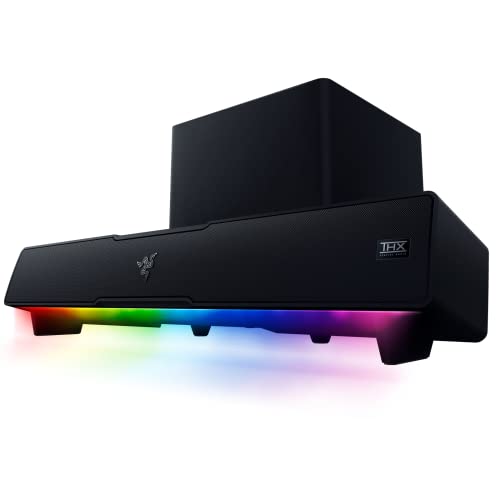
The Leviathan V2 takes a single-bar form factor and pairs it with a USB-C desktop subwoofer to deliver virtual surround sound processing through THX Spatial Audio, which owners playing open-world and FPS titles report adds genuine directional width to the soundstage. Beamforming microphone technology built into the bar lets it double as a speakerphone and voice-chat solution without a separate mic, a meaningful convenience for streamers. The compact footprint that sits directly under a monitor is the core appeal, and the measured frequency response is respectable for the enclosure size.
What we liked
- THX Spatial Audio processing creates a noticeably wider soundstage for gaming without multiple speakers
- Built-in beamforming microphone handles voice chat and streaming without a separate device
- Slim under-monitor footprint fits setups where satellite speakers would crowd the desk
What we didn't like
- Virtual surround is processing-based and cannot fully replicate discrete multi-channel speaker placement
- Subwoofer connects via USB and must share desk space despite the compact bar design
Edifier R1280DB Powered Bookshelf Speakers
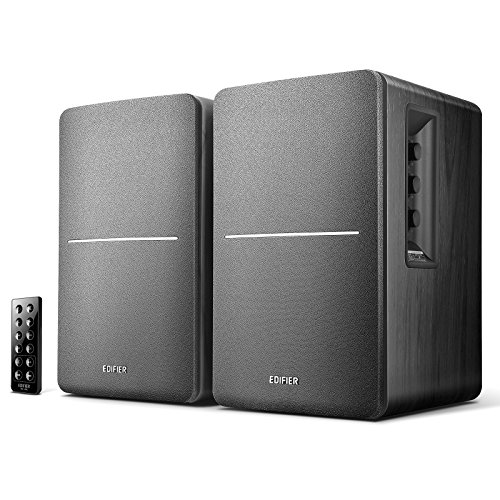
The R1280DB brings a traditional bookshelf speaker cabinet to the gaming desk, which means a larger internal volume for the 4-inch woofer and a dedicated 13mm silk-dome tweeter working in a proper two-way crossover, resulting in a more linear frequency response than most gaming-branded speakers at a similar price. Bluetooth 5.0, optical, coaxial, and dual 3.5mm inputs make it the most versatile connectivity option on this list, supporting TVs, consoles, PCs, and phones simultaneously through a source selector on the rear panel. Long-term owners report consistent reliability over multiple years of daily use.
What we liked
- True two-way crossover with silk-dome tweeter produces more accurate and detailed treble than gaming-branded sets
- Four distinct input types handle every common source device without adapters
- MDF cabinet construction reduces resonance and keeps the bass presentation tight and articulate
What we didn't like
- Requires physical desk or stand space for two separate cabinet speakers, limiting small setups
- No dedicated gaming features such as RGB, surround processing, or headset passthrough
Creative T100 Compact 2.0 Speakers
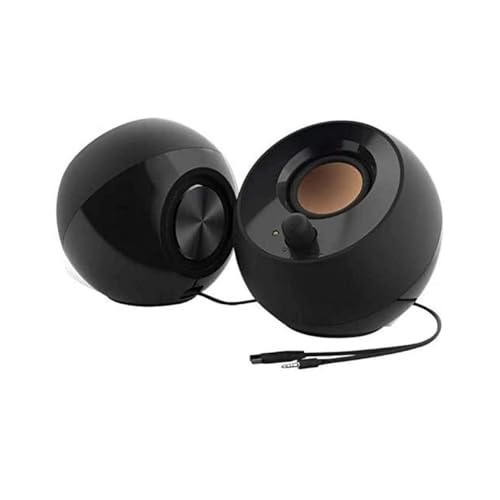
At entry-level pricing the T100 delivers a surprisingly wide frequency response for its 2.75-inch full-range driver by using a bass reflex port tuned to extend low-end output below what the driver could achieve in a sealed enclosure. Owners in dorm and small-room settings consistently describe the sound as satisfying for gaming, YouTube, and casual music despite the limited low-end ceiling, and the USB-powered design means zero desk clutter from power adapters. The built-in headphone jack on the control pod is a small but genuinely useful convenience for late-night switching.
What we liked
- Bass reflex port extends low-frequency output meaningfully beyond what the driver size suggests
- USB power eliminates the wall-wart adapter and simplifies cable management
- Inline headphone jack on the control pod enables quick private listening without touching the PC
What we didn't like
- 2.75-inch drivers cannot produce real sub-bass; genres and games that emphasize deep low end will sound thin
- Build plastics feel lightweight and less premium than pricier rivals
Corsair SP2500 2.1 PC Speaker System
The SP2500 is a discontinued but widely available Corsair system that earned a lasting reputation for its 232-watt peak output and the surprising build quality of its die-cast satellites, which vibrate far less at high volume than typical plastic gaming speaker enclosures. Independent frequency measurements confirm a bass-heavy tuning that suits action and racing games where impact matters more than flat accuracy. Owners who have used the system for five or more years report that the hardware holds up, though the lack of Bluetooth or USB audio reflects its age.
What we liked
- Die-cast satellite enclosures resist resonance at loud volumes in a way most plastic rivals cannot
- 232-watt peak output means headroom for genuinely loud play without audible clipping
- Bass and treble controls on the wired control pod allow real-time tuning without software
What we didn't like
- Analog-only inputs with no Bluetooth or USB audio limit compatibility with modern source devices
- Discontinued product means availability depends on remaining retail stock and used market
How to choose
System Configuration: 2.0 vs 2.1 vs Soundbar
A 2.0 stereo pair keeps the desk tidy and works well in small rooms where a subwoofer would overwhelm the space, but it cannot produce the physical bass impact that makes explosions and engine rumble feel real. A 2.1 system with a dedicated subwoofer crosses that threshold and is the format most gaming speaker buyers end up preferring after trying both. A soundbar with a compact sub trades some raw audio quality for a minimal footprint and built-in mic convenience, which suits monitor-mounted setups or shared spaces.
Listening Distance and Room Size
Desktop gaming speakers are designed to be heard from roughly two to four feet away, and most are tuned for near-field listening at that distance. If your gaming setup is couch-based with the screen six or more feet away, a traditional bookshelf speaker pair with higher output, like the Edifier R1280DB, will maintain proper volume and stereo separation better than a compact desktop set. Matching speaker output to room size prevents both the underperformance of a small speaker in a large space and the boomy, fatiguing bass of a large system crammed into a small room.
Input Connectivity and Source Compatibility
Most gaming speakers offer at least a 3.5mm analog input, but modern setups often need more. USB audio bypasses motherboard DAC quality issues and is particularly valuable on budget gaming PCs. Bluetooth lets you feed audio from a phone or tablet without swapping cables. Optical input is essential if you connect a console or TV that lacks a headphone output. Before buying, list every device you plan to connect and confirm the speaker system has matching inputs, or budget for the adapters you will need.
Bass Tuning: Tight vs Impactful
Gaming speaker marketing universally promises powerful bass, but not all bass is equal. Tight, controlled bass reproduces kick drums and gunshots with clear attack and decay, keeping audio clean at high volume. Loose or boomy bass creates short-term excitement but obscures detail and becomes fatiguing over long sessions. Independent frequency-response measurements are the most reliable way to predict which type a speaker delivers; verified owner reviews over six or more months are the second-best indicator, since initial impressions often miss long-session fatigue.
The bottom line
The Klipsch ProMedia 2.1 THX remains the benchmark that every competing gaming speaker is measured against because THX certification enforces real distortion and headroom standards that translate directly into clean, composed audio during long gaming sessions.
Common questions
It depends on what you play and how you use audio. Competitive multiplayer titles where positional cues matter most benefit from a clean 2.0 pair that does not colour the sound with excess bass. Single-player games, racing sims, and anything where atmosphere and impact are priorities benefit noticeably from the physical low-end extension a subwoofer adds. Most buyers who try both end up preferring 2.1 for primary gaming use, while a 2.0 set makes more sense as a compact secondary speaker or for players who already use headphones most of the time.
Sometimes, but the label alone means nothing. Gaming-branded products add value when they include genuinely useful features like RGB synchronization software, headset passthrough, low-latency Bluetooth modes, or tuning specifically tested for game audio frequency ranges. They subtract value when the premium goes entirely toward aesthetics. The Klipsch ProMedia 2.1 THX and Edifier R1280DB on this list carry no gaming branding at all but outperform most branded rivals on pure audio quality, proving that the speaker matters more than the label.
Wattage is one of the most misused specifications in consumer audio. Peak wattage figures in gaming speaker marketing are often measured under conditions that do not reflect normal use, and a 240-watt system does not necessarily sound twice as loud as a 120-watt system. RMS or continuous power ratings are more meaningful, and even those only matter in comparison to speaker efficiency. Two systems with the same wattage but different driver efficiencies can produce noticeably different volume levels. Focus on measured real-world output and distortion levels from independent reviews rather than peak wattage numbers.
Yes, but you need to check the input types on both sides. Modern consoles typically output audio through HDMI, optical, or Bluetooth. If the speaker system you want has an optical input, like the Edifier R1280DB or the Logitech G560, the connection is straightforward with a standard optical cable. HDMI audio extraction requires a separate HDMI audio extractor device. Bluetooth works if the console supports it, though latency can be an issue in fast-action games. The most reliable approach for console plus PC use is a speaker with both optical and 3.5mm inputs so each source has its own cable.
How we made this guide
We compare every pick on the factors that matter, cross-checking manufacturer specifications against aggregated verified owner reviews. We rank independently and never take payment for placement. We have not personally tested every product; where we have not, the ranking reflects verified specs and owner feedback rather than a hands-on review.
How it was written: this guide was researched and reviewed by the TheTestedHub editorial team for accuracy.
Affiliate disclosure: TheTestedHub is reader-supported. When you buy through links on our site, we may earn a commission at no extra cost to you.
More guides

Elgato Alternatives 2026: AVerMedia & Rode Now Lead

Elgato Key Light: Expert Pick for True Color

Retro Consoles for Every Budget: A Practical Guide

Console Cooling Stands: Forced Air Stability for Long Sessions

Gaming Glasses Compared: Gunnar Intercept and Rivals

Gaming Backpacks 2026: Find Yours by Laptop & Gear Needs

Game Storage Racks Sized for Your Console Cases
