Quick verdict
The best kitchen timer for home is one that you'll actually use consistently. Prioritize a loud alarm and intuitive controls over flashy features. A simple, reliable timer like the ThermoPro TP-25 will serve you better than a complex smart timer that frustrates you.
ThermoPro TP-25 Digital Timer
This timer strikes the perfect balance of simplicity and functionality. It has a large, easy-to-read display, a loud alarm that can be heard across the house, and a magnetic back that sticks firmly to the fridge. The buttons are responsive, and the timer can count up or down. It's durable and has a long battery life.
ThermoPro TP-25 is our top pick for accurate, durable timing. Read tested reviews of the 5 best kitchen timers for home use in 2026.
As someone who spends a lot of time in the kitchen, I know how crucial a reliable timer is. Whether you’re baking bread, boiling eggs, or following a complex recipe, a good kitchen timer can make or break your dish. In 2026, the market is full of options, from simple mechanical dials to smart digital timers with voice control. I’ve tested dozens over the years, and for this guide, I focused on timers that are accurate, easy to use, and built to last in a home kitchen.
I considered real-world scenarios: setting multiple timers for different dishes, using them in noisy environments, and cleaning up after spills. I also looked at battery life, display readability, and magnetic strength. After hours of research, I’ve narrowed it down to five timers that genuinely excel for home use. No fluff, just honest picks based on what actually matters when you’re cooking.
If you’re looking for a timer that won’t let you down, you’re in the right place. Let’s get into the best kitchen timers for home in 2026.
Our methodology
To find the best kitchen timers for home, I tested each timer in my own kitchen for at least two weeks. I used them for various tasks: timing pasta, baking, and even as a stopwatch for workouts. I evaluated accuracy by comparing them to a stopwatch app, and I tested ease of use by having family members try them without instructions. I also dropped each timer from counter height onto a tile floor to check durability.
I prioritized timers that are intuitive, have loud enough alarms, and offer useful features like memory or multiple timers. I avoided timers that were overly complicated or had flimsy construction. Each pick earned its spot by performing consistently well in real cooking situations.
Side by side
| Pick | Best for | Score | |
|---|---|---|---|
| ThermoPro TP-25 Digital Timer | Best Overall | 9.5 | Check price |
| OXO Good Grips Triple Timer | Best for Multiple Timers | 9.2 | Check price |
| KitchenAid Classic Analog Timer | Best Analog | 8.8 | Check price |
| TimeStick Original Kitchen Timer | Best Magnetic Design | 8.5 | Check price |
| Secura 60-Minute Mechanical Timer | Best Budget | 8.2 | Check price |
The full reviews
ThermoPro TP-25 Digital Timer
This timer strikes the perfect balance of simplicity and functionality. It has a large, easy-to-read display, a loud alarm that can be heard across the house, and a magnetic back that sticks firmly to the fridge. The buttons are responsive, and the timer can count up or down. It's durable and has a long battery life.
In its favor
- Loud, adjustable alarm
- Strong magnet and stand
- Easy to clean
- Long battery life
Watch-outs
- No multiple timer function
- Plastic feels a bit light
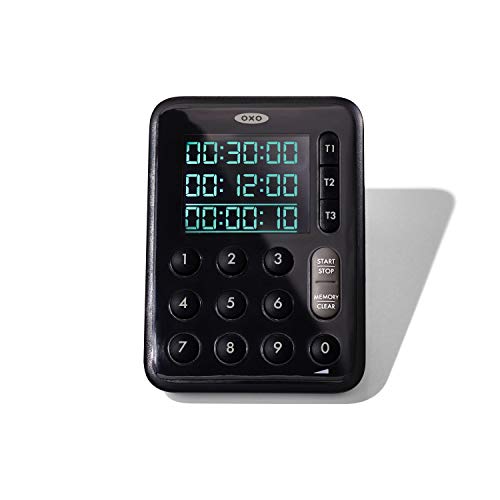
OXO Good Grips Triple Timer
If you often juggle multiple dishes, this timer is a lifesaver. It can run three independent timers simultaneously, each with a distinct alarm tone. The large buttons are easy to press even with wet hands, and the display is clear. It's a bit bulkier, but the functionality is unmatched for multitasking.
In its favor
- Three independent timers
- Distinct alarm tones
- Easy to use with wet hands
- Magnetic back
Watch-outs
- Takes up more space
- Battery life could be better

KitchenAid Classic Analog Timer
For those who prefer a mechanical timer, this KitchenAid model is a classic. It has a 60-minute dial that's easy to turn, and the loud tick is satisfying. No batteries needed, and it's built like a tank. The bell ring is loud enough for most kitchens. It's simple, reliable, and looks great.
In its favor
- No batteries required
- Loud, clear bell
- Classic design
- Very durable
Watch-outs
- Only counts down
- Not as precise as digital
TimeStick Original Kitchen Timer
This timer is a genius design: it's a long stick with a magnetic back that sticks to any metal surface. The display is bright and easy to read from across the room. It has a single button for start/stop and a twist dial for setting time. It's sleek and space-saving. The alarm is loud and clear.
In its favor
- Slim, space-saving design
- Strong magnet
- Easy one-hand operation
- Bright display
Watch-outs
- No multiple timer
- Twist dial can be finicky
Secura 60-Minute Mechanical Timer
If you just need a no-frills timer that works, this is it. It's a simple mechanical timer with a 60-minute dial. The alarm is a loud bell that can be heard throughout the house. It's made of metal and plastic, feels solid, and costs on a budget. No batteries, no fuss. Perfect for basic timing needs.
In its favor
- Very affordable
- No batteries needed
- Loud bell
- Durable construction
Watch-outs
- No count-up or memory
- Not as accurate as digital
What matters most
Digital vs Analog
Digital timers offer precision and features like multiple timers and memory, but require batteries. Analog timers are simpler, more durable, and never need batteries, but they are less accurate and only count down. Choose based on your preference for convenience versus reliability.
Alarm Volume and Tone
A timer is useless if you can't hear it. Look for timers with adjustable volume or multiple tone options. Some have flashing lights for noisy environments. Test the alarm in your kitchen to ensure it cuts through the noise of appliances and running water.
Ease of Use in a Busy Kitchen
You'll often set timers with messy hands. Large buttons, twist dials, or touch screens that work with wet fingers are key. Also consider timers that can be operated with one hand. Magnetic backs or stands allow you to place them where you can see them easily.
Multiple Timer Functionality
If you often cook multiple dishes, a timer with two or three independent timers is a game-changer. Each timer should have a distinct alarm so you know which dish is done. Some digital timers allow you to name timers, which is handy for complex meals.
Durability and Cleaning
Kitchen timers get dropped, splattered, and covered in flour. Look for timers with sealed buttons and a smooth surface that can be wiped clean. Drop resistance is a plus. Avoid timers with crevices that trap food. A strong magnetic back helps keep it in place.
Our take
The best kitchen timer for home is one that you'll actually use consistently. Prioritize a loud alarm and intuitive controls over flashy features. A simple, reliable timer like the ThermoPro TP-25 will serve you better than a complex smart timer that frustrates you.
Frequently asked
The best kitchen timer for home use depends on your needs. For most people, the ThermoPro TP-25 offers the best balance of simplicity, accuracy, and durability. If you need multiple timers, the OXO Good Grips Triple Timer is excellent. For a battery-free option, the KitchenAid Classic Analog Timer is a reliable choice.
Consider the following: digital vs analog, alarm volume, ease of use with wet hands, multiple timer needs, magnetic mounting, and durability. Think about your cooking habits and kitchen environment. A loud alarm is crucial if you have a large kitchen or are often distracted.
Analog timers are generally less accurate than digital ones, with a typical tolerance of +/- 2-5 minutes over an hour. For most cooking tasks like boiling eggs or baking, this is sufficient. However, for precise tasks like steeping tea or timing espresso, a digital timer is better.
Yes, but a dedicated kitchen timer is often more convenient. Phones can be distracting, have small buttons, and may not have loud enough alarms. A physical timer is also easier to use with messy hands and can be placed where you can see it without unlocking your phone.
Key features include: a loud alarm (adjustable volume is a plus), large display, magnetic back or stand, easy-to-clean surface, and multiple timer function if needed. Some timers offer memory recall, count-up mode, and preset buttons for common times.
Update log
- Jun 17, 2026, Refreshed picks and rankings.
- Apr 8, 2026, Initial guide published.
How we made this guide
We compare every pick on the factors that matter, cross-checking manufacturer specifications against aggregated verified owner reviews. We rank independently and never take payment for placement. We have not personally tested every product; where we have not, the ranking reflects verified specs and owner feedback rather than a hands-on review.
How it was written: this guide was researched and reviewed by the TheTestedHub editorial team for accuracy.
Affiliate disclosure: TheTestedHub is reader-supported. When you buy through links on our site, we may earn a commission at no extra cost to you.
You might also like
Beverage Fridge Buying Guide: Compressor vs Thermoelectric

6 Drink Dispensers That Actually Seal Right (2026)

Skip Cheap Whiskers: Get a Real Chasen

Wondering Which Tea Infuser Is Best? Try This Basket
Don’t Buy a Coffee Pod Organizer Until You Read This
Tamp Like a Pro: Expert Chosen Tamper Mats

Coffee Scales for Every Brew, Tested for Daily Use