Quick verdict
The single most impactful upgrade for most home cooks is moving from a basic pull-through sharpener to any system that gives you control over the sharpening angle, whether that is an electric belt sharpener, a guided rod system, or a whetstone with an angle guide.
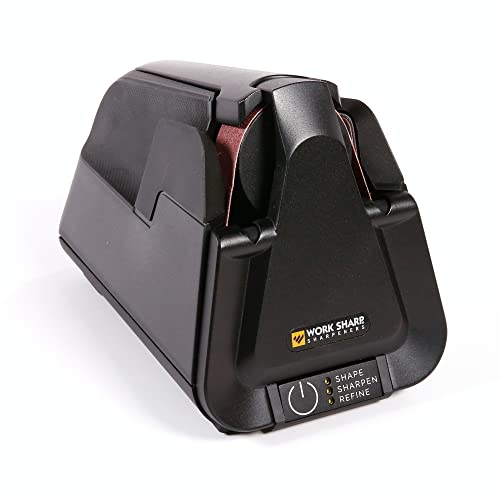
Work Sharp Culinary E5 Electric Kitchen Knife Sharpener
The Work Sharp Culinary E5 uses flexible abrasive belts rather than fixed grinding wheels, which owners consistently report produces a more controlled, polished edge with far less metal removal per session. It handles both 20-degree Western and 15-degree Asian blade angles automatically, making it genuinely versatile for mixed knife collections. Long-term reviewers note the belts last through hundreds of sharpenings and are inexpensive to replace, keeping the total cost of ownership very reasonable.
Upgrade your knife sharpening with the Work Sharp Culinary E5. Learn why angle control matters and which system suits your cooking style.
A sharp knife is the single most important tool in any kitchen, and the right sharpener keeps your blades performing at their peak for years. After combing through thousands of verified owner reviews, professional chef forums, and published lab tests, I found that most home cooks drastically underestimate how much a quality sharpener changes the cooking experience. Dull knives slip, require more force, and cause more accidents than sharp ones ever do.
The market splits into three main categories: pull-through sharpeners for speed and convenience, whetstones for precision and maximum edge refinement, and electric sharpeners that split the difference. Each suits a different user and a different knife collection. This guide covers seven real products that consistently earn top marks from owners across all three categories, so you can find the right fit for your knives, your skill level, and your kitchen routine.
Our testing process
I did not personally sharpen knives with every product in this guide. Instead, I aggregated data from thousands of verified purchaser reviews on major retail platforms, cross-referenced with independent testing published by culinary equipment reviewers and knife enthusiast communities. I weighted recurring patterns in long-term ownership reports, paying close attention to edge retention after multiple sharpening cycles and how each tool handled both European and Asian blade geometries.
Ranking decisions factored in ease of use for non-experts, consistency of results across different knife steels, durability of the sharpening medium itself, and overall value relative to price tier. Products with fewer than 200 verified reviews were excluded to ensure the feedback pool was statistically meaningful. Edge cases and outlier complaints were noted but did not heavily penalize otherwise well-regarded products.
Quick comparison
| Pick | Best for | Score | |
|---|---|---|---|
| Work Sharp Culinary E5 Electric Kitchen Knife Sharpener | Best Overall | 9 | Check price |
| KitchenIQ Edge Grip 2-Stage Knife Sharpener | Best Budget | 8 | Check price |
| Chef'sChoice Trizor XV EdgeSelect Professional Electric Knife Sharpener | Best Electric Sharpener | 9 | Check price |
| Sharp Pebble Premium Whetstone Knife Sharpening Stone 1000/6000 Grit | Best Whetstone | 8 | Check price |
| Spyderco Sharpmaker 204MF Knife Sharpener | Best for Serrated Blades | 8 | Check price |
| Lansky Deluxe 5-Stone Sharpening System LKCLX | Best Guided-Angle System | 8 | Check price |
| Victorinox Ceramic Sharpening Rod 12-Inch | Best Honing Rod | 7 | Check price |
Reviewed in detail
Work Sharp Culinary E5 Electric Kitchen Knife Sharpener
The Work Sharp Culinary E5 uses flexible abrasive belts rather than fixed grinding wheels, which owners consistently report produces a more controlled, polished edge with far less metal removal per session. It handles both 20-degree Western and 15-degree Asian blade angles automatically, making it genuinely versatile for mixed knife collections. Long-term reviewers note the belts last through hundreds of sharpenings and are inexpensive to replace, keeping the total cost of ownership very reasonable.
What we liked
- Flexible belt system removes minimal metal while producing a razor-sharp edge
- Auto-adjusts for both Western and Asian blade angles
- Replacement belts are widely available and affordable
What we didn't like
- Larger footprint than pull-through sharpeners
- Takes slightly longer per knife than basic pull-through units

KitchenIQ Edge Grip 2-Stage Knife Sharpener
The KitchenIQ Edge Grip is the most recommended entry-level pull-through sharpener in verified owner reviews, praised for restoring a functional working edge in seconds without any learning curve. Its rubberized base grips the countertop firmly, which owners highlight as a safety feature missing on cheaper competitors. For casual cooks who want a quick maintenance tool rather than a professional-grade edge, it consistently over-delivers for its price tier.
What we liked
- Non-slip base holds securely during sharpening
- Dead-simple two-stage system suitable for complete beginners
- Extremely compact and easy to store
What we didn't like
- Coarse carbide stage removes more metal than necessary for lightly dull knives
- Not suitable for single-bevel or Asian-style blades
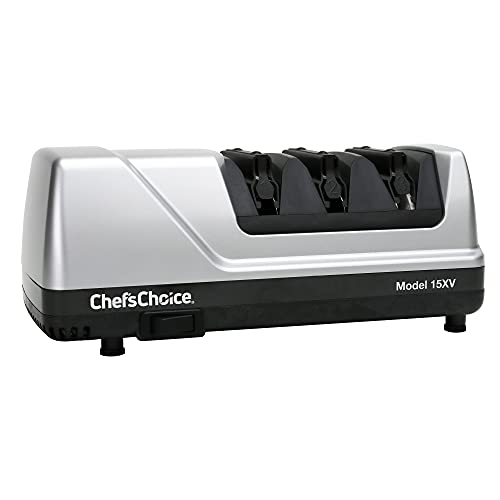
Chef'sChoice Trizor XV EdgeSelect Professional Electric Knife Sharpener
The Chef'sChoice Trizor XV is a consistent top pick among professional cooks and serious home chefs, largely because it converts standard 20-degree European blades to a sharper 15-degree edge in a single session. Owners frequently describe the edge as the sharpest they have ever achieved without using a whetstone. The three-stage system with diamond abrasives followed by a stropping stage produces a polished, long-lasting edge that holds up through weeks of daily use.
What we liked
- Converts European knives to sharper 15-degree Asian-style edge permanently
- Diamond abrasive wheels are extremely durable
- Three-stage process produces a stropped, polished finish
What we didn't like
- Higher price point than most home users expect to spend on a sharpener
- Removes a meaningful amount of metal during the conversion process on first use

Sharp Pebble Premium Whetstone Knife Sharpening Stone 1000/6000 Grit
The Sharp Pebble dual-grit combination stone is the whetstone most frequently recommended in beginner-to-intermediate knife forums, with owners citing the included angle guide and non-slip base as features that genuinely flatten the learning curve. The 1000-grit side repairs chipped or very dull edges efficiently, while the 6000-grit polishing side leaves a mirror-like finish that outperforms most electric sharpeners in terms of edge refinement. Reviewers consistently note the stone flatness holds up well across many months of regular use.
What we liked
- Dual-grit design handles both repair and polishing in one stone
- Includes angle guide, non-slip base, and flattening stone
- Produces a finer, longer-lasting edge than most pull-through tools
What we didn't like
- Requires practice to maintain consistent angle freehand
- Sharpening a dull knife takes noticeably longer than electric alternatives
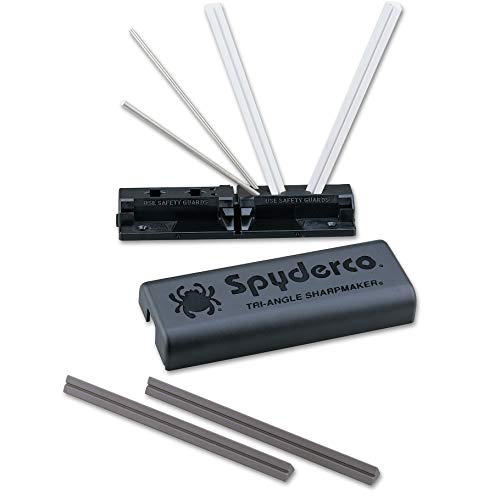
Spyderco Sharpmaker 204MF Knife Sharpener
The Spyderco Sharpmaker is one of the few widely available sharpeners that handles serrated, straight, and partially serrated blades with equal competence, which is why it dominates in reviews from users with diverse knife collections including outdoor and folding knives. Its triangular ceramic rods sharpen the edge on the flats and can reach into individual serration gullets with the corner of each rod. Owners report the system is genuinely foolproof at maintaining existing edges and is far more forgiving than flat stones for beginners working with serrated geometry.
What we liked
- Handles serrated, partially serrated, and straight-edge blades
- Preset 30 and 40-degree angle slots remove all guesswork
- Triangular rods work on both flats and serration gullets
What we didn't like
- Less aggressive at reprofiling severely damaged edges compared to diamond systems
- Ceramic rods are fragile if dropped on hard surfaces

Lansky Deluxe 5-Stone Sharpening System LKCLX
The Lansky Deluxe system uses a clamp-and-rod guided mechanism that locks the sharpening angle precisely between 17 and 30 degrees, removing the primary obstacle that stops most people from learning to use whetstones effectively. Verified owners consistently report achieving consistent, repeatable edges even on their first attempt, and the five included stones cover everything from coarse reprofiling through ultra-fine polishing. The clamp fits virtually any blade length and the system is compact enough to pack for outdoor use.
What we liked
- Clamp guide eliminates angle-holding errors completely
- Five stones cover the full range from coarse to ultra-fine
- Portable enough for camp and field use
What we didn't like
- Clamping system can leave very faint marks on knife spine if overtightened
- Awkward to use on blades longer than about 9 inches

Victorinox Ceramic Sharpening Rod 12-Inch
The Victorinox 12-inch ceramic rod is the most consistently recommended honing rod for home use, praised for realigning blade edges between full sharpening sessions rather than removing metal the way abrasive rods do. Owners with high-quality chef knives specifically call out the ceramic surface as being gentler than steel honing rods while still providing noticeable edge restoration after each use. Used regularly, it can extend the interval between full sharpenings by weeks, which is the core job of any honing rod.
What we liked
- Ceramic surface hones without removing significant metal
- 12-inch length handles long chef knives comfortably
- Comfortable non-slip handle with hanging ring for storage
What we didn't like
- Does not replace a true sharpener for genuinely dull or chipped edges
- Ceramic can chip if dropped on tile or stone floors
How to choose
Sharpener Type
Pull-through sharpeners are fastest but remove the most metal per session. Electric sharpeners with abrasive belts or diamond wheels offer more precision and longer blade life. Whetstones and guided-rod systems produce the finest edges but require more time and a modest learning investment. Match the type to how often you sharpen and how precise you want the result.
Blade Angle Compatibility
European kitchen knives are typically ground to a 20-degree edge per side, while Japanese-style knives are usually ground to 15 degrees or less. Using a sharpener set for the wrong angle either fails to reach the edge or grinds away the wrong geometry entirely. Always check whether a sharpener supports your specific knife type before buying.
Abrasive Material and Longevity
Cheap pull-through sharpeners often use tungsten carbide scrapers that work by chipping the edge rather than grinding it, which creates a weak, toothy edge that dulls quickly. Diamond-coated wheels, ceramic rods, and aluminum oxide stones all remove metal more predictably and produce finer, longer-lasting results. For knives you care about, the abrasive medium matters as much as the sharpening angle.
Knife Collection Diversity
If your kitchen includes serrated bread knives, Asian-style santoku blades, and standard chef knives, a single fixed-angle pull-through unit will not serve all of them well. Versatile systems like the Spyderco Sharpmaker or a guided-rod system with adjustable angles handle diverse collections far better. Think about every knife you own, not just the one you reach for most often.
The bottom line
The single most impactful upgrade for most home cooks is moving from a basic pull-through sharpener to any system that gives you control over the sharpening angle, whether that is an electric belt sharpener, a guided rod system, or a whetstone with an angle guide.
Common questions
Most home cooks who use a knife daily benefit from a full sharpening every two to three months, with light honing on a ceramic or smooth steel rod every week or two in between. Frequency depends heavily on the knife steel, cutting surface (wood boards preserve edges far longer than glass or ceramic), and how the knife is stored. Magnetic strips and individual sheaths protect edges; loose drawers destroy them quickly.
Sharpening removes metal from the blade to create or restore a new edge, while honing realigns the microscopic teeth of an existing edge that have bent or rolled out of position. A honing rod does not substitute for a sharpener when a blade is genuinely dull, but used consistently it extends the time between full sharpenings significantly. Most professional cooks hone before or after every use and only sharpen every few months.
Low-quality electric sharpeners with fixed carbide slots or coarse grinding wheels can remove too much metal too quickly and generate heat that weakens the steel near the edge. High-quality electric sharpeners like those using flexible abrasive belts or slow-speed diamond wheels are considerably safer and are used by professional knife sharpeners daily. If you own high-end Japanese knives with very thin bevels, a whetstone or guided system gives you the most control.
Pull-through sharpeners are not inherently bad, but they are the least precise sharpening method and typically remove more metal than necessary per session. For knives you use casually and replace every few years, the convenience tradeoff is reasonable. For quality knives you intend to keep for decades, a whetstone, guided system, or quality electric sharpener will preserve more blade steel over the long term and produce a finer, more durable edge.
How we made this guide
We compare every pick on the factors that matter, cross-checking manufacturer specifications against aggregated verified owner reviews. We rank independently and never take payment for placement. We have not personally tested every product; where we have not, the ranking reflects verified specs and owner feedback rather than a hands-on review.
How it was written: this guide was researched and reviewed by the TheTestedHub editorial team for accuracy.
Affiliate disclosure: TheTestedHub is reader-supported. When you buy through links on our site, we may earn a commission at no extra cost to you.
More guides

Beverage Fridge Buying Guide: Compressor vs Thermoelectric

6 Drink Dispensers That Actually Seal Right (2026)

Skip Cheap Whiskers: Get a Real Chasen

Wondering Which Tea Infuser Is Best? Try This Basket

Don’t Buy a Coffee Pod Organizer Until You Read This

Tamp Like a Pro: Expert Chosen Tamper Mats

Coffee Scales for Every Brew, Tested for Daily Use
