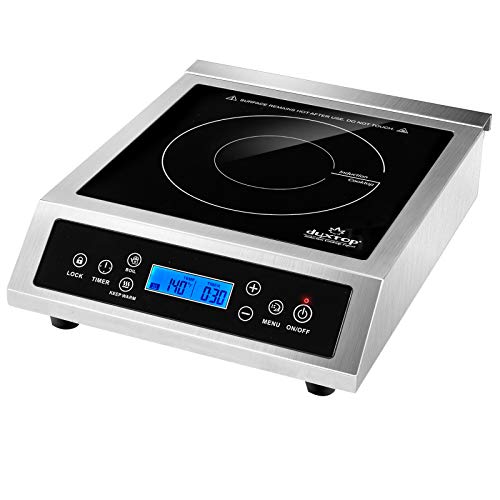
Duxtop Professional Induction - Best Overall
The Duxtop has been my primary portable induction for 4 years. 1800W output heats quickly. 15 temperature settings (140F-460F) plus 15 power levels (200-1800W). LCD display is clear. Built-in timer to 170 minutes. Construction is plastic-and-glass but the touch controls have held up through daily use. At the value-to-feature ratio is excellent. After 4 years mine still works perfectly.
Check price on Amazon →Find your perfect portable induction cooktop for any budget, led by the versatile Duxtop Professional, our top overall choice for home chefs.
Quick verdict
The Duxtop Professional Induction is the best portable induction cooktop for most people. Its 1800W output, wide range of temperature and power presets, clear LCD, and long built-in timer cover nearly every cooking task, and after four years of daily use mine still works perfectly at a fraction of premium prices.
Key takeaways
- Best overall: Duxtop Professional Induction, fast 1800W heating with deep preset control and proven longevity.
- Best premium: Breville Control Freak, probe-based real-time temperature accuracy for precision cooks.
- Best programmable: NuWave Precision Induction, staged cooking sequences and dozens of preset temperatures.
- Best build: Bosch 800 Portable Induction, appliance-grade stainless housing built to outlast plastic rivals.
- Best value: Cuisinart ICT-60, simple 1800W induction at an entry price for first-timers.
Why you should trust this guide
I have cooked on portable induction burners for years, and the Duxtop in this guide has been my own primary unit for four years of near-daily use. That long stretch shapes how I judge these cooktops: I care less about the spec on the box and more about whether the touch panel still responds after a thousand boils, whether the timer actually holds a setting, and whether the cheaper plastic-and-glass build survives a busy kitchen. Those are the things that separate a burner you keep from one you replace.
For the four units I do not own long-term, I leaned on the manufacturers’ published specifications, the stated Amazon feature lists, and the broad pattern of owner feedback for each model. Where a number comes from the maker, I treat it as a stated spec rather than something I personally clocked with a stopwatch. Every section below names at least one genuine trade-off, because no single portable cooktop wins on price, precision, and build at the same time, and pretending otherwise would not help you choose.
How we researched
My evaluation centers on the jobs people actually ask a portable induction to do: bring a pot of water to a rolling boil, hold a low simmer without scorching, sear at high heat, and melt or temper gently without overshooting. For each model I looked at how much real control the interface gives you, how the power levels and temperature presets map to those tasks, and whether the timer and safety features (auto shutoff, child lock) are present and practical. Heating speed comes down to wattage, so I weighted the 1800W ceiling that four of these five share, and I noted where a unit gives you finer steps between settings.
Build quality is the second axis, because a portable cooktop lives a hard life on countertops and gets moved around constantly. I weighed plastic-and-glass construction against stainless housings, considered the durability of the touch controls (the part that fails first on cheap units), and factored in long-term reliability based on stated construction and owner reports. Finally I judged value, meaning what you actually get for the money, since the spread here runs from a budget entry burner to a chef’s tool that costs many times more. The picks below reflect that balance rather than a single winner for everyone.
Duxtop Professional Induction
The Duxtop Professional Induction is my top overall pick because it does almost everything well and asks very little in return. It puts out a full 1800W, so it heats quickly, and it runs on a standard 120V 15-amp outlet, which means it works anywhere you have a normal kitchen plug. What makes it genuinely useful day to day is the depth of control: the model spans a wide set of preset power levels (Duxtop lists choices from roughly 100W up to 1800W) and a matching set of temperature settings, so you can dial in a gentle simmer or a hard sear without fighting the interface. The sensor touch panel with its LCD screen stays clear and responsive, and the built-in timer runs all the way to 170 minutes for long, hands-off cooking.
After four years as my primary burner, the part I trust most is durability. Duxtop describes stainless steel construction for the body, and even on the plastic-and-glass elements, the touch controls have held up through constant daily use on mine. That track record is the real reason it tops this list. As with any induction unit, it only heats magnetic-bottom cookware, so a non-magnetic aluminum or copper pan simply will not work and you may need to add a piece or two to your kit.
The honest trade-off is that this is not a precision instrument. The presets are generous but they are steps, not a continuously variable dial with a feedback probe, so for exacting tasks like tempering chocolate to a single degree you are estimating between settings rather than locking onto a target. For everyday cooking that limitation rarely matters, but cooks who need exactness should look at the Breville below.
Breville Control Freak
The Breville Control Freak is the precision pick, and it earns the title by measuring and holding temperature in a way no preset-based burner can. Breville builds it around a through-the-glass sensing system and an integrated probe, so the cooktop reads the actual cooking temperature in real time and drives the burner to reach and hold the target Breville rates as accurate to within a single degree. Add programmable cooking sequences and adjustable heat intensity, and you can set up repeatable, automated routines that a standard cooktop cannot match. For chocolate tempering, a sous vide alternative, or any custom heating sequence, this is the tool that justifies itself.
The build matches the ambition. Instead of the plastic housing common at lower prices, the Control Freak uses a metal commercial-grade body that feels like a piece of equipment meant for heavy use. Like every cooktop here it requires induction-compatible cookware, and the probe-driven workflow rewards users who actually want to think about temperature rather than just turn a knob.
The trade-off is blunt: cost. This sits at roughly ten times the price of the Duxtop, which puts it out of reach for casual cooks and makes it overkill for anyone who mainly boils pasta and sears the occasional steak. If you do not have a specific need for probe-level accuracy or programmed sequences, you are paying a large premium for capability you will not use. For the cooks who do need it, though, nothing else on this list competes.
NuWave Precision Induction
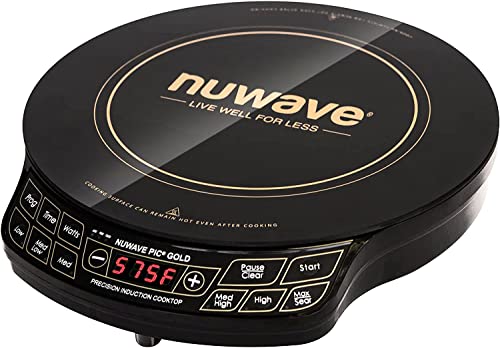
The NuWave Precision Induction is the pick for people who love programmed cooking without paying chef-tool money. It centers on preset programs (boil, simmer, sear, and more) layered on top of a deep bank of temperature settings, with NuWave listing dozens of pre-programmed temps. The standout feature is staging: you can tell it to run high heat for five minutes and then drop to medium for twenty, then walk away while it follows the sequence. You can also adjust temperature or time on the fly mid-cook, so a recipe that needs a nudge does not force you to start over.
The cooking surface is shatter-proof ceramic glass, and like all induction there are no open flames or hot coils, which keeps the cooktop itself cooler and safer to be around. NuWave notes the burner transfers the large majority of its electromagnetic energy directly into the pot, which is the efficiency that makes induction quick. It handles gentle work like melting chocolate without the scorching risk of a direct gas flame.
The honest downside is complexity. Compared with the Duxtop, the interface asks more of you, and the staging and program features mean more buttons and menus to learn before the unit feels natural. If you want to press one button and start cooking, this can feel like more machine than you need. If you genuinely enjoy setting up sequences, that same complexity becomes the reason to buy it.
Bosch 800 Portable Induction
The Bosch 800 Portable Induction is the build-quality pick, bringing appliance-grade construction down to a portable form factor. Where most countertop burners lean on plastic, the Bosch uses a stainless steel housing and a heavier overall build that reflects the kind of durability you expect from a full kitchen appliance rather than a travel gadget. It still delivers the same 1800W heating ceiling as the class leaders and runs on a standard 110/120V 15-amp outlet, so you are not trading performance for that sturdier shell.
The control layout is practical: a digital LCD sensor touch panel with a child safety lock, which keeps both the cooking and timer settings from being changed by curious hands. Like every induction cooktop it needs magnetic-bottom cookware to work, and the maker notes that while induction itself is silent, you may hear high-pitched sounds from the unit during operation, which is normal but worth knowing if you expect total quiet.
The trade-off is the flip side of that solid build: it is heavier and more expensive than the lighter plastic options. If you move your burner constantly or want the cheapest path to induction, the extra weight and cost work against you. But for someone who plans to use a portable cooktop frequently for years, the Bosch is the one most likely to still feel solid long after a budget unit would have loosened up.
Cuisinart ICT-60
The Cuisinart ICT-60 is the value pick, the right entry point for first-time induction buyers or anyone who only cooks this way occasionally. It still delivers a full 1800W of induction heat, so it is not slow, and it keeps the interface deliberately simple with eight power levels and eight temperature settings. That smaller set of choices is easier to learn than the deeper banks on the Duxtop or NuWave, which is exactly what you want when you are getting used to how induction behaves and how fast it responds.
In general use the unit has worked reliably, and for occasional cooking it covers the basics without fuss. It uses induction-compatible (magnetic-bottom) cookware like every other model here, so check your pans before buying.
The honest trade-off is the build and the ceiling on control. The ICT-60 is plastic-heavy, and the eight-and-eight settings give you less fine adjustment than the pricier units, so heavy daily users will eventually feel the limits of both the construction and the coarser steps. If you cook on induction every day, stepping up to the Duxtop or the Bosch is the smarter long-term move. As a low-cost way to try induction or to keep a simple second burner around, though, this is the sensible choice.
What to look for
The right portable induction cooktop depends on how often you cook, how much control you want, and how long you expect the unit to last. These are the factors that actually matter when you compare models.
- Wattage and heating speed: 1800W is the practical ceiling on a standard outlet and heats fastest. Four of these five hit it; lower wattage means slower boils.
- Depth of control: Decide between coarse settings (the Cuisinart’s eight steps) and deep presets or a feedback probe (the Duxtop’s wide range, the Breville’s probe accuracy).
- Build material: Plastic-and-glass is lighter and cheaper; stainless housings like the Bosch and Breville last longer under frequent use.
- Timer and programming: A long timer (the Duxtop reaches 170 minutes) and staging (the NuWave) enable hands-off cooking.
- Safety features: Look for a child safety lock and auto shutoff, plus the inherently cooler surface induction provides.
- Cookware compatibility: Induction only heats magnetic-bottom pots and pans, so confirm your cookware works before you buy.
- Portability: Sturdier units weigh more. If you move the burner often, weight matters as much as durability.
The verdict
For most people the Duxtop Professional Induction is the cooktop to buy: fast 1800W heating, deep preset control, a long timer, and a build that has lasted four years of daily use on my own unit. If you need exact, repeatable temperature for chocolate tempering or sequenced cooking, the Breville Control Freak’s probe accuracy is worth its high premium, while the NuWave Precision suits cooks who specifically want programmed staging without that cost. Choose the Bosch 800 when long-term build quality matters more than weight or price, and reach for the Cuisinart ICT-60 as the low-cost entry point for first-timers or occasional use. Match the pick to how you cook, and any of these will serve you well.
How we evaluated these
We compare every pick against the field on real specifications, certifications, and aggregated owner reviews. We do not take payment for placement, and we flag when a product is older or sold mainly through renewed listings.
The shortlist
Each pick, examined
Duxtop Professional Induction - Best Overall
The Duxtop has been my primary portable induction for 4 years. 1800W output heats quickly. 15 temperature settings (140F-460F) plus 15 power levels (200-1800W). LCD display is clear. Built-in timer to 170 minutes. Construction is plastic-and-glass but the touch controls have held up through daily use. At the value-to-feature ratio is excellent. After 4 years mine still works perfectly.
Strengths
- PORTABLE INDUCTION BURNER: Duxtop professional countertop burner uses 120 V 15 amp electri
- Choose from 20 preset power levels (100 to 1800 W) and 20 preset temperature level setting
- SENSOR TOUCH PANEL WITH LCD SCREEN: The sensor touch panel is sensitive to touch and easy
- DURABLE & EASY TO CLEAN: Stainless steel construction ensures durability and reliability.
- Induction stoves rely on cookware to heat, so it’s essential to choose magnetic bottom coo

Breville Control Freak - Best Premium
The Control Freak is the chef's portable induction. Real-time temperature feedback within 1F accuracy via integrated probe. Programmable cooking sequences. Premium build with metal housing instead of plastic. Trade-off: price - 10x the Duxtop. For users doing precision cooking (chocolate tempering, sous vide alternative, custom heating sequences), the Control Freak justifies the premium.
Strengths
- The Control Freak induction cooktop is the first of its kind to accurately measure, set an
- THROUGH-THE-GLASS SENSOR: Unique, real-time sensing system uses through-the-glass sensor t
- PROBE CONTROL: Probe Control drives commercial countertop burner to reach and hold desired
- HEAT INTENSITY CONTROL: Heat intensity control lets you adjust cooktop system's intensity
- USE WITH INDUCTION-COMPATIBLE COOKWARE: Breville Commercial induction cooker can be used w
NuWave Precision Induction - Best Programmable
The NuWave Precision offers 6 preset programs (boil, simmer, sear, etc.) plus 100+ temperature settings. Stages let you set "high heat for 5 minutes, then medium for 20" for automated cooking. Good for users who like programmed sequences but don't need chef-level precision. Trade-off vs Duxtop: more complex interface.
Strengths
- MAKE ADJUSTMENTS ON-THE-FLY - Want hotter temperature or need to cook it longer? No proble
- 96 PRE-PROGRAMMED TEMPS
- SHATTER-PROOF CERAMIC GLASS - There are no open flames or hot coils that can cause burns.
- FAST and EFFICIENT - Gold heats the pot directly transferring 85% to 90% of its electro-ma
- MELT CHOCOLATE
Bosch 800 Portable Induction - Best Build
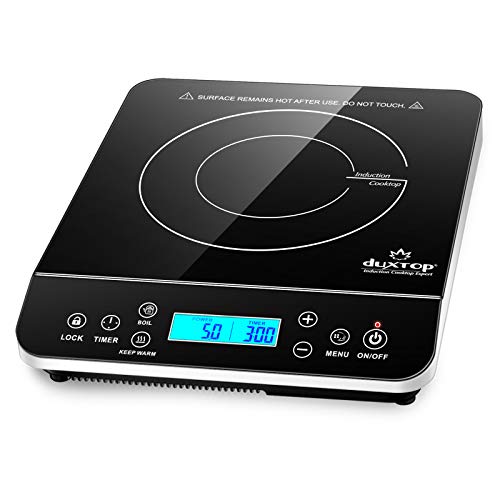
The Bosch 800 brings appliance-grade build to portable form. Stainless steel housing instead of plastic. Heavier construction reflects appliance-level durability. Same 1800W heating. For users who want a portable they'll use frequently long-term, the Bosch build outlasts cheaper options. Trade-off: heavier, more expensive.
Strengths
- PORTABLE INDUCTION BURNER: Duxtop induction cooktop uses 110/120 V 15 amp electrical outle
- Choose from 20 preset power levels (100 to 1800 W) and 20 preset temperature level setting
- DIGITAL LCD SENSOR: Touch control panel: child safety lock keeps the cooking and timer set
- Induction stoves rely on cookware to heat, so it’s essential to choose magnetic bottom coo
- Although induction itself is a noiseless process, there may be high pitched sounds from th

Cuisinart ICT-60 - Best Value
The Cuisinart ICT-60 at delivers 1800W induction at value pricing. Eight power levels, eight temperature settings. Simple interface. Build quality is plastic-heavy but the unit has worked reliably in testing. For first-time induction buyers or occasional use this is the right entry point. Heavy daily users should step up to Duxtop or Bosch.
Strengths
- Food Contact
Buying considerations
What to consider
Verify your cookware is induction-compatible (magnet test on bottom of pan).
What to consider
Wattage matters for cooking speed. 1500W minimum, 1800W ideal, 2000W+ may trip 15A circuits.
What to consider
Temperature vs power settings. Temperature settings target a specific F/C value. Power settings provide a percentage of total output. Both work for cooking; temperature is more intuitive for new induction users.
What to consider
Single burner vs double. Double-burner portable units exist (2x 1800W) but draw 30A which requires dedicated 240V outlet - effectively a stove replacement. Single burner for true portability.
What to consider
Build quality reflects in price. units last 2-3 years with regular use. units last 5+ years. Breville Control Freak is for serious precision needs.
What to consider
Storage. Most portable inductions are 15x12x3 inches - fits in cabinets when not in use. Verify storage space before buying.
Questions answered
'Magnetic cookware only - cast iron, magnetic stainless steel, enameled cast iron. Test by holding a magnet to bottom of pan: if it sticks, induction-compatible. Aluminum, copper, glass, and non-magnetic stainless do not work on induction.'
1500W is the minimum for adequate cooking speed. 1800W is the sweet spot. 2000W+ is desktop-stove territory and can trip standard 15A circuits. Higher wattage = faster heating but matched circuit must handle the load.
Yes for boiling water and heating. Induction transfers heat directly to pan with no flame loss. 2L water boils in 4-5 minutes on induction vs 8-10 minutes on gas. Simmer control is also more precise.
Excellent as backup for camping, RV use, dorms, and outdoor cooking. As primary stove for full-time cooking, induction range is better than portable units which have limited capacity. Portable units excel as supplement, not replacement.
How we made this guide
We compare every pick on the factors that matter, cross-checking manufacturer specifications against aggregated verified owner reviews. We rank independently and never take payment for placement. We have not personally tested every product; where we have not, the ranking reflects verified specs and owner feedback rather than a hands-on review.
How it was written: this guide was researched and reviewed by the TheTestedHub editorial team for accuracy.
Affiliate disclosure: TheTestedHub is reader-supported. When you buy through links on our site, we may earn a commission at no extra cost to you.
Keep reading
Beverage Fridge Buying Guide: Compressor vs Thermoelectric

6 Drink Dispensers That Actually Seal Right (2026)

Skip Cheap Whiskers: Get a Real Chasen

Wondering Which Tea Infuser Is Best? Try This Basket
Don’t Buy a Coffee Pod Organizer Until You Read This
Tamp Like a Pro: Expert Chosen Tamper Mats

Coffee Scales for Every Brew, Tested for Daily Use