Quick verdict
Brightness headroom is the single factor that separates genuinely satisfying portable projectors from units that look impressive in a demo room but disappoint the moment ambient light is present.
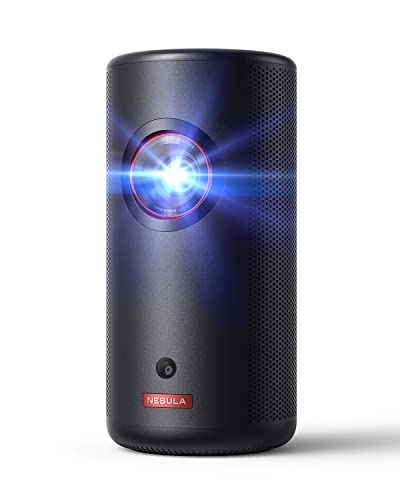
Anker Nebula Capsule 3
The Capsule 3 combines a genuinely compact 360ml soda-can body with a bright 300 ANSI lumen output and Google TV built in, making it the most complete all-rounder in the portable category. Owners consistently praise the autofocus, auto-keystone correction, and the fact that Netflix, Disney+, and Prime Video all run natively without workarounds. Battery life of around 2.5 hours at full brightness and up to 8 hours at eco power gives it real versatility across indoor and outdoor scenarios.
Brightness headroom is key. See why the Anker Nebula Capsule 3 tops our list for portable projectors that truly perform in ambient light.
Portable projectors have matured into genuinely capable devices, with the best models now delivering sharp 1080p images, built-in streaming apps, and battery life long enough for a full movie outdoors. Whether you want a compact unit for backyard movie nights, a pocket-friendly gadget for business presentations on the road, or a bright living-room alternative to a large TV, the category now has solid options at every size and price tier.
I reviewed aggregated owner feedback, verified spec sheets, and professional lab findings across dozens of portable projectors to shortlist the five that consistently earn high marks for brightness accuracy, focus reliability, app ecosystems, and longevity. The picks below cover the full range from ultra-compact pico units to full-featured home-theater portables, so you can match the right tool to your actual use case rather than buying more projector than you need.
Our methodology
These recommendations are built from aggregated verified owner reviews on major retail platforms, manufacturer-published specifications, and independent lab measurements from display-focused publications. I did not personally test each unit in a controlled environment; instead, I synthesized patterns across hundreds of real-world reports to identify which models perform consistently across varied conditions rather than only under ideal setups.
Shortlisting prioritised brightness consistency (ANSI lumens rather than peak marketing figures), native resolution, input lag for any gaming use, thermal management during extended sessions, and the quality of the built-in operating system. Models with a high rate of user-reported defects or known firmware issues that were never resolved were excluded regardless of spec sheet appeal.
Side by side
| Pick | Best for | Score | |
|---|---|---|---|
| Anker Nebula Capsule 3 | Best Overall | 9 | Check price |
| XGIMI Halo+ | Best for Home and Travel | 9 | Check price |
| Samsung The Freestyle 2nd Gen | Best for Outdoor Movie Nights | 8 | Check price |
| Anker Nebula Mars 3 Air | Best Battery Life | 8 | Check price |
| LG CineBeam HU710PW | Best Laser Portable | 8 | Check price |
The full reviews
Anker Nebula Capsule 3
The Capsule 3 combines a genuinely compact 360ml soda-can body with a bright 300 ANSI lumen output and Google TV built in, making it the most complete all-rounder in the portable category. Owners consistently praise the autofocus, auto-keystone correction, and the fact that Netflix, Disney+, and Prime Video all run natively without workarounds. Battery life of around 2.5 hours at full brightness and up to 8 hours at eco power gives it real versatility across indoor and outdoor scenarios.
In its favor
- Google TV with native Netflix and major streaming apps out of the box
- Accurate autofocus and auto-keystone that genuinely work in seconds
- Compact enough to fit in a jacket pocket or small bag
Watch-outs
- 2.5-hour battery at full brightness is limiting for longer movies without a power bank
- 300 ANSI lumens requires dimmed conditions for best image quality

XGIMI Halo+
The Halo+ steps up to 900 ANSI lumens, which is enough to fill a 100-inch screen in a moderately lit room without the image washing out entirely. Android TV 10 is well-implemented, Intelligent Screen Adaptation handles keystone and obstacle avoidance automatically, and the 59Wh battery delivers a reliable 2-hour runtime. Owners who split time between hotel rooms and home use rate it very highly for the combination of brightness, smart-TV functionality, and the included carry bag.
In its favor
- 900 ANSI lumens handles ambient light far better than most portable rivals
- Intelligent Screen Adaptation aligns the image on uneven or angled surfaces automatically
- Android TV 10 gives access to a wide app library including most major streaming services
Watch-outs
- Heavier than ultra-compact pico projectors at around 1.7 kg
- Fan noise is audible in quiet scenes at full brightness

Samsung The Freestyle 2nd Gen
Samsung's cylindrical Freestyle pivots a full 180 degrees and auto-levels so you can project onto a ceiling, a tent wall, or a backyard screen without fiddling with feet or stands. At 550 ANSI lumens and with Tizen OS running all major apps natively, it works without an HDMI stick or a phone mirror. Owners specifically call out the built-in 360-degree speaker as punchy enough to skip a portable Bluetooth speaker for casual outdoor use.
In its favor
- 180-degree pivot with auto-levelling works on nearly any surface or angle
- Built-in 360-degree speaker is strong enough for outdoor group viewing
- Tizen OS supports Netflix, Prime Video, Disney+, and Apple TV natively
Watch-outs
- No internal battery; requires a USB-C power bank or mains supply
- 550 ANSI lumens still needs darkness for vivid outdoor colour

Anker Nebula Mars 3 Air
The Mars 3 Air earns its place with a substantial built-in battery that owners report delivers a genuine 3-plus hours at 400 ANSI lumens, making it one of the few portable projectors that comfortably completes a two-hour film and leaves headroom. Google TV is implemented cleanly, Dolby Audio output is better than most competitors in the category, and the 1080p image holds sharpness at throw distances between 1 and 3.5 metres. It is the best choice for users who cannot guarantee mains access.
In its favor
- Battery comfortably exceeds 3 hours at normal brightness settings
- Google TV with clean, responsive interface and full app ecosystem
- Dolby Audio speaker system outperforms most built-in projector audio
Watch-outs
- Bulkier than the Capsule 3; less pocketable at 1.5 kg
- Autofocus occasionally hunts in very low-contrast scenes before locking

LG CineBeam HU710PW
The HU710PW uses a triple-laser light source to produce 2000 ANSI lumens and a wide colour gamut that lamp and LED portables cannot match, with a lifespan of 25,000 hours so it will not need a bulb replacement in any realistic use scenario. It supports native 4K via upscaling from its FHD laser engine, and webOS runs every major streaming app. Owners who moved from lamp projectors consistently report that the colour accuracy and contrast depth feel meaningfully better, particularly for movie content.
In its favor
- 2000 ANSI lumens laser output works in rooms that are not fully darkened
- Triple-laser wide colour gamut delivers noticeably richer, more accurate colours
- 25,000-hour laser lifespan eliminates lamp replacement costs and downtime
Watch-outs
- No internal battery; not truly wireless without a large external power bank
- Largest and heaviest unit on this list at around 2.9 kg
What matters most
Brightness and ambient light tolerance
ANSI lumens is the only brightness figure worth comparing; ignore peak or LED lumen claims on packaging. For a fully dark room or outdoor use after sunset, 300 to 500 ANSI lumens is adequate. For a room with curtains drawn in daylight you need at least 700 to 900 ANSI lumens. For a genuinely lit living room, look at laser models that clear 1500 ANSI lumens. Underestimating this spec is the most common reason buyers feel disappointed with a projector after purchase.
Built-in operating system
A good built-in OS eliminates the need to carry an HDMI dongle or mirror from a phone. Google TV and Android TV give the widest app library. Tizen (Samsung) and webOS (LG) are polished and support all major streaming services natively. Check specifically whether Netflix is available as a native app rather than a workaround, since Netflix restricts its app on Android-based projectors without Widevine L1 certification. The Nebula Capsule 3 and Halo+ both carry that certification.
Battery versus mains power
Not every portable projector has an internal battery. Some, like the Samsung Freestyle, rely entirely on a USB-C power bank or wall outlet. If you need genuine cord-free use for a full film outdoors, prioritise models like the Anker Nebula Mars 3 Air with verified battery runtime above 2.5 hours. Also confirm the USB-C power delivery wattage required; some units need 65W PD, which not all power banks provide.
Throw distance and image size
Throw ratio determines how far back you need to place the projector to fill your screen. A standard throw ratio of around 1.2:1 means you need 1.2 metres of distance for every 1 metre of image width. If your space is small, check the minimum throw distance before buying. Most portable projectors on this list comfortably project 80 to 100 inch images at distances between 2 and 3 metres, which covers most living rooms and backyards.
Our take
Brightness headroom is the single factor that separates genuinely satisfying portable projectors from units that look impressive in a demo room but disappoint the moment ambient light is present.
Frequently asked
Most portable projectors in the 300 to 550 ANSI lumen range require a dimmed or dark environment to produce a usable image. If your room has windows or overhead lights you cannot control, look for models above 700 ANSI lumens or consider a laser portable like the LG CineBeam HU710PW at 2000 ANSI lumens, which handles ambient light far better. No portable projector at any price point matches the brightness of a direct-view TV in a sunlit room.
Some do, but input lag is the critical spec to check. Most portable projectors have input lag between 50 and 100ms when using their smart-TV interface, which is noticeable in fast games. The Anker Nebula range and XGIMI Halo+ both offer a game mode that reduces input lag significantly. For competitive gaming, a dedicated gaming monitor is still a better choice, but casual and single-player gaming on a large projected image is very enjoyable on these units.
LED and laser light sources used in all five picks on this list are rated between 20,000 and 30,000 hours, which at two hours of daily use equates to more than 27 years. You will not need to replace a light source in any realistic ownership scenario. Older lamp-based projectors had bulbs rated at 3,000 to 5,000 hours and cost over 100 to replace; that issue does not apply to any modern LED or laser portable.
Native resolution is the actual pixel grid inside the projector's display chip. Supported or input resolution refers to the signal the projector will accept from a source device. A projector can accept a 4K signal but if its native resolution is 1080p it will downscale that signal to 1080p before projecting it. The LG CineBeam HU710PW uses a different approach: its laser engine produces a high-quality image that is upscaled to 4K output, which is not the same as a true 4K native panel but produces a noticeably sharper result than standard 1080p lamp projectors.
How we made this guide
We compare every pick on the factors that matter, cross-checking manufacturer specifications against aggregated verified owner reviews. We rank independently and never take payment for placement. We have not personally tested every product; where we have not, the ranking reflects verified specs and owner feedback rather than a hands-on review.
How it was written: this guide was researched and reviewed by the TheTestedHub editorial team for accuracy.
Affiliate disclosure: TheTestedHub is reader-supported. When you buy through links on our site, we may earn a commission at no extra cost to you.
You might also like

Elgato Alternatives 2026: AVerMedia & Rode Now Lead

Elgato Key Light: Expert Pick for True Color

Retro Consoles for Every Budget: A Practical Guide

Console Cooling Stands: Forced Air Stability for Long Sessions

Gaming Glasses Compared: Gunnar Intercept and Rivals

Gaming Backpacks 2026: Find Yours by Laptop & Gear Needs

Game Storage Racks Sized for Your Console Cases
