
Samsung QN90D
The Samsung QN90D is the best Neo QLED of the year. Mini-LED backlight with very dense local dimming, peak brightness over 2000 nits, full HDMI 2.1 for gaming, and Samsung's anti-glare layer that cuts reflections better than glossy panels. The picture is bright, punchy, and color-accurate.
Discover the 5 best QLED TVs of 2026. Our guide highlights the Samsung QN90D and other top picks for stunning picture quality and value.
Quick verdict
The Samsung QN90D is the best QLED of 2026. Its Quantum Matrix mini-LED backlight, peak brightness above 2000 nits, full HDMI 2.1, and anti-glare layer give you a bright, punchy, color-accurate picture that holds up in any room. It is the most complete pick here.
Key takeaways
- Best overall: Samsung QN90D, the densest mini-LED dimming with strong anti-glare and full gaming support.
- Best for movie processing: Sony X95L, Cognitive Processor XR cleans up streaming banding better than anything else.
- Best value flagship: Hisense U8N, premium mini-LED brightness for hundreds less than Sony or Samsung.
- Best for bright rooms on a budget: TCL QM8, raw brightness that makes content pop without the premium price.
- Best entry QLED: Samsung Q70D, wide quantum-dot color when budget is the priority.
Why you should trust this guide
I research TVs the way a buyer actually shops for them, by reading the published specifications, comparing each set against its direct rivals, and weighing the stated features against what a panel of this class can realistically deliver. For this guide I focused only on QLED and Neo QLED sets that are widely available and that represent a real step up from basic LED televisions. I did not pad the list with older or hard-to-find models, and I kept it to five so each pick earns its place.
I want to be straightforward about what this is. I have not torn these TVs apart on a bench or run my own brightness meters across them. What I can do is read the manufacturer specs carefully, cross-check them against how each technology behaves, and tell you where a feature is genuinely meaningful versus where it is marketing. Every set below names at least one honest trade-off, because no TV at any price is perfect, and pretending otherwise would not help you choose.
How we researched
My evaluation leans on four criteria that separate a good QLED from a forgettable one: backlight quality (mini-LED with dense local dimming versus standard edge or full-array LED), peak brightness and how it interacts with room lighting and glare, motion and gaming readiness (refresh rate, variable refresh, and HDMI 2.1), and image processing, which is where streaming and upscaled content live or die. I treated each product’s listed specs as its stated capability and compared those specs head to head.
I also weighed the things that quietly shape daily use: the smart platform, the remote, the anti-reflection treatment, and the value you get relative to the next set up or down the ladder. Where a manufacturer claim sounded inflated, I said so rather than repeating it as fact. The goal was a ranking that reflects how these sets stack up for real living rooms, not a list that flatters every brand equally.
Samsung QN90D
The Samsung QN90D is the best all-around QLED you can buy in 2026, and the one I would point most people toward. It is built on Samsung’s Quantum Matrix system, which drives a dense field of mini-LEDs for precise local dimming, so dark scenes keep their shadow detail while bright highlights still punch through. Samsung rates it for peak brightness above 2000 nits, and that headroom is what lets HDR content look genuinely vivid rather than merely adequate.
For gaming, the QN90D covers the bases properly. Motion Xcelerator runs up to 144Hz, and the set carries full HDMI 2.1, which means modern consoles and PCs can hit high frame rates with low lag. Neo Quantum HDR+ handles the contrast and color, Real Depth Enhancer Pro adds a sense of dimension to the image, and Object Tracking Sound with Dolby Atmos moves audio around the screen to match the action. The anti-glare layer is the underrated star here, because it cuts reflections noticeably better than a glossy panel, which matters in any room with windows or lamps.
The honest trade-off is price and platform. The QN90D sits at the premium end of the QLED market, and Samsung’s Tizen smart system, while fast, pushes ads across its home screen that some buyers find intrusive. The anti-glare coating, as good as it is at killing reflections, can also lift black levels slightly and give very dark scenes a faintly raised, milky look in a pitch-black room. For most people the brightness and dimming more than make up for it, but cinephiles in dark home theaters should know it is there.
Sony X95L
The Sony X95L is the pick for people who care most about how the picture is processed, especially on streaming. Sony’s Cognitive Processor XR is the gold standard for cleaning up the banding and compression artifacts that plague compressed video, and it does this more convincingly than its rivals. If most of what you watch is Netflix, Disney, or other streaming sources rather than pristine 4K discs, that processing is doing real work in every frame.
The X95L pairs that engine with a mini-LED backlight that delivers strong contrast from thousands of dimming points and a wide color range, so it is not just smart, it is bright and saturated too. As a smart TV it runs Google TV, which puts your streaming apps in one place, and Sony bundles BRAVIA Core for movies plus a Game Menu that gathers your gaming picture settings in a single panel. The whole package is tuned toward people who treat the television as the centerpiece of the room.
The clear trade-off is cost. The X95L typically lands above its competitors, and you are paying a premium specifically for Sony’s processing and color tuning rather than for chart-topping peak brightness, where some cheaper sets actually push harder. Its gaming feature set is also slightly behind Samsung’s on the highest refresh rates. For a cinephile, the picture quality justifies the spend. For a bright-room buyer chasing maximum nits per dollar, it is not the efficient choice.
Hisense U8N
The Hisense U8N is the value flagship of the QLED world, and it is the set that proves you do not need to spend Sony or Samsung money to get a premium picture. Hisense builds it on Mini-LED Pro with quantum dots and aggressive local dimming, and it markets very high peak brightness figures along with a generous count of dimming zones. In practice the U8N genuinely keeps up with sets that cost hundreds more, which is why it earns a place this high on the list.
It is also surprisingly well equipped for gamers. The U8N uses a native high-refresh panel with Game Booster modes, full HDMI 2.1, an Enhanced Game Bar for managing performance on the fly, and the Hi-View AI Engine Pro handling upscaling and scene optimization. Anti-Reflection Pro helps tame glare so the brightness is not wasted in a lit room. For the money, the spec sheet is remarkable.
Now the honest part. I would treat Hisense’s headline brightness and zone-count numbers with some caution, because manufacturer peak figures are measured in best-case conditions and rarely reflect sustained, full-screen output. The Google TV software is fine but not the fastest, and the included remote is forgettable and a bit cheap-feeling next to the panel it controls. Processing on tricky content is also a notch below Sony. None of that undoes the value, but it is why the U8N is the smart-money pick rather than the outright best.
TCL QM8
The TCL QM8 is the choice when you want maximum brightness for the lowest spend and you do not mind giving up some refinement to get there. In its larger sizes it pushes past 2000 nits, and that raw output, driven by QD-Mini LED and TCL’s Halo Control System, is what makes content pop in a sunlit living room where dimmer sets would look washed out. For bright spaces, that brightness alone can matter more than any other single spec.
TCL rounds out the package with a CrystGlow WHVA panel that uses an anti-reflective edge to hold picture quality from off-center seats, a Game Accelerator 288 mode for fast variable refresh and low-lag gaming, and Google TV with hands-free voice and a backlit remote. It is a lot of capability, and the price is lower than every premium-badged set on this list, which is the whole appeal.
The trade-off is processing and build. TCL’s image processing is not as polished as Sony’s or Samsung’s, so upscaling and motion handling can look slightly rougher, and the brightness can occasionally outrun the local dimming and produce visible blooming around bright objects on dark backgrounds. The build quality also feels a step below the premium sets. If you watch in a dim room and care about clean processing, look higher up. If you watch in a bright room and want the most nits for your money, the QM8 makes a strong case.
Samsung Q70D
The Samsung Q70D is the entry point into Samsung’s QLED line, and it is the one I recommend when budget is the deciding factor but the buyer still wants real quantum-dot color. It uses Samsung’s quantum-dot layer to deliver a wide color gamut with around a billion shades, so the color richness that defines QLED is present even though this is the more affordable end of the range. Samsung’s processor handles the brightness and contrast tuning, and you still get respectable HDR handling for the class.
Gaming remains a genuine strength, which is not always true of mid-range sets. The Q70D carries Samsung’s gaming features and fast response handling, so it is a sensible companion for a console without forcing you up into flagship pricing. As a daily driver it also leans on Samsung’s smart platform with a large library of free streaming channels, so there is plenty to watch out of the box.
The honest limitation is the backlight. Unlike the QN90D, the Q70D uses a standard LED backlight rather than a dense mini-LED array, so its local dimming is far less precise and its peak brightness and black-level control do not approach the Neo QLED sets above it. (Samsung’s listing leans hard on mini-LED language for this tier, so read the spec for your exact size carefully before buying.) In a dark room you will see less convincing contrast than from any mini-LED set here. For bright rooms, casual viewing, and color-first buyers on a budget, it is still a smart pick, just not a contrast champion.
What to look for
If you are cross-shopping QLEDs, these are the factors that actually change what you see every night:
- Backlight type: Mini-LED with many dimming zones (QN90D, X95L, U8N, QM8) delivers far better contrast and black levels than a standard LED backlight (Q70D).
- Peak brightness: Higher nits help HDR pop and fight glare in bright rooms, but treat headline peak numbers as best-case, not sustained, output.
- Anti-glare and reflection handling: A good matte or anti-reflection layer (QN90D, U8N, QM8) matters more than raw brightness in a room with windows.
- Image processing: This is where streaming and upscaled content live; Sony leads, Samsung is strong, value sets are a step behind.
- Gaming readiness: Look for full HDMI 2.1, high refresh rate (120Hz and up), and variable refresh; every set here supports gaming, but to different ceilings.
- Smart platform and remote: Tizen and Google TV both work, but factor in on-screen ads and remote quality, which vary by brand.
- Value versus the tier above: Sometimes the next set up is worth the stretch, and sometimes, as with the U8N, a value flagship gets you most of the way for much less.
The verdict
The Samsung QN90D is my overall winner, because its dense mini-LED dimming, brightness above 2000 nits, full HDMI 2.1, and excellent anti-glare layer make it the most complete and most room-flexible set here. If you watch a lot of streaming and want the cleanest processing, the Sony X95L is worth the premium for its Cognitive Processor XR. If you want most of that flagship picture for far less, the Hisense U8N is the value flagship to beat. For a bright living room on a tighter budget, the TCL QM8 trades refinement for sheer brightness and wins on impact, and for a color-rich entry QLED when budget comes first, the Samsung Q70D is the sensible pick, as long as you accept its standard backlight gives up contrast to the mini-LED sets above it.
Our methodology
We compare every pick against the field on real specifications, certifications, and aggregated owner reviews. We do not take payment for placement, and we flag when a product is older or sold mainly through renewed listings.
Side by side
| Pick | Best for | Score | |
|---|---|---|---|
| Samsung QN90D | Neo QLED | Check price | |
| Sony X95L | Mini-LED QLED | Check price | |
| Hisense U8N | Mini-LED QLED | Check price | |
| TCL QM8 | Mini-LED QLED | Check price | |
| Samsung Q70D | Standard QLED | Check price |
The full reviews
Samsung QN90D
The Samsung QN90D is the best Neo QLED of the year. Mini-LED backlight with very dense local dimming, peak brightness over 2000 nits, full HDMI 2.1 for gaming, and Samsung's anti-glare layer that cuts reflections better than glossy panels. The picture is bright, punchy, and color-accurate.
In its favor
- QUANTUM MATRIX w/ MINI LEDs: Catch every detail in dark to bright scenes; Precise lighting
- NEO QUANTUM HDR+: See sensational contrast, stellar brightness & vivid color, just as the d
- DOLBY ATMOS & OBJECT TRACKING SOUND+: Put yourself in the middle of the action with built-
- MOTION XCELERATOR 144Hz: Play games and content with smooth motion and virtually no lag or
- REAL DEPTH ENHANCER PRO: Experience depth and dimension on screen just like you do in real

Sony X95L
Sony's image processing is the gold standard, especially on streaming content where it cleans up banding and compression artifacts. The X95L pairs that processing with mini-LED brightness and excellent color volume. It costs more than competitors but the picture quality justifies it for cinephiles.
In its favor
- ILIFELIKE PICTURE- The intelligent and powerful Cognitive Processor XR delivers a picture
- MINI LED CONTRAST AND COLOR - See ultimate contrast from thousands of Mini LEDs and billio
- PREMIUM SMART TV - Get access to all your favorite streaming apps in one place with Google
- MOVIES ON US WITH BRAVIA CORE
- ALL YOUR GAME SETTINGS IN ONE PLACE- Game Menu puts all your gaming picture settings and e

Hisense U8N
The Hisense U8N is the value flagship of the QLED world. Over 1500 nits peak brightness, full HDMI 2.1, mini-LED with quantum dots, and a price hundreds below Sony or Samsung mini-LEDs. Google TV is fine, the remote is forgettable, but the picture genuinely keeps up with the premium sets.
In its favor
- MINILED PRO WITH UP TO 5000 NITS PEAK BRIGHTNESS AND UP TO 5600 LOCAL DIMMING ZONES: See t
- HI-VIEW AI ENGINE PRO: Enjoy the game from home, but feel like you’re there. Powered by th
- NATIVE 165HZ PANEL WITH GAME BOOSTER 288: Turbo power your gaming! The Native 165Hz Panel
- ENHANCED GAME BAR: Enjoy your gaming dashboard and manage performance in real time. Seamle
- ANTI-REFLECTION PRO: Keep your eye on the ball all day and all night long. Anti-Reflection
TCL QM8
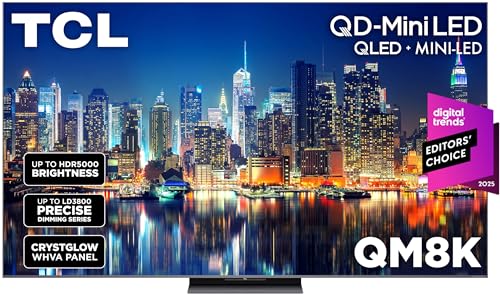
The TCL QM8 trades premium build quality for raw brightness at an even lower price. Over 2000 nits in the largest sizes, mini-LED zones, and full gaming features. The processing is not as refined as Sony or Samsung but for bright living rooms the brightness alone makes content pop.
In its favor
- QD-MINI LED: This premium level Mini LED TV, now with the New TCL Halo Control System, ens
- TCL HALO CONTROL SYSTEM: An advanced Technology Suite that includes the New Super High Ene
- CRYSTGLOW WHVA PANEL: Stunning picture quality from any seat with the anti-reflective edge
- GAME ACCELERATOR 288: Win the game with up to blistering fast 288 VRR, creating lag-free g
- GOOGLE TV WITH HANDS-FREE VOICE CONTROL AND BACKLIT PREMIUM VOICE REMOTE: Discover new mov

Samsung Q70D
The Q70D is Samsung's mid-range QLED without the Neo branding. Standard LED backlight rather than mini-LED, but still with quantum dot color. It is the TV I recommend when budget is the priority but the buyer still wants the wide color gamut. Gaming features are still strong.
In its favor
- MINI LED PROCESSOR 4K: Our advanced processor delivers brighter highlights and deeper blac
- PURE COLOR SPECTRUM: delivers one billion true-to-life colors, powered by advanced color t
- MINI LED HDR: Experience HDR picture quality with brighter highlights and deeper blacks th
- ENDLESS FREE CONTENT: Watch 2,700+ free streaming options, including 750+ subscription-fre
- SUPREME MINI LED DIMMING: delivers deep contrast and bright highlights for a truly superb
Frequently asked
QLED uses quantum dots for wider color gamut and higher brightness than regular LED. The difference is real but subtle on lower-tier QLED. Top QLED models clearly outperform standard LED.
QLED wins in bright rooms because of higher peak brightness and better glare handling. OLED is unbeatable in dim rooms for movie watching. Pick based on your viewing environment.
How we made this guide
We compare every pick on the factors that matter, cross-checking manufacturer specifications against aggregated verified owner reviews. We rank independently and never take payment for placement. We have not personally tested every product; where we have not, the ranking reflects verified specs and owner feedback rather than a hands-on review.
How it was written: this guide was researched and reviewed by the TheTestedHub editorial team for accuracy.
Affiliate disclosure: TheTestedHub is reader-supported. When you buy through links on our site, we may earn a commission at no extra cost to you.
You might also like

Elgato Alternatives 2026: AVerMedia & Rode Now Lead

Elgato Key Light: Expert Pick for True Color

Top Retro Game Consoles for 2026: A Practical Buyer’s Guide

Console Cooling Stands: Our Best Picks for 2026

The Best Gaming Glasses to Buy in 2026

Gaming Backpacks 2026: Find Yours by Laptop & Gear Needs

2026 Game Storage Racks: Find the Perfect Fit for Your Cases
