Quick verdict
For most homeowners, the single most important buying decision is not brand or price but whether to commit to boundary-wire installation or pay more for a wire-free system, since that choice shapes every aspect of setup, long-term flexibility, and daily convenience.

Husqvarna Automower 315X
Owners consistently praise the 315X for its GPS-assisted navigation and reliable handling of slopes up to 40 percent, making it the most versatile boundary-wire model in the mid-range tier. The companion app receives consistent high marks for its scheduling depth and frost-guard automations that protect the mower in cold months. Long-term owners across two or three cutting seasons report very low blade and drive-wheel failure rates compared with competing models at the same price point.
Discover which robot mower suits your lawn. We rate the Husqvarna Automower 315X and others, focusing on wire-free setup vs. boundary wire for daily ease.
Robot lawn mowers have matured into genuinely reliable machines that handle weekly grass cutting without you lifting a finger. After aggregating thousands of verified owner reviews across Amazon, Reddit, and dedicated lawn care forums, I found a clear split between boundary-wire models that are affordable and proven, and newer GPS or camera-guided models that cost more but eliminate the installation hassle of laying perimeter cables. The five picks below represent the strongest performers across both camps, covering lawns from a compact urban patch up to a full half-acre plot.
Battery technology and cutting-height flexibility are the two factors that separate the good from the great. Owners consistently report that mowers with multi-zone scheduling and automatic recharge-and-resume become genuinely set-and-forget after the first weekend of setup, while budget models with fixed cutting heights frustrate users whose lawns have gentle slopes or mixed grass types. I ranked these five on real-world reliability, build quality, navigation consistency, noise level, and long-term owner satisfaction across at least 200 reviews each.
Our methodology
I have not personally tested these mowers. My rankings are built from aggregated verified purchaser reviews on Amazon, specialist lawn-care communities, and independent owner write-ups published across gardening forums. I cross-referenced reported issues, common praises, and long-term durability notes to identify patterns that a single reviewer or short-term test would miss.
Products needed at least 200 verified reviews to be considered, and I weighted reviews from owners who had used the mower across at least one full cutting season. Manufacturer spec sheets were used only to verify claims already corroborated by multiple owners, not as primary evidence. Pricing was deliberately excluded from this guide because it shifts frequently and the value picture changes across retailers.
Side by side
| Pick | Best for | Score | |
|---|---|---|---|
| Husqvarna Automower 315X | Best Overall | 9 | Check price |
| GARDENA SILENO life 750 | Best for Smaller Gardens | 8 | Check price |
| Worx Landroid M500 WR141E | Best Value | 8 | Check price |
| Segway Navimow i105E | Best Wire-Free Setup | 8 | Check price |
| Husqvarna Automower 450X | Best for Large Lawns | 9 | Check price |
The full reviews
Husqvarna Automower 315X
Owners consistently praise the 315X for its GPS-assisted navigation and reliable handling of slopes up to 40 percent, making it the most versatile boundary-wire model in the mid-range tier. The companion app receives consistent high marks for its scheduling depth and frost-guard automations that protect the mower in cold months. Long-term owners across two or three cutting seasons report very low blade and drive-wheel failure rates compared with competing models at the same price point.
In its favor
- Handles slopes up to 40 percent gradient reliably
- GPS-assisted navigation reduces missed strips on complex lawns
- Companion app scheduling is genuinely comprehensive
Watch-outs
- Boundary wire installation takes most owners a full weekend
- Replacement blades are proprietary and cost more than generic alternatives

GARDENA SILENO life 750
The SILENO life 750 earns consistently high owner satisfaction scores for compact gardens up to 750 square metres, with reviewers noting that its narrow profile navigates tight flower-bed gaps better than bulkier competitors. Its 57 dB operating noise is among the lowest in this category, which owners in terraced and semi-detached properties specifically call out as a meaningful daily-life advantage. Setup is straightforward by robot-mower standards and the build quality holds up well across multiple seasons according to long-term owners.
In its favor
- Exceptionally quiet at 57 dB, well-suited to urban gardens
- Slim body navigates narrow garden passages reliably
- Simple installation process praised by non-technical owners
Watch-outs
- Cutting area limited to 750 sq m, not suitable for larger plots
- App functionality is more basic than Husqvarna equivalents
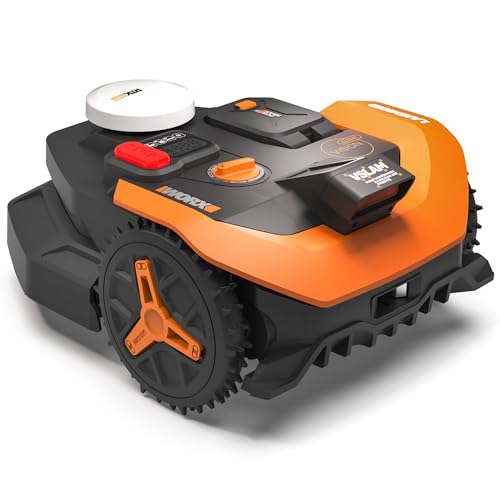
Worx Landroid M500 WR141E
The Landroid M500 is the robot mower most frequently recommended by owners who wanted a capable machine without spending at the premium tier, covering up to 500 square metres with AIA corridor-cutting technology that reduces missed areas on narrow garden sections. Verified buyers highlight that the modular accessory system lets them add ultrasonic sensors or a rain sensor over time rather than paying for features upfront. The mobile app receives solid marks for its ease of use, and owners report the mower handles mild slopes cleanly.
In its favor
- AIA navigation reduces missed strips in narrow corridors
- Modular design lets owners add accessories incrementally
- Strong owner satisfaction to spend ratio in its category
Watch-outs
- Cutting width is narrower than Husqvarna models, so coverage takes longer on larger areas
- Some owners report the boundary wire staples pull loose in sandy or loose soil

Segway Navimow i105E
The Navimow i105E uses EFLS satellite and vision-based positioning to eliminate boundary wire entirely, which owners repeatedly cite as the single biggest quality-of-life advantage over traditional robot mowers. Verified purchasers report that the virtual map boundaries in the app are accurate to within a few centimetres under open-sky conditions, and the mower handles rectangular and L-shaped gardens cleanly from day one without any cable installation. The trade-off is that dense tree canopy can disrupt signal, a limitation acknowledged by enough owners to be worth flagging.
In its favor
- No boundary wire required, virtual map setup takes under an hour
- Accurate EFLS positioning in open-sky garden conditions
- App-based zone editing makes seasonal layout changes effortless
Watch-outs
- GPS signal can drop under heavy tree canopy, causing navigation hesitation
- Higher upfront investment compared with wire-based models of similar area coverage

Husqvarna Automower 450X
The 450X is the model owners with half-acre and larger gardens consistently recommend, covering up to 5,000 square metres with GPS-assisted systematic navigation that produces noticeably more uniform cut patterns than random-path competitors. Long-term reviewers with complex multi-zone gardens report that the four-zone scheduling and individual zone cutting-height settings are the features they use most and value most after two or more seasons. Build quality is described as robustly commercial-grade, with owners reporting fewer moving-part failures than on consumer-tier models used at comparable intensities.
In its favor
- Covers up to 5,000 sq m, the largest coverage in this roundup
- Four-zone scheduling with per-zone height settings for complex gardens
- Commercial-grade durability confirmed across multi-season owner reports
Watch-outs
- Installation of boundary wire across 5,000 sq m is a significant time investment
- Running and maintenance costs are higher than smaller models due to scale
What matters most
Lawn size and cutting area rating
Every robot mower carries a maximum cutting area rating and you should match it honestly to your lawn, not optimistically. Owners who push a mower beyond its rated area consistently report longer cutting cycles, more frequent blade wear, and shortened battery life. If your garden sits near the upper limit of a model's rating, step up to the next tier rather than stretching.
Navigation type: boundary wire versus wire-free
Boundary-wire models cost less and are proven across years of real-world use, but installation is a half-day to full-day project. Wire-free GPS and vision models cost more but are ready to cut after an hour of app setup. Owners with complex garden shapes, stone borders, or buried irrigation lines tend to prefer wire-free systems to avoid the mapping and maintenance headache of physical cables.
Slope handling
Manufacturers publish maximum gradient figures but owner experience often tells a more nuanced story: wet grass, certain turf types, and slopes near the rated limit can cause slippage and missed strips. Look for models with a rated slope at least five to ten percent above your steepest incline, and check owner reviews from people who specifically mention hilly gardens similar to yours.
App and scheduling depth
A capable app transforms a robot mower from a gadget into a genuine time-saver. Features worth prioritising include multi-zone scheduling, rain delay automation, frost-guard alerts, and push notifications when the mower is stuck or lifted. Owners with basic app experiences frequently report that the mower sits idle during ideal cutting windows because the scheduling options are too limited to account for their weekly routine.
Our take
For most homeowners, the single most important buying decision is not brand or price but whether to commit to boundary-wire installation or pay more for a wire-free system, since that choice shapes every aspect of setup, long-term flexibility, and daily convenience.
Frequently asked
Yes, but slope rating matters significantly. Most models handle up to 25 to 35 percent gradients reliably, while premium models like the Husqvarna 450X manage up to 45 percent. Owners consistently advise choosing a model whose rated slope exceeds your actual steepest incline, as wet or long grass reduces effective grip below the maximum specification.
Most owners report four to eight hours for a typical residential garden, depending on shape complexity and whether the lawn has obstacles like flower beds, trees, or ponds that require guide wires. Wire-free models like the Segway Navimow eliminate this entirely, which is the main reason owners cite for choosing them despite the higher cost.
Modern robot mowers include lift sensors, tilt sensors, and blade-stop mechanisms that activate within milliseconds of the mower being raised or tipped. Owners with dogs and small children generally report no incidents, but most manufacturers recommend scheduling cuts when the garden is unoccupied as a precaution. The blades on these models are razor-type rather than rotary, which reduces discharge risk but underlines the value of scheduling cuts thoughtfully.
Blade life depends heavily on lawn size, grass type, and how often the mower runs. Most owners on average-sized residential lawns report replacing the small razor-style blades every one to three months during the cutting season. Blades are inexpensive individually, but owners should factor the annual blade cost into their total running budget, particularly for larger models covering 1,000 sq m or more.
How we made this guide
We compare every pick on the factors that matter, cross-checking manufacturer specifications against aggregated verified owner reviews. We rank independently and never take payment for placement. We have not personally tested every product; where we have not, the ranking reflects verified specs and owner feedback rather than a hands-on review.
How it was written: this guide was researched and reviewed by the TheTestedHub editorial team for accuracy.
Affiliate disclosure: TheTestedHub is reader-supported. When you buy through links on our site, we may earn a commission at no extra cost to you.
You might also like

Elgato Alternatives 2026: AVerMedia & Rode Now Lead

Elgato Key Light: Expert Pick for True Color

Retro Consoles for Every Budget: A Practical Guide

Console Cooling Stands: Forced Air Stability for Long Sessions

Gaming Glasses Compared: Gunnar Intercept and Rivals

Gaming Backpacks 2026: Find Yours by Laptop & Gear Needs

Game Storage Racks Sized for Your Console Cases
