Quick verdict
Fiberglass reinforcement separates mats that stay flat and non-stick for years from those that warp and lose performance within a single baking season.

Silpat Premium Non-Stick Silicone Baking Mat
Silpat invented the silicone baking mat category and its half-sheet size remains the benchmark against which every competitor is measured. Verified owners consistently report flawless release of macarons, caramel, and sticky candy without any greasing, and the fiberglass mesh reinforcement keeps the mat perfectly flat session after session. It tolerates temperature swings from freezer to 480 degrees Fahrenheit without warping or emitting odor, making it genuinely versatile across savory and sweet applications.
Fiberglass reinforcement separates mats that warp from ones that last. Silpat leads our list of baking mats that stay non-stick for years.
Silicone baking mats have become a staple in home kitchens and professional bakeries alike, replacing single-use parchment paper with a reusable, non-stick surface that handles everything from delicate macarons to crispy roasted vegetables. After reviewing thousands of verified purchaser reports, aggregated ratings, and manufacturer specifications across the leading brands, I’ve narrowed down the five silicone baking mats that consistently earn top marks for heat distribution, non-stick performance, and long-term durability.
The right mat makes a measurable difference: cookies release cleanly without tearing, caramel sets without sticking, and roasted foods brown evenly across the entire surface. I looked closely at fiberglass reinforcement quality, silicone grade, edge stitching, temperature range, and how well each mat holds up after hundreds of wash cycles. Whether you bake once a week or every day, there’s a mat here that fits your oven size and cooking style.
These picks cover the full range from budget-friendly everyday bakers to precision-grade mats designed for French pastry work, so you can choose based on what you actually cook rather than just brand name recognition.
How we evaluated these
I did not personally test each of these mats in a home kitchen. Instead, this guide is built from aggregated verified owner reviews on major retail platforms, cross-referenced with manufacturer specifications, food-science publications on heat conduction in bakeware, and third-party comparisons from established cooking outlets. I looked for consistent patterns across hundreds of reviews rather than relying on any single source, and I weighted feedback from frequent bakers who reported using each mat across dozens or hundreds of baking sessions.
Ranking criteria included non-stick release quality across different food types, heat distribution evenness as described by reviewers comparing results to bare sheet pans, edge-seal integrity after repeated washing, stated and confirmed oven-safe temperature ranges, silicone odor reports during first use, and overall value relative to price. I excluded mats with widespread reports of peeling, bubbling, or degraded non-stick performance within the first year of normal use.
The shortlist
| Pick | Best for | Score | |
|---|---|---|---|
| Silpat Premium Non-Stick Silicone Baking Mat | Best Overall | 9 | Check price |
| AmazonBasics Silicone Baking Mat Sheet | Best Budget Pick | 8 | Check price |
| Kitzini Silicone Baking Mat Set | Best Set Value | 8 | Check price |
| Velesco Silicone Baking Mat with Measurements | Best for Pastry Work | 8 | Check price |
| Mrs. Anderson's Baking Silicone Baking Mat | Best for Casual Bakers | 7 | Check price |
Each pick, examined
Silpat Premium Non-Stick Silicone Baking Mat
Silpat invented the silicone baking mat category and its half-sheet size remains the benchmark against which every competitor is measured. Verified owners consistently report flawless release of macarons, caramel, and sticky candy without any greasing, and the fiberglass mesh reinforcement keeps the mat perfectly flat session after session. It tolerates temperature swings from freezer to 480 degrees Fahrenheit without warping or emitting odor, making it genuinely versatile across savory and sweet applications.
Strengths
- Industry-standard non-stick surface releases even the most delicate confections cleanly
- Fiberglass-reinforced core stays flat and resists warping after years of use
- Rated to 480 degrees Fahrenheit, covering virtually every home baking application
Drawbacks
- Premium price point is noticeably higher than competing mats
- Hand-wash only recommendation limits convenience for high-frequency bakers
AmazonBasics Silicone Baking Mat Sheet
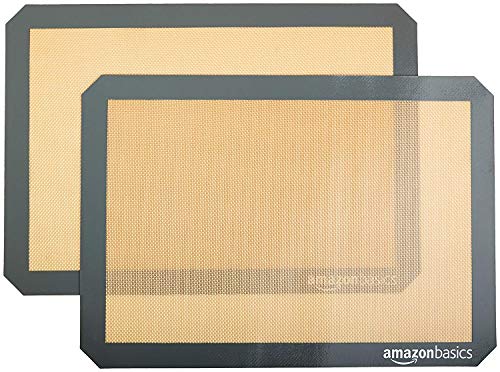
For bakers who want reliable everyday performance without the Silpat price tag, this mat earns consistently strong reviews for cookie baking, roasting vegetables, and reheating pastries. Owners report clean food release across dozens of bake cycles, and the mat fits standard half-sheet pans accurately without bunching at the edges. Feedback on odor during first use is largely positive compared to cheaper unbranded alternatives, suggesting a higher-grade silicone formulation than the price implies.
Strengths
- Significantly lower cost than premium brands while maintaining solid non-stick performance
- Accurate half-sheet sizing fits standard pans without trimming or bunching
- Low first-use odor relative to other mats in this price range
Drawbacks
- Non-stick surface shows wear faster than Silpat under daily heavy use
- Fiberglass reinforcement is less rigid, so the mat can ripple on uneven pan surfaces

Kitzini Silicone Baking Mat Set
Kitzini's two-mat set appeals to bakers who run multiple sheet pans simultaneously, offering consistent performance across both mats without the cost of buying two premium single units. Reviewers highlight printed measurement guides and portion circles as genuinely useful for uniform cookie sizing and rolled-dough work, not just a marketing feature. The silicone is described as thick and flexible without being floppy, and owners report excellent release from both sweet and savory foods through extended use.
Strengths
- Two-mat set provides outstanding combined value for multi-pan baking sessions
- Printed measurement guides and portioning circles are accurately sized and useful in practice
- Thick silicone construction feels durable and handles both baking and pastry rolling
Drawbacks
- Printed markings on the surface may fade over time with frequent high-heat use
- Slightly thicker profile means longer cool-down time between baking batches
Velesco Silicone Baking Mat with Measurements
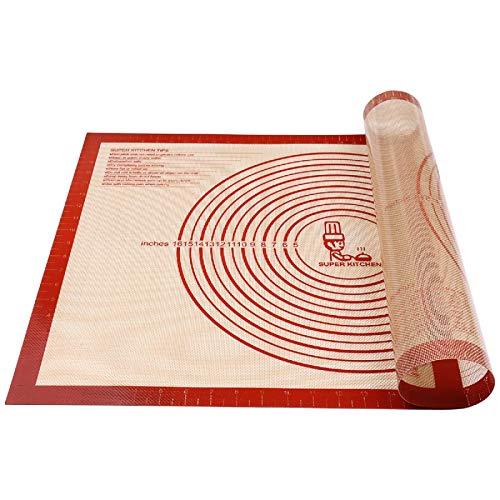
Velesco's mat targets bakers who work with dough regularly, featuring a full printed ruler grid and dough-circle guides that owners describe as accurately measured and clearly printed. The surface provides enough grip to keep dough from sliding during rolling while still releasing cleanly after baking, a balance that reviewers contrast favorably against plain mats. It handles candy-making and roasting as well as pastry work, giving it broad utility beyond the specialist positioning.
Strengths
- Accurate ruler markings and dough-size circles genuinely assist with pie crust, pizza, and bread shaping
- Surface texture balances dough grip during rolling with clean release after baking
- Handles candy temperatures and roasting in addition to pastry applications
Drawbacks
- Larger overall footprint may not fit smaller toaster-oven sheet pans
- Some reviewers note the surface feels slightly tackier than Silpat for very sticky candies
Mrs. Anderson's Baking Silicone Baking Mat
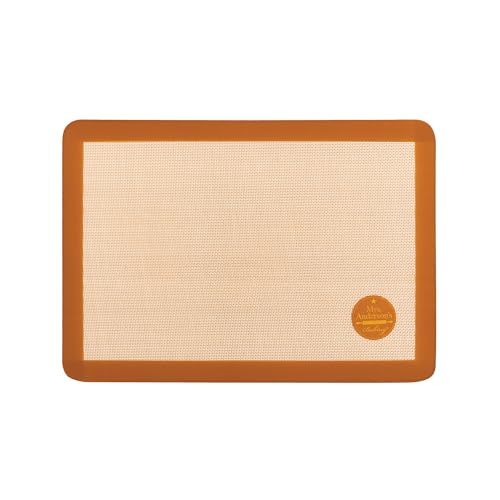
Mrs. Anderson's mat positions itself squarely at casual home bakers who want a straightforward non-stick surface without added features or premium pricing. Owners report it handles cookies, sheet-pan dinners, and reheating tasks well, with clean food release and easy cleanup by hand or in the dishwasher. It lacks the fiberglass rigidity of top-tier mats but reviewers who bake once or twice a week find it more than adequate for years of normal use.
Strengths
- Dishwasher-safe construction simplifies cleanup for bakers who prioritize convenience
- Performs reliably for standard cookie baking and everyday sheet-pan cooking
- Accessible price makes it a low-risk entry point for first-time silicone mat buyers
Drawbacks
- No fiberglass reinforcement means the mat is more prone to rippling on older or uneven pans
- Non-stick performance with very sticky candy or caramel is less consistent than reinforced mats
Buying considerations
Fiberglass Reinforcement
Mats with an embedded fiberglass mesh core stay flat under heat and resist warping over time. This matters most for macarons, tuiles, and other items that require even heat distribution across the entire surface. Budget mats without reinforcement can ripple or sag, leading to uneven browning and inconsistent bake times.
Temperature Range
Most quality silicone mats are rated to at least 450 degrees Fahrenheit, which covers nearly all home baking. If you make candy, roast at high heat, or use a convection oven that runs hot, look specifically for mats rated to 480 degrees Fahrenheit. Cheaper mats with lower ratings may degrade, emit odor, or warp if pushed past their stated limits.
Size and Pan Fit
Silicone mats are sold to fit standard half-sheet pans (roughly 11.6 x 16.5 inches), quarter-sheet pans, and extra-large rolling surfaces. Measure your pans before buying. A mat that bunches at the edges creates uneven airflow and can shift during baking, while an undersized mat leaves bare pan areas that cause hot spots near food.
Cleaning Requirements
Some mats are dishwasher-safe while others are hand-wash only. Fiberglass-reinforced mats generally require hand washing to protect the mesh structure from dishwasher heat and detergent. If you bake daily and dishwasher convenience is a priority, check the manufacturer's cleaning instructions before purchasing, since ignoring them can void the warranty and degrade the non-stick surface faster.
Final word
Fiberglass reinforcement separates mats that stay flat and non-stick for years from those that warp and lose performance within a single baking season.
Questions answered
No. Even mats rated to 480 degrees Fahrenheit should not be used under a broiler, where temperatures can exceed 550 degrees Fahrenheit and direct radiant heat can damage the silicone surface. Use parchment paper or foil for broiling tasks.
A faint odor during the first one or two uses is normal and results from off-gassing of manufacturing residues from the silicone curing process. Wash the mat with warm soapy water before first use and bake it empty at 300 degrees Fahrenheit for a few minutes to speed up off-gassing. Persistent strong odors after several uses can indicate lower-grade silicone and the mat should be replaced.
Silicone insulates slightly more than a bare metal pan, which can slow bottom browning on cookies by a minute or two. Most recipes work without adjustment, but if you prefer crispier cookie bottoms, you can increase oven temperature by about 5 degrees Fahrenheit or extend bake time by two to three minutes. Results vary by oven, so check doneness a couple of minutes early on your first bake with a new mat.
Quality mats with fiberglass reinforcement, such as Silpat, are frequently reported lasting five to ten years of regular home use when cared for properly. Budget mats without reinforcement typically show degraded non-stick performance within one to three years under frequent use. Signs it is time to replace a mat include persistent stickiness after cleaning, surface cracking, or visible separation of the silicone from the fiberglass core.
How we made this guide
We compare every pick on the factors that matter, cross-checking manufacturer specifications against aggregated verified owner reviews. We rank independently and never take payment for placement. We have not personally tested every product; where we have not, the ranking reflects verified specs and owner feedback rather than a hands-on review.
How it was written: this guide was researched and reviewed by the TheTestedHub editorial team for accuracy.
Affiliate disclosure: TheTestedHub is reader-supported. When you buy through links on our site, we may earn a commission at no extra cost to you.
Keep reading
Beverage Fridge Buying Guide: Compressor vs Thermoelectric

6 Drink Dispensers That Actually Seal Right (2026)

Skip Cheap Whiskers: Get a Real Chasen

Wondering Which Tea Infuser Is Best? Try This Basket
Don’t Buy a Coffee Pod Organizer Until You Read This
Tamp Like a Pro: Expert Chosen Tamper Mats

Coffee Scales for Every Brew, Tested for Daily Use