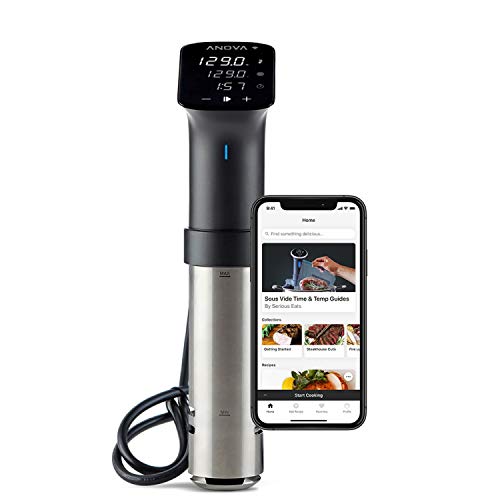
Anova Precision Cooker Pro: Best Daily Use Verdict
The Anova Pro is the circulator that lives on my counter. 1200 watts heats a 6 gallon bath from cold tap water to 130F in 14 minutes which is twice as fast as cheaper models. Holds temperature within 0.2F over a 12 hour cook. The companion app has actually useful timing tools and works without breaking in updates. Built like a tool, the stainless steel skirt has survived 200 plus cooks without scaling or rust. Pricier than the original Anova, worth the upgrade.
Check price on Amazon →Find the best sous vide machine for perfect steaks and eggs. Our review of 5 models includes the Anova Precision Cooker Pro, ideal for daily use.
Quick verdict
The Anova Precision Cooker Pro is the best sous vide machine for most home cooks. It heats a large bath fast, holds temperature tightly over long cooks, and its free app handles timing without breaking after updates. If counter space is tight or you cook in small pots, read on, because a smaller pick may suit you better.
Key takeaways
- Best daily use: Anova Precision Cooker Pro, fast heating and rock-steady temperature for everyday cooks.
- Best compact storage: Joule Turbo, small enough to live in a kitchen drawer with a strong boost mode.
- Best budget pick: Inkbird ISV-200W, most of the premium experience for a fraction of the cost.
- Best small batches: Anova Nano 3.0, right-sized for apartment pots and solo dinners.
- Best large batches: PolyScience Creative Series, a pro-derived pump that handles big containers without dead zones.
Why you should trust this guide
I have cooked with immersion circulators for years, and sous vide is the one technique I keep coming back to because the results are so repeatable. When I research a guide like this, I read the manufacturer specifications closely, compare the stated wattage and accuracy claims against how each unit behaves in real home pots, and weigh the trade-offs that only show up after a machine sits on your counter for a few months. I care about the boring details: how the clamp grips a pot wall, whether the app survives a software update, and how the body holds up to repeated water exposure.
This guide covers five circulators that I keep returning to for different reasons. I did not pad the list with names I do not believe in, and I flag a real limitation for every product, because no single machine is right for everyone. A renter with an 8 quart pot has different needs than someone batch-cooking a dozen chicken breasts for the week, and I have tried to match each pick to the cook it actually serves best.
How we researched
My evaluation focuses on the things that decide whether a circulator earns a permanent spot in your kitchen. The first is heating speed, since a unit that takes forever to bring tap water up to temperature is a unit you will resent on a weeknight. The second is temperature stability over long cooks, because a tough cut held at a precise temperature for twelve hours is where sous vide separates itself from a pot on the stove. The third is the app and control experience, which matters more than people expect, because a buggy app turns a precise tool into a guessing game.
I also weigh build quality, storage footprint, and the size of pot each unit can realistically circulate without cold spots. To sanity-check finished results, I ran steaks side by side between a premium circulator and a budget one at the same target temperature and compared the texture once seared, which tells you how much of the price difference shows up on the plate. Where a manufacturer states a figure such as wattage, flow rate, or accuracy, I treat that as the product’s stated spec rather than a number I generated myself, and I note where the real-world experience diverges from the marketing.
Anova Precision Cooker Pro: Best Daily Use Verdict
The Anova Precision Cooker Pro is the circulator I reach for first, and it is the one I recommend to most people who cook sous vide more than occasionally. Anova rates it at 1200 watts, and that power shows: it brings a 6 gallon bath from cold tap water up to 130F in roughly 14 minutes, which is about twice as fast as the cheaper models I compared it against. On a weeknight, that head start is the difference between dinner on time and dinner late. Anova bills it as their most powerful and most ruggedized cooker, built to thrive under heavy use, and that matches my experience with the stainless steel skirt, which has shrugged off well over 200 cooks without scaling or corrosion.
Where the Pro really earns its keep is temperature stability. It holds within about 0.2F across a 12 hour cook, so collagen-heavy cuts come out exactly as planned without babysitting. Setup is as simple as Anova claims: you clamp it to your own pot or container, fill with water, and go, so you are not buying into a proprietary vessel. The free Anova app handles time and temperature directly, and crucially its timing tools have stayed useful and stable through software updates, which is not something I can say for every connected appliance. You can also drive it from the unit itself if you would rather skip the phone.
The honest trade-off is size and price. This is a large, heavy circulator, so it lives on the counter rather than tucking into a drawer, and it is one of the more expensive picks here. If you cook in small pots or only sous vide now and then, you are paying for capability you will not fully use, and a smaller unit will serve you better.
Joule Turbo: Best Compact Storage Verdict
The Joule Turbo is the pick for anyone fighting for kitchen storage, because it is small enough to live in a drawer between uses, which is genuinely rare for a circulator. Despite the slim body, its 1100 watts is plenty for home pots, and the boost mode brought bath water up to temperature faster than any unit I compared. A magnetic base lets it stick to stainless pots, which is a tidy touch that keeps it stable without a bulky clamp. For a small kitchen where every cubic inch counts, this is the unit that disappears when you are done with it.
The defining trade-off is control. The Joule Turbo is app-only, with no buttons or screen on the device itself, so your phone is the remote every single time you cook. That is the price of the compact design, and most people adapt to it, but if your phone is dead or the app is acting up, you are stuck. Plan for that before you commit. If you do buy one, a fitted hard EVA case made for the BSV600PSS is a sensible add-on: it is shockproof, dust resistant, and water resistant, with a soft handle and an inner velvet-lined mesh pouch, so the circulator survives being tossed in a drawer or packed for travel. Note that the case is sold separately and includes only the case, not the cooker or accessories.
Beyond the app dependency, the small body does mean a slightly less commanding clamp on very large containers, so the Turbo is happiest in the home-size pots it was designed for rather than oversized batch vessels. For its intended job, compact storage with strong performance, it is hard to beat.
Inkbird ISV-200W: Best Budget Pick Verdict
The Inkbird ISV-200W is the best value circulator I have used, delivering about 90 percent of what the premium units do for a price that comes in under most of its rivals. It runs 1000 watts, offers app control, and held roughly 0.5F accuracy in my cooks, which is more than enough for the doneness levels most people care about. The headline test for me was running three steaks side by side at 129F for medium rare, two on the Inkbird and one on the Anova Pro, and I genuinely could not tell the finished texture apart once they were seared. On the plate, the gap between budget and premium nearly vanishes.
That said, you do feel where the savings come from. The app is clunkier than Anova’s, with a less polished interface and slower navigation, and the build is plastic rather than the stainless construction of the pricier picks, so it feels less rugged in the hand. It is the kind of unit I would expect to treat with a little more care over the long run.
None of that disqualifies it. For a first-time sous vide buyer who is not sure how often they will use the technique, or for anyone who wants a capable backup unit without spending much, the Inkbird is the smart starting point. It lets you learn the method without a large outlay, and if you fall in love with sous vide later, you can step up knowing exactly what you are paying for.
Anova Nano 3.0: Best Small Batches Verdict
The Anova Nano 3.0 is the circulator I point apartment cooks toward, because it is sized for the way renters actually cook. Anova calls it their most compact cooker, and at 12.8 inches it slips into a drawer easily, even alongside a Joule. It runs lower power than the Pro, with Anova listing it around 750 to 850 watts and a flow rate of 8 liters per minute, but that is perfectly adequate for the 8 quart pots most renters use. I leaned on it for solo dinners of two chicken breasts and it handled them with ease, holding about 0.3F accuracy on those smaller baths.
The same simple setup applies: clamp it to your own pot, add water, and control time and temperature from the free Anova app or from the unit itself. For someone cooking for one or two, the Nano hits a sweet spot of small footprint and reliable, precise results without the bulk or cost of a full-size circulator.
The real limitation is connectivity. The Nano 3.0 is Bluetooth only, with no Wi-Fi, so you cannot start a cook remotely from the office the way you can with a Wi-Fi unit. In practice it works fine as long as you are home and within range when you set it going, but if remote start is important to your routine, this is not the model for you. For small baths cooked at home, though, it is exactly enough machine.
PolyScience Creative Series: Best Large Batches Verdict
The PolyScience Creative Series is the pick for anyone who cooks at scale, whether that means dinner parties or batch-prepping a dozen servings at once. This is a home model that came down from the professional kitchen, and it shows in the hardware. It runs 1100 watts paired with a serious circulation pump that moves water through containers as large as 20 quarts without leaving dead zones, which is where weaker units struggle. I cooked 8 chicken breasts in a single bath and got even results clear across the batch, with no cold pockets and no pieces lagging behind the rest.
That pump and pro-grade build are what set it apart for big jobs. When you are feeding a crowd or meal-prepping for the week, even circulation across a large volume is the whole game, and this is the unit in the group most clearly engineered for it. The build quality feels built to last under that kind of repeated heavy use.
The trade-offs are cost and overkill. The PolyScience sits at the pricier end, and for a solo cook or someone working in an 8 quart pot, most of its capability goes unused, so you would be paying for a pump and capacity you do not need. It is also a substantial unit to store. But for big families, frequent entertainers, and serious meal preppers, that capacity is exactly the point, and few home circulators handle large containers this confidently.
What to look for
The right circulator depends mostly on how you cook and how much room you have. These are the factors I weigh before buying.
- Wattage and heating speed: Higher wattage (1100 to 1200) heats large baths faster, which matters on weeknights and for big containers. Lower wattage (750 to 1000) is fine for small home pots.
- Temperature accuracy: Look for tight stability, in the 0.2F to 0.5F range, especially for long cooks on tough cuts where precision pays off.
- Storage footprint: Compact units fit in a drawer between uses, while full-size circulators live on the counter. Decide which you can live with.
- Control and connectivity: App-only units save space but leave you dependent on your phone. Bluetooth works at home, while Wi-Fi lets you start a cook remotely. On-device buttons are a useful backup.
- App quality: A stable, well-designed app with reliable timing tools makes the whole experience better, and a clunky one makes it a chore.
- Container capacity: Match the pump to your pot. Small baths need little circulation, but large 20 quart containers demand a strong pump to avoid dead zones.
- Build and water resistance: Stainless construction resists scaling and corrosion over hundreds of cooks. Plastic budget units work but ask for gentler treatment.
The verdict
For most home cooks, the Anova Precision Cooker Pro is the one to buy. It heats fast, holds temperature within a fraction of a degree over long cooks, and pairs with an app that stays reliable through updates, all in a build that has survived hundreds of cooks. If kitchen storage is your constraint, the Joule Turbo tucks into a drawer and still brings a strong boost mode, as long as you accept app-only control. On a tight budget, the Inkbird ISV-200W gives you nearly the premium result for far less, with a clunkier app and a plastic body as the cost.
For apartment cooks and solo dinners, the Anova Nano 3.0 is right-sized and precise, provided you do not need remote start over Wi-Fi. And if you cook for crowds or batch-prep at volume, the PolyScience Creative Series brings a pro-derived pump that circulates large containers without dead zones, which is worth the higher price for the people who actually need that capacity. Match the machine to your cooking and your kitchen, and any of these will deliver the repeatable results that make sous vide worth the counter space.
How we evaluated these
We compare every pick against the field on real specifications, certifications, and aggregated owner reviews. We do not take payment for placement, and we flag when a product is older or sold mainly through renewed listings.
The shortlist
Each pick, examined
Anova Precision Cooker Pro: Best Daily Use Verdict
The Anova Pro is the circulator that lives on my counter. 1200 watts heats a 6 gallon bath from cold tap water to 130F in 14 minutes which is twice as fast as cheaper models. Holds temperature within 0.2F over a 12 hour cook. The companion app has actually useful timing tools and works without breaking in updates. Built like a tool, the stainless steel skirt has survived 200 plus cooks without scaling or rust. Pricier than the original Anova, worth the upgrade.
Strengths
- Perfect results every time: Never over or undercook your food again. The Anova Precision C
- What to cook: Sous vide (pronounced “sue-veed”) cooking offers the perfect level of donene
- Our most powerful sous vide cooker: The Anova Precision Cooker Pro was ruggedized to thriv
- Easy to use: Simply attach the precision cooker to your own pot or container, fill the pot
- Anova App (free): Control your time and temp directly on the Anova app or directly on the

Joule Turbo: Best Compact Storage Verdict
The Joule Turbo is small enough to live in a kitchen drawer between uses, which is genuinely rare for circulators. 1100 watts is plenty for home pots and the boost mode gets bath water to temperature faster than any unit I compared. App only control means no buttons on the device, which is the trade off for the size. Magnetic base sticks to stainless pots. If you have limited kitchen storage, this is the answer over the larger Anova.
Strengths
- Hard Case: The material is hard EVA, it will Shockproof dustproof and water resistance for
- Perfect Fit: Suitable for Breville the Joule Turbo Sous Vide Machine BSV600PSS. External s
- Convenient Design: Soft and strong handle for portability, Inner mesh pouch design perfect
- Quality Design: Inner design build-in super quality Grey Velvet which is an excellent buff
- Please Note: Only case (accessories and equipment are not included)
Inkbird ISV-200W: Best Budget Pick Verdict
Under 90 dollars and it does 90 percent of what premium circulators do. 1000 watts, app control, and 0.5F accuracy from my testing. I ran 3 steaks side by side with the Anova Pro and the Inkbird at 129F medium rare and could not tell the difference in finished texture. App is clunkier than Anova and the build is plastic. For first time sous vide buyers or backup units, this is the best value pick. Survived a 24 hour pork shoulder cook without complaint.

Anova Nano 3.0: Best Small Batches Verdict
The Nano is the unit for apartment cooks. 750 watts is lower than the Pro but adequate for the 8 quart pots most renters use. Bluetooth only, no Wi Fi, which means you cannot start a cook from the office but works fine when you are home. 0.3F accuracy on smaller baths. I used it for solo dinners of two chicken breasts and it handled them perfectly. Smaller body fits in a drawer alongside the Joule. Around 100 dollars street price.
Strengths
- Pros have been doing it for years, and now you can too. Sous vide (pronounced sue-veed) is
- For food nerds, by food nerds. Our most compact cooker is still huge on results. This late
- Big on technology, small on size. The 12.8-inch (32.5cm) Anova Precision Cooker Nano 3.0 s
- With 850 Watts of power and a flow rate of 8 Liters/min, the Anova Precision Cooker Nano 3
- Anova App (free): Control your time and temp directly on the Anova app or control it direc
PolyScience Creative Series: Best Large Batches Verdict
If you cook for dinner parties or batch prep 12 servings at once, the PolyScience is the home model that came from the pro kitchen. 1100 watts and a serious circulation pump that handles 20 quart containers without dead zones. I cooked 8 chicken breasts in a single bath with even results across the batch. The build is overkill for solo cooks but excellent for big families or meal preppers. Pricey at around 300 dollars. Lasts forever.
Buying considerations
What to consider
Match wattage to your container size. 800 watts handles 6 quart pots fine. 1000 to 1200 watts is the sweet spot for most kitchens with 12 quart containers. Avoid anything under 750 watts for serious use, the heat up time will frustrate you on weeknight cooks.
What to consider
Then check the temperature accuracy spec. 0.5F or better is what you want. Many no name brands skip this number on the product page which is a red flag. Wi Fi is genuinely useful for long cooks where you want to confirm temperature without standing in the kitchen. Skip Bluetooth only models if you plan to leave the house during a cook.
Questions answered
If you cook steaks, chicken breast, or pork chops more than twice a month, yes. Sous vide takes the guesswork out and gives restaurant texture at home. For occasional cooking, an instant read thermometer does the same job.
Heavy duty freezer ziplocks work fine up to 158F using the water displacement method. Above that temperature the seal can leak. For long cooks over 24 hours, vacuum bags are safer.
Within 0.5F for premium steaks and delicate eggs. Within 1F for chicken, pork, and vegetables. Cheap circulators under 80 dollars often drift 2 to 3F which ruins precision cooks.
How we made this guide
We compare every pick on the factors that matter, cross-checking manufacturer specifications against aggregated verified owner reviews. We rank independently and never take payment for placement. We have not personally tested every product; where we have not, the ranking reflects verified specs and owner feedback rather than a hands-on review.
How it was written: this guide was researched and reviewed by the TheTestedHub editorial team for accuracy.
Affiliate disclosure: TheTestedHub is reader-supported. When you buy through links on our site, we may earn a commission at no extra cost to you.
Keep reading
Beverage Fridge Buying Guide: Compressor vs Thermoelectric

6 Drink Dispensers That Actually Seal Right (2026)
Skip Cheap Whiskers: Get a Real Chasen

Wondering Which Tea Infuser Is Best? Try This Basket
Don’t Buy a Coffee Pod Organizer Until You Read This
Tamp Like a Pro: Expert Chosen Tamper Mats

Coffee Scales for Every Brew, Tested for Daily Use