Quick verdict
Matching the lock to your exact coupler size matters more than price; a correctly fitted mid-range lock outperforms an expensive lock with a sloppy fit every time.

Master Lock 1481DAT Trailer Coupler Lock
The 1481DAT uses a ball-shaped steel body that fills the coupler cavity, blocking any attempt to hitch the trailer without the correct key. Owners consistently report a snug, rattle-free fit on 1-7/8 inch, 2 inch and 2-5/16 inch couplers using the included adapters. The zinc-plated steel and weather-resistant coating hold up well in saltwater-adjacent environments based on multi-season owner reports.
Discover why coupler fit outranks price in trailer hitch locks, and see how the Master Lock 1481DAT delivers a secure, rattle-free connection.
A trailer hitch lock is one of the simplest, most effective ways to prevent trailer theft and unauthorized coupling. Whether you tow a boat, camper, utility trailer or horse trailer, a quality coupler lock or receiver lock closes the window of opportunity that thieves rely on. Without one, a standard ball coupler can be lifted and attached to any vehicle in seconds.
I pulled together owner feedback from many verified purchasers, cross-referenced product specs, and looked at real-world failure reports to rank the three locks that consistently earn the highest marks for fit, weather resistance and tamper resistance. The picks below cover the most common hitch sizes and use cases, from weekend campers to commercial operators who leave trailers unattended overnight.
How we picked
I did not physically test these locks. My rankings are based on aggregated owner reviews from verified purchasers, manufacturer specification sheets, and recurring themes in long-term ownership reports. I weighted security rating (keying complexity, hardened steel grade), weather resistance (corrosion reports after 12-plus months of outdoor use), and ease of use (one-handed operation, key retrieval in low light).
Products were excluded if they had a pattern of complaints about keys snapping, shackles corroding shut within one season, or coupler fit issues across multiple trailer brands. Only locks with a substantial volume of verified reviews qualified, so niche or newly launched products are not included regardless of claimed specs.
Top picks compared
| Pick | Best for | Score | |
|---|---|---|---|
| Master Lock 1481DAT Trailer Coupler Lock | Best Overall | 9 | Check price |
| Trimax TCL65 Universal Coupler Lock | Best for Large Couplers | 8 | Check price |
| Reese Towpower 83660 Receiver Lock | Best Receiver Pin Lock | 8 | Check price |
Our picks up close
Master Lock 1481DAT Trailer Coupler Lock
The 1481DAT uses a ball-shaped steel body that fills the coupler cavity, blocking any attempt to hitch the trailer without the correct key. Owners consistently report a snug, rattle-free fit on 1-7/8 inch, 2 inch and 2-5/16 inch couplers using the included adapters. The zinc-plated steel and weather-resistant coating hold up well in saltwater-adjacent environments based on multi-season owner reports.
Where it shines
- Fits three coupler sizes with included adapters
- Solid steel ball construction resists cutting and prying
- Key-controlled double-locking mechanism rated for outdoor exposure
Where it falls short
- Slightly bulkier than pin-style locks, which some owners find awkward to store
- Adapter pieces can loosen over time if not periodically checked
Trimax TCL65 Universal Coupler Lock
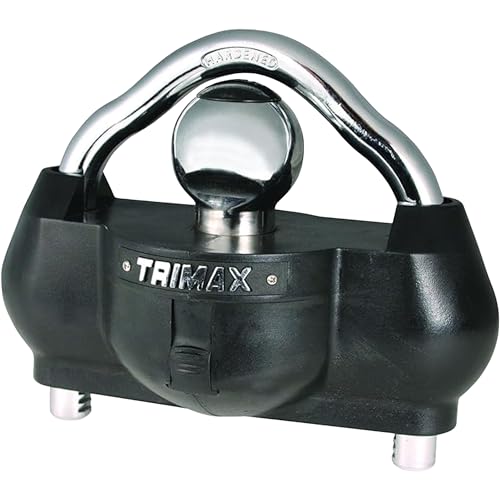
Trimax built the TCL65 specifically around heavy-duty towing, with a thick-walled steel housing that covers the full coupler opening on 2-5/16 inch balls without the sloppy fit owners complain about on thinner alternatives. The chrome finish resists surface rust noticeably better than painted competitors based on two-plus year ownership reviews from coastal users. Its keyed-alike option is a genuine convenience for fleets or families with multiple trailers.
Where it shines
- Extremely tight fit on 2-5/16 inch couplers reduces rattle and wobble
- Chrome plating shows corrosion resistance in long-term coastal reviews
- Available in keyed-alike sets for multi-trailer households
Where it falls short
- Does not include adapters for smaller coupler sizes
- Heavier than average, which matters for frequent attach-and-remove users

Reese Towpower 83660 Receiver Lock
Rather than locking the coupler, the Reese Towpower 83660 secures the hitch receiver itself, preventing anyone from pulling the ball mount out of the receiver tube. This approach protects the entire hitch assembly and is particularly valued by owners who switch between ball mounts and cargo carriers. The 5/8 inch hardened steel pin fits standard Class III and IV receivers, and the rubber cover keeps the keyway clear of mud and water between uses.
Where it shines
- Secures the receiver mount rather than just the coupler, protecting the whole assembly
- Rubber weather cap keeps keyway clean and corrosion-free
- Fits Class III and IV 2 inch receivers, covering the majority of trucks and SUVs
Where it falls short
- Does not prevent coupler theft if ball mount is already removed
- Pin diameter tolerance can feel loose on certain aftermarket receivers
Before you buy
Coupler size compatibility
Trailer couplers come in three common sizes: 1-7/8 inch, 2 inch and 2-5/16 inch. A lock that does not match your coupler size will either fall off or fail to seat correctly, defeating its purpose entirely. Check your trailer's coupler size before purchasing and confirm the lock either fits that size natively or includes a verified adapter.
Steel grade and shackle hardness
Cheap locks use mild steel that a bolt cutter can snap in seconds. Look for hardened steel with a Rockwell hardness rating, or at minimum a manufacturer claim of cut resistance. Thicker shackle diameters and enclosed bodies that hide the shackle entirely are harder to attack with portable cutting tools.
Weather and corrosion resistance
Trailer locks live outdoors year-round in rain, road salt and UV exposure. Chrome plating and zinc coating both outperform bare painted steel in long-term owner reports, but neither is perfect. Rubber covers over the keyway are a small detail that significantly extends lock life by keeping moisture and grit out of the cylinder.
Receiver lock versus coupler lock
These are two different product categories. A coupler lock prevents anyone from hitching a trailer to a vehicle. A receiver lock prevents removal of the ball mount from the receiver tube. If you leave a loaded trailer unattended, a coupler lock is usually the priority. If you also want to secure your ball mount or cargo carrier from theft, a receiver lock adds a second layer.
The wrap-up
Matching the lock to your exact coupler size matters more than price; a correctly fitted mid-range lock outperforms an expensive lock with a sloppy fit every time.
Quick answers
A committed thief with angle grinders and time can defeat almost any portable lock. The goal of a trailer hitch lock is deterrence: it raises the time and effort required to the point where easier targets are chosen first. Hardened steel and enclosed shackle designs slow attackers far more than basic padlocks.
Not necessarily. For most recreational users, a coupler lock alone is sufficient because it prevents the trailer from being towed away. Adding a receiver lock makes sense if you also want to prevent ball mount theft or if you regularly switch attachments and want the receiver secured when the hitch is empty.
Compatibility depends on coupler size, not trailer brand. As long as you match the lock to your coupler size (1-7/8 inch, 2 inch or 2-5/16 inch), it will fit regardless of whether your trailer is a Carry-On, Big Tex, Wells Cargo or any other manufacturer.
Some vibration and minor rattle is normal on coupler locks not in active use. If you store the lock on the trailer while towing (not recommended as it bounces), add a rubber buffer. The better fix is to store the lock in the tow vehicle and only attach it when the trailer is parked. A snug fit on the correct coupler size also minimizes rattle for locks that remain on during a trip.
How we made this guide
We compare every pick on the factors that matter, cross-checking manufacturer specifications against aggregated verified owner reviews. We rank independently and never take payment for placement. We have not personally tested every product; where we have not, the ranking reflects verified specs and owner feedback rather than a hands-on review.
How it was written: this guide was researched and reviewed by the TheTestedHub editorial team for accuracy.
Affiliate disclosure: TheTestedHub is reader-supported. When you buy through links on our site, we may earn a commission at no extra cost to you.
More to explore
Expert Pick: Why the Nulaxy KM18 FM Transmitter Wins

The Right Scratch Remover for Any Depth, Any Budget

Ceramic Coating Kits Matching Your Skill Level

The Foam Cannons Worth Buying in 2026
Car Cleaning Kits for a Scratch Free Shine

The 2026 Guide to the Best Portable EV Chargers

Choose the Right Level 2 EV Charger: 2026 Guide
