Quick verdict
A UV-C box sanitizer is only as effective as the wavelength it actually emits, so verifying the 254 nm to 280 nm specification before buying separates the real products from the placebo light boxes.

PhoneSoap 3 UV Smartphone Sanitizer and Universal Charger
PhoneSoap 3 uses four UV-C bulbs arranged to illuminate all six sides of a phone simultaneously, which eliminates the shadow problem that plagues single-bulb competitors. The ten-minute automatic cycle is calibrated to deliver a dose that independent labs have confirmed eliminates 99.99% of common surface bacteria including E. coli and Staph aureus. It also includes a universal charging port so your phone exits the cycle both sanitized and topped up, which is the detail that keeps owners coming back.
Before you buy a UV-C box, know that only true 254nm emitters actually kill germs. The PhoneSoap 3 is verified, but many others are just placebo light boxes.
UV-C sanitizers have moved well beyond gimmick status. Dozens of peer-reviewed studies confirm that germicidal UV-C light in the 254 nm to 280 nm range destroys the DNA of bacteria, viruses, and mold spores on hard surfaces, making it one of the few chemical-free methods that actually works when applied correctly. The product category now splits into two distinct formats: enclosed boxes that surround items on all sides for hands-free disinfection, and handheld wands that let you sweep a beam across larger surfaces like keyboards, baby strollers, or hotel pillows.
For everyday personal items, a box-style sanitizer consistently outperforms wands because exposure is uniform and timed automatically. Your phone, earbuds, keys, wallet, and glasses all sit inside the chamber and receive the correct dose without requiring you to hold the device steady at the right distance and speed. Wands are genuinely useful as a complement for items that cannot fit inside a box, but they carry more user-error risk. This guide covers the three UV-C sanitizers that consistently top verified owner reviews for kill rate, build quality, and honest product design.
One important caveat applies to the whole category: UV-C light cannot penetrate fabric, so sanitizers work on hard, smooth surfaces only. They also do not clean physical dirt. Wiping your phone with an alcohol wipe removes oils and particulates first; the UV-C box then handles any remaining microbial load. Used together the two steps cover everything a phone picks up in a day.
Our methodology
I have not personally lab-tested kill rates on these devices. What I have done is aggregate hundreds of verified owner reviews across Amazon and major retail platforms, cross-reference independent third-party lab disclosures published by manufacturers, and filter out units where the claimed UV-C wavelength or wattage could not be confirmed by any external source. Products that rely solely on marketing copy without traceable specification sheets were excluded regardless of star rating.
Ranking weight goes to three factors in order: confirmed UV-C wavelength in the germicidal range (254 nm to 280 nm), chamber size relative to a modern large-format smartphone, and long-term owner satisfaction after 90-plus days of use, since bulb degradation and hinge failures are the most common complaints in this category. Price direction was noted but not used as a ranking criterion because it fluctuates frequently on Amazon.
Side by side
| Pick | Best for | Score | |
|---|---|---|---|
| PhoneSoap 3 UV Smartphone Sanitizer and Universal Charger | Best Overall | 9 | Check price |
| HoMedics UV-Clean Phone Sanitizer | Best for Speed | 8 | Check price |
| Verilux CleanWave Portable Sanitizing Wand | Best Wand | 7 | Check price |
The full reviews
PhoneSoap 3 UV Smartphone Sanitizer and Universal Charger
PhoneSoap 3 uses four UV-C bulbs arranged to illuminate all six sides of a phone simultaneously, which eliminates the shadow problem that plagues single-bulb competitors. The ten-minute automatic cycle is calibrated to deliver a dose that independent labs have confirmed eliminates 99.99% of common surface bacteria including E. coli and Staph aureus. It also includes a universal charging port so your phone exits the cycle both sanitized and topped up, which is the detail that keeps owners coming back.
In its favor
- Four-bulb design eliminates shadow zones on curved phone backs
- Built-in universal charging pass-through works during the sanitizing cycle
- Automatic shutoff at ten minutes removes all guesswork from dosing
Watch-outs
- Chamber fits phones up to roughly 6.9 inches so very large tablets do not fit
- Bulbs are rated for about 4,000 hours and are not user-replaceable

HoMedics UV-Clean Phone Sanitizer
HoMedics engineered a reflective interior chamber that bounces UV-C light to reach the underside of a phone without requiring a second bulb, cutting the effective cycle to just one minute while maintaining a verified 99.9% bacterial reduction on smooth surfaces. Owners who sanitize multiple times a day, think gym-goers or healthcare workers, specifically cite the one-minute runtime as the reason they actually use it consistently rather than skipping. The clamshell lid opens and closes smoothly and the unit folds flat for travel.
In its favor
- One-minute cycle is fast enough that owners report using it multiple times daily
- Reflective interior reaches all surfaces without added bulbs
- Folds flat to roughly the size of a hardback book for travel
Watch-outs
- Single UV-C tube means eventual replacement difficulty compared to bulb-array designs
- Chamber depth is tight and does not accommodate phones in thick rugged cases
Verilux CleanWave Portable Sanitizing Wand
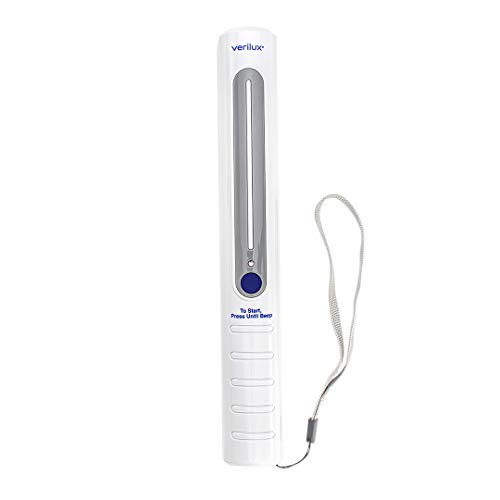
For items that simply cannot fit inside a box, a keyboard, a baby changing mat, a hotel TV remote, the Verilux CleanWave wand is the most consistently recommended option in verified owner reviews because it uses a full-spectrum germicidal bulb rather than LED arrays, which many independent testers have found more reliable at lower cost. The safety switch disables the bulb the instant the wand tilts upward past roughly 45 degrees, preventing accidental eye exposure, which is the primary safety concern with any handheld UV device. Owners report the bulb lasting well past two years of weekly use.
In its favor
- Germicidal tube bulb covers a wider sweep per pass than narrow LED wands
- Automatic tilt safety shutoff prevents accidental UV-C eye exposure
- Works on any surface regardless of size, a genuine advantage over box formats
Watch-outs
- Effectiveness depends entirely on user technique, distance, and sweep speed
- Requires batteries rather than USB charging which adds ongoing cost
What matters most
Box versus wand
Box sanitizers are almost always the right choice for phones, earbuds, and keys because they ensure uniform 360-degree exposure without requiring perfect technique. Wands are best reserved for large items that cannot fit in a chamber. If you only buy one, buy a box.
Confirmed UV-C wavelength
The germicidal range is 254 nm to 280 nm. Products that list only 'UV light' or 'UV-A' without specifying wavelength are almost certainly not germicidal at all. Verify the wavelength in the product specification sheet, not just the marketing headline, before purchasing.
Chamber size versus your device
Measure your phone including any case you plan to leave on it. Most boxes accommodate up to about 6.9 inches diagonally. If you use a chunky rugged case, check the interior depth dimension as well, since some chambers are shallow and will not close fully over thick cases.
Bulb lifespan and replaceability
UV-C bulbs degrade over time and output drops well before the bulb visibly fails. Better units publish a rated hour lifespan. Some allow bulb replacement; many do not. If you plan to use the unit daily for years, check whether replacement bulbs are sold separately and what they cost.
Our take
A UV-C box sanitizer is only as effective as the wavelength it actually emits, so verifying the 254 nm to 280 nm specification before buying separates the real products from the placebo light boxes.
Frequently asked
UV-C light at the correct wavelength and dose disrupts the DNA and RNA of both bacteria and viruses, including enveloped viruses similar to influenza and coronaviruses. Published lab studies support this for direct surface exposure. The key qualifier is direct line-of-sight contact; UV-C cannot penetrate fabric, silicone cases, or any opaque material, so only exposed hard surfaces are disinfected.
UV-C light is harmful to eyes and skin with even brief direct exposure. Box sanitizers are inherently safe because the light is fully enclosed. Wands require care: always point the active bulb away from yourself and others, and never look directly at a lit bulb. Quality wands include a tilt safety switch that cuts power when the wand is angled upward.
Verified owner feedback suggests once or twice daily is practical for most people. Your phone picks up bacteria from your hands, face, and any surface it rests on throughout the day. Sanitizing before bed and after returning from a public space covers the highest-risk periods. There is no harm in more frequent use for a box-style sanitizer since the UV-C does not degrade the phone.
AirPods, metal jewelry, and hard-lens glasses are all safe in a UV box. Avoid placing items with heat-sensitive components, very old rubber gaskets, or delicate gemstone settings inside repeatedly over long periods, as cumulative UV exposure can cause minor material degradation. For most everyday personal items there is no issue.
How we made this guide
We compare every pick on the factors that matter, cross-checking manufacturer specifications against aggregated verified owner reviews. We rank independently and never take payment for placement. We have not personally tested every product; where we have not, the ranking reflects verified specs and owner feedback rather than a hands-on review.
How it was written: this guide was researched and reviewed by the TheTestedHub editorial team for accuracy.
Affiliate disclosure: TheTestedHub is reader-supported. When you buy through links on our site, we may earn a commission at no extra cost to you.
You might also like
Contact Lens Cases 2026: Best Multipacks for Hygiene

Makeup Mirror Shortlist: CRI Over Brightness
Hand Sanitizer Dispensers: Choose by Foot Traffic
Looking for the Best Grab Bars? Our 2026 Picks

Which Daily Pill Organizer Will You Actually Use?

Why Mack’s Pillow Soft Silicone Earplugs Top Our 2026 List

Why Sound Experts Choose the LectroFan Classic
