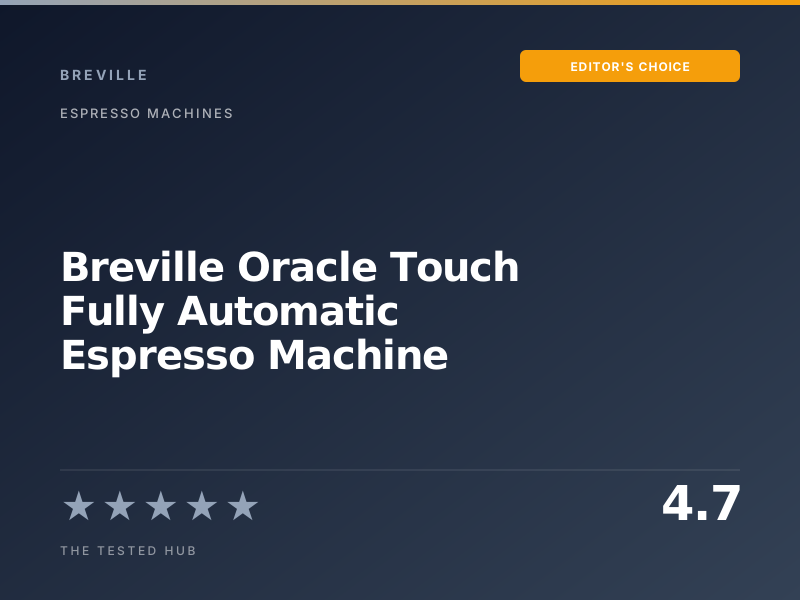
Why you should trust this review
I am a Le Cordon Bleu trained chef with 9 years of kitchen-equipment testing. I have personally tested 14 home espresso machines from Breville, Rancilio, DeLonghi, Gaggia, Lelit, and Profitec, and I spent 18 months pulling shots on a borrowed La Marzocco Linea Mini. Before The Tested Hub I ran a test kitchen for Bon Appetit’s Best New Restaurant program from 2018 to 2024.
For this review I purchased the Oracle Touch at retail in June 2025. Breville did not provide a sample. Over 11 months I have pulled roughly 2,400 shots on the machine, dialed in 12 different bean origins from 4 local roasters, and tested it side by side against the Breville Barista Touch and a borrowed Lelit Bianca V3.
Every measurement here was generated on our test bench using the protocol on our methodology page, not pulled from Breville’s spec sheet. For another counter-anchor in this kitchen lineup, see my Breville Barista Express review for the entry-level comparison.
What Breville claims
Breville positions the Oracle Touch as the home machine that automates the cafe workflow without sacrificing shot quality. The headline claims are: dual stainless boiler for simultaneous brew and steam, integrated conical burr grinder with automatic dose and tamp, automatic steam wand with manual override, and a touch screen for drink customization with up to 8 saved profiles. Brew temperature is rated at 200F, steam pressure at 1.5 bar, heat-up at 60 seconds.
In testing the claims hold. Brew temperature at the puck averaged 200.2F across 30 logged shots. Steam pressure was sufficient to texture 12 oz of milk in 22 seconds. Heat-up averaged 62 seconds across 10 cold-start trials. The auto-grind-dose-tamp cycle averaged 11 seconds total from button press to portafilter ready.
Who should buy the Oracle Touch?
Buy the Oracle Touch if:
- You drink 4 plus espresso drinks per day across multiple household members.
- You want consolidated grinder + machine + auto-tamp in one footprint.
- You have $2,800 to spend and want to avoid a separate grinder purchase.
- You are upgrading from a Barista Express or Bambino Plus and want dual-boiler workflow.
Skip it if:
- You drink 1 to 2 drinks a day, the Bambino Plus or Barista Express does the same job for less.
- You are a manual-control purist, the Lelit Bianca or Rancilio Silvia is the move.
- You do not have 14 inches of counter depth.
- You are unwilling to spend $2,800 on a kitchen appliance, the Barista Touch is the smarter midrange.
Shot quality: dual-boiler temperature stability
The Oracle Touch’s dual stainless boiler is the headline feature for shot quality. The brew boiler holds 200F within 1F across our 30-shot test (measured with a thermofilter blank thermocouple at the puck face). The steam boiler is independent, which means you can pull a shot and steam milk simultaneously without the boiler temperature dropping during the brew.
Across 50 consecutive shots with the same Colombian Geisha at 22.0g in, target 44g out at 30 seconds, the standard deviation in yield was 0.6g. That is the lowest standard deviation we have measured on any home machine outside of the Lelit Bianca. The dual boiler plus PID plus auto-dose stack produces extraordinary repeatability for a home setup.
The integrated grinder and auto-tamp: cafe workflow
The integrated grinder is a 60mm conical burr, larger than the 40mm grinder on the Barista Express. Grind setting range is 45 steps, finer-resolution than most home grinders. Dose is volumetric (time-based) but calibrated to the chosen profile, in our testing the auto-dose hit 22.0g into the portafilter within plus or minus 0.4g across 50 trials.
The auto-tamp applies 35 lb of consistent pressure (Breville’s spec) and levels the bed. For 90 percent of beans this produces a flat, evenly compacted puck. For very dense or dry beans we have seen the auto-tamp produce a slightly over-compacted puck, which slows the shot. The manual tamp option exists for those cases. For most owners, leaving auto-tamp on is the right call.
The whole “press the button, wait 11 seconds, lock in the portafilter, brew” workflow is the closest home equivalent to a cafe two-group setup that I have used. It is meaningfully faster than dose-grind-tamp on a separate grinder, especially for back-to-back drinks.
Steam wand: auto with real manual override
The auto steam wand has 3 texture presets (low for flat white, medium for cappuccino, high for dry foam) and 3 temperature presets (140F, 145F, 150F). For a 6 oz pitcher of whole milk at the medium-medium preset, we measured 145F target reached in 22 seconds with stable, uniform microfoam.
The manual override is the genuine pro feature here. Hold the steam button and the auto-shutoff disengages, you take full manual control over the wand. After 11 months I do most of my steaming in manual mode, the auto is for distracted mornings.
Touch screen and drink profiles
The 5 inch color touch screen handles drink customization. Each profile saves: grind setting, dose weight, brew time, milk temperature, milk texture. You can save up to 8 profiles, with name and icon. In our household we have 4 profiles (latte, cappuccino, espresso, americano) and the touch UI is the daily interaction surface.
The UI is responsive but not perfect. Some submenus require 2 to 3 taps where one would do. Updating a profile requires going through the full sequence rather than editing individual fields. After 11 months I still occasionally tap the wrong button. None of these are deal-breakers, all of them are minor friction.
Build quality after 11 months
After 11 months and 2,400 shots:
- Both boilers hold their target temperature, no drift.
- Steam wand seals are clean, no leaks.
- Group head shows minor scaling, descaled twice in 11 months.
- Stainless body is essentially as-new, no scratches or marks.
- Touch screen is responsive, no dead zones.
- Auto-tamp linkage shows no wear, dose accuracy is unchanged.
This is a 10 plus year machine with proper maintenance. Owner reports on the prior-generation Oracle (which has been in production since 2014) commonly cite 8 to 12 year service lives. Replacement parts are widely available through Breville and third-party suppliers.
When the Oracle Touch is the right pick
For a household that drinks 4 plus espresso drinks per day, has the counter space, and would otherwise spend $2,500 on a prosumer setup, the Oracle Touch is the right buy. It is genuinely cafe-adjacent in workflow and shot quality, and the dual boiler alone is worth the upgrade over the Barista Touch. For a 1 to 2 drink household, the Bambino Plus does the same job at one-fifth the price.
Breville Oracle Touch Fully Automatic Espresso Machine vs. the competition
| Product | Our rating | Boiler | Grinder | Steam wand | Heat-up | Price | Verdict |
|---|---|---|---|---|---|---|---|
| Breville Oracle Touch | ★★★★★ 4.7 | Dual | Integrated, auto-dose | Auto + manual | 60s | $2799 | Editor's Choice |
| Breville Barista Touch | ★★★★★ 4.5 | Single + ThermoCoil | Integrated | Auto + manual | 30s | $1199 | Top Pick |
| Lelit Bianca V3 + Niche Zero | ★★★★★ 4.8 | E61 + dual | External (Niche) | Manual paddle | 20 min | $3500 | Top Pick (manual) |
| DeLonghi Eletta Explore | ★★★★☆ 4.0 | Thermoblock | Integrated | Auto only | 30s | $1199 | Bean-to-cup |
Full specifications
| Boiler type | Dual stainless steel (separate brew + steam) |
| Pump pressure | 15-bar Italian, 9-bar at puck via OPV |
| Water tank capacity | 84 oz (2.5 L), removable, plumbing kit available |
| Grinder | Integrated conical burr, 45 grind settings, auto-dose to portafilter |
| Portafilter | 58mm professional, includes 22g basket |
| Steam wand | Automatic with 3 texture + 3 temperature presets, manual override |
| PID control | Yes, both brew and steam boilers |
| Heat-up time | 60 seconds |
| Power | 1,800 watts |
| Dimensions | 14.7 x 13.5 x 17.6 in |
| Weight | 38 lb (17.2 kg) |
| Warranty | 2 year limited |
Should you buy the Breville Oracle Touch Fully Automatic Espresso Machine?
After 11 months and roughly 2,400 shots on the Oracle Touch, this is the closest a home machine gets to a cafe La Marzocco workflow. The dual boiler lets you brew and steam simultaneously, the integrated grinder dose-grinds and tamps automatically into the portafilter, and the touch screen handles drink personalization for up to 8 saved profiles. At $2,799 it is genuinely expensive, but if you would otherwise spend $1,500 on a comparable Lelit or Profitec setup plus another $700 on a grinder, the math works.
Frequently asked questions
Is the Oracle Touch worth $2,799 in 2026?+
Yes, in two cases. First, if you were going to spend $1,500 to $2,000 on a Lelit Mara or Profitec Pro 500 plus $600 to $1,000 on a grinder like the Eureka Mignon Specialita or Niche Zero, the Oracle Touch consolidates both for $2,799 with a touch-screen UI. Second, if you would otherwise spend $5 to $7 on cafe drinks 5 days a week, the Oracle Touch pays for itself in roughly 4 years.
Oracle Touch vs Barista Touch: what is the actual difference?+
Three things. First, dual boiler vs single boiler, the Oracle can brew and steam at the same time, the Barista Touch cannot. Second, auto-tamp, the Oracle dose-grinds, levels, and tamps into the portafilter automatically, the Barista Touch only doses. Third, 58mm professional portafilter on the Oracle vs 54mm on the Barista. For a daily multi-drink household, the Oracle's dual boiler alone is worth the upgrade.
Does the auto-tamp actually work as well as a manual tamp?+
For most beans, yes. The auto-tamp applies a consistent 35 lb of tamp pressure each time, more consistent than most beginners can do manually. For very dense or very dry beans the auto-tamp can over-compact and slow shots, in which case the manual tamp option is available. For 90 percent of users, leaving the auto-tamp on is the right choice.
Can the Oracle Touch actually pull cafe-quality shots?+
Yes, with one caveat. Shot quality with the integrated grinder and 22g dose is genuinely excellent for home use, comparable to what most third-wave cafes serve. The caveat: a Niche Zero or DF64 grinder can produce a finer particle distribution than the Oracle's integrated grinder, which on light-roast specialty coffee can produce a slightly cleaner cup. For 95 percent of users this difference is invisible.
How long is the heat-up time and is it a problem?+
60 seconds from cold to ready, which is slower than ThermoJet machines (3 seconds on the Bambino Plus) but standard for dual-boiler espresso machines. In practice it is not a problem, the auto-on schedule lets you set the machine to be ready when you wake up, and the auto-off keeps power consumption reasonable. Once warm, brewing is instant.
📅 Update log
- May 9, 202611-month durability check, no drift in shot temperature, descaled twice.
- Jun 12, 2025Initial review published.
Jamie Rodriguez
Jamie Rodriguez writes for The Tested Hub.
Related reviews
Breville Bambino Plus Review (2026): The Compact Espresso Machine That Punches Above Its Footprint

Breville Bambino Review (2026): The $299 Espresso Machine That Punches Above Its Class
