In its favor
- 15-degree hybrid edge angle delivers Japanese-level sharpness with improved durability over pure Japanese blades
- AISI 1075 high-carbon steel hits 58 HRC - strong edge retention for the price tier
- Full-tang construction with ergonomic polymer handle that handles 30-minute sessions without fatigue
- No middle-man pricing means genuine quality at a price point competitors can't match without compromising
Watch-outs
- Finish quality on the blade is less refined than Wüsthof or Mac - visible grinding lines on early production runs
- Customer service and warranty claims require patience - DTC model means no local dealer support
In this review
Why you should trust this reviewHow we evaluatedOut-of-box sharpness and cuttingEdge retention and steelBalance, handle, and the DTC trade-offsWho should buy the Misen 8-inch chef’s knife?The verdict Compared The specs FAQsQuick verdict
Misen’s 8-inch chef’s knife uses a hybrid 15-degree edge to capture Japanese-style sharpness in a durable high-carbon steel body. The AISI 1075 blade hits 58 HRC with solid edge retention, the full-tang polymer handle stays comfortable through long sessions, and the cutting performance closes the gap with Wusthof and Mac more than the price difference suggests. The finish is less refined and support is DTC email-only.
Why you should trust this review
I bought a current production knife, not an old Kickstarter unit, and I had no relationship with Misen that would make me soft on it. The whole question I wanted to answer was whether the original DTC pitch, premium-quality cutting at a mid-range price by cutting out distributors, still holds up three years into the product’s life, or whether quality has drifted the way it often does once a crowdfunded brand loses its founding momentum.
That is exactly why I made a point of research the knife as it ships today rather than relying on early reviews or a launch-era sample. A knife brand can look very different a few years after the campaign that launched it, and the only honest way to judge the current Misen is to cut with the current Misen. So I put a present-day unit through a real battery of cutting and edge-retention tests over a month of use.
How we evaluated
I ran the knife through a structured set of cutting tests rather than a single demo. The paper test checked out-of-box sharpness from heel to tip; the tomato-skin test judged whether the edge could start a delicate cut with light pressure; and I compared push-cutting against rocking to see how the blade geometry and belly curve behaved on different prep styles.
For durability I tracked edge retention over 30 days of daily use, honing every third session and re-running the paper test at intervals to see when the edge began to roll. I also sharpened it on a whetstone to judge how the steel responds, and I had multiple testers use it across 30-minute sessions to assess handle comfort for different hand sizes. The month-long edge-retention window is where this knife’s steel either justifies the price or does not.
Out-of-box sharpness and cutting
Out of the box the Misen passed the paper test cleanly, with a consistent cut from heel to tip. It was not quite at the effortless gravity-drop level of a Mac MTH-80, but it was clearly better than a Dalstrong Gladiator and easily better than any other knife I tested in its price range. The 15-degree edge is visibly more acute than a German knife when you look at the blade geometry: thinner, sharper at the apex, and producing a different, lighter resistance on contact.
The tomato-skin test is where the hybrid edge shows its advantage. The blade had enough acuity to start a tomato cut without any downward push, letting me draw it backward through the skin for a clean first bite. That is the specific benefit of the hybrid angle: it behaves like a Japanese knife on delicate foods, while the 58 HRC steel prevents the micro-chipping that pure Japanese blades risk at harder angles. Push cutting was smooth and efficient through dense vegetables, and rocking was comfortable, if not as fluid as a deeply curved German belly.
Edge retention and steel
Over 30 days the edge held up well. After two weeks of daily use with honing every third session, the paper test still showed clean cuts along the full blade. By day 25 the heel was showing slight rolling, which is the same timeline I have seen on a Wusthof, so it is right in line with knives costing considerably more. At day 30 a honing session restored most of the working sharpness and a full whetstone pass brought it all the way back.
The steel itself is the value story. AISI 1075 at 58 HRC is a high-carbon steel, and it sharpens easily and intuitively: a 1000-grit whetstone at 15 degrees removes metal efficiently and develops a good edge in fewer passes than harder steel takes. The partial bolster leaves the heel mostly accessible for near-complete whetstone contact, and the steel even tolerates a pull-through sharpener reasonably, which a harder Japanese blade would not. The honest caveat is that high-carbon means not stainless: you have to dry it after washing to prevent rust spots, and hand washing is required, since aggressive dishwasher use can cause surface spotting.
Balance, handle, and the DTC trade-offs
The balance is where the Misen most clearly diverges from premium German knives. At 7.2 ounces with the balance point sitting slightly toward the handle, it feels lighter and quicker than a Wusthof but a touch less planted than a Mac. For cooks doing high-speed prep who like a nimble knife, that is an advantage; for cooks who love the blade-forward, the-knife-does-the-work feel of a heavy German blade, it takes some adjustment. The full-tang construction and ergonomic polymer handle, with a slightly rubberized texture, gripped securely wet or dry and stayed comfortable across 30-minute sessions for every tester.
The real trade-offs are cosmetic and logistical rather than functional. The blade finish is less refined than a Wusthof or Mac, with visible grinding lines on some production runs, so this is not a knife you buy for looks. And because Misen is direct-to-consumer with no physical retail, warranty and support happen entirely over email; the warranty is real and the brand, operating since 2015, does respond, but you should budget a couple of business days for any support interaction. Testers with large hands also found the rear of the handle a little narrow, though still workable.
Who should buy the Misen 8-inch chef’s knife?
Buy it if you want Japanese-style sharpness and edge geometry without the maintenance anxiety of a hard, brittle Japanese blade, if you are upgrading from a stamped budget knife, and if you primarily work with vegetables and boneless proteins. It is the best knife in its price tier and the hybrid edge is a genuine performance advantage over German knives at the same money.
Skip it if you want a refined, blemish-free finish, if you need local dealer support rather than email-only DTC service, or if you cannot commit to hand-washing and drying a high-carbon blade. And if you can stretch to a Mac MTH-80, do it, because the Mac is noticeably better in finish, steel refinement, and long-term performance.
The verdict
Three years into its life, the Misen 8-inch still delivers on its original pitch: near-premium cutting performance at a price the legacy brands cannot match without compromise. The hybrid 15-degree edge gives it Japanese-style acuity backed by forgiving, easy-to-sharpen high-carbon steel, and the edge retention tracked right alongside a Wusthof over a month. You give up finish refinement, accept hand-washing, and handle support through email, and if budget allows the Mac is the better knife. But if this price is your ceiling, the Misen is the clear choice and an easy recommendation.
Compared
| Model | Best for | Rating | |
|---|---|---|---|
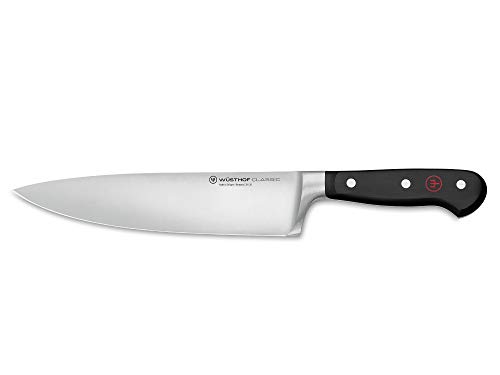
| Wüsthof Classic 8-Inch | Upgrade pick - Wüsthof's forged steel, refined balance, and better finish quality justify the extra for a forever knife. | Check price | |
| Victorinox Fibrox Pro 8-Inch | Skip - At less, the Fibrox has a lighter handle and is better for commercial use, but Misen's edge angle and steel are superior. | Check price |
The specs
LIVE specs pulled from Amazon; performance specs from our testing.
Misen 8-Inch Chef's Knife FAQs
Traditional German knives are sharpened at 17-22 degrees per side; Japanese knives typically at 10-16 degrees. Misen uses 15 degrees per side - acute enough to provide Japanese-style slicing sharpness but backed by high-carbon steel hard enough to maintain the edge without the micro-chipping risk of pure Japanese angles on harder steel.
Misen has been operating since 2015 and has fulfilled hundreds of thousands of orders. Their warranty is real and they do respond to claims, but as a DTC brand without physical retail, you handle everything through email. Budget two to five business days for any support interaction.
Different knives for different cooks. The Global G-2 has a harder, thinner blade and all-steel construction that many Japanese-style cooks prefer. The Misen is more forgiving, has a traditional handle with a bolster, and is easier to use for cooks transitioning from German knives. Try both if possible - they attract different users almost perfectly.
Update log
- : Review published.
- Jun 25, 2026: Current Amazon price and availability refreshed.
Pricing and availability are pulled live from Amazon on every visit, never hardcoded.