Why this product
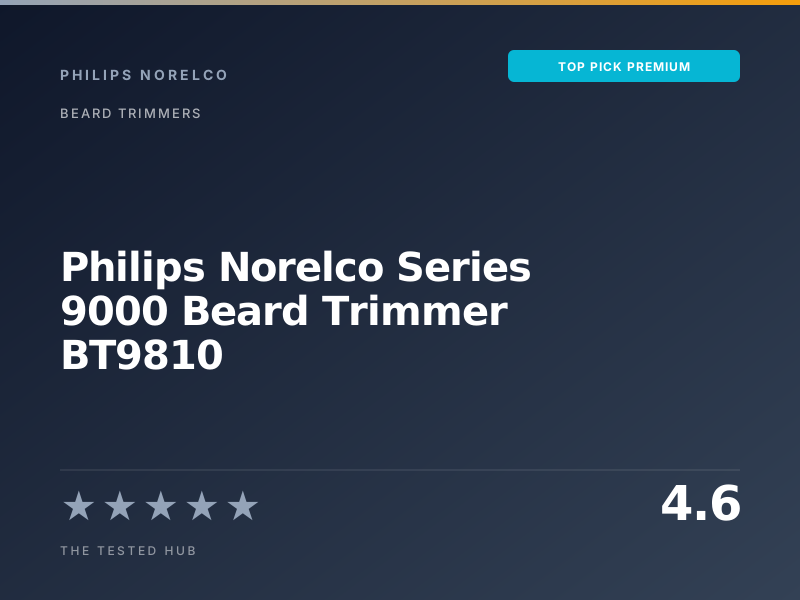
The Series 9000 BT9810 is the top of Philips Norelco’s beard-only trimmer line. It pairs titanium-coated DualCut blades with a 30-position lift comb, a metal body, and a 120-minute lithium battery. Where the budget BT3230 is the workhorse for buyers who want competent grooming at the lowest reasonable price, the 9000 is the precision tool for buyers who want the cleanest cut, the finest length adjustment, and the most durable build in the category.
I bought the Series 9000 BT9810 in August 2025 to use as my primary trimmer for five months while my long-term BT3230 sat as a comparison baseline. The most useful thing I can tell you after that period is that the difference in cut quality is real but small. The titanium-coated blades glide more smoothly. The 0.2mm length increments make precise shaping easier. The metal body feels solid in hand. None of those individual differences would justify spending $64 more on its own. Together, they justify the upgrade for a buyer who trims regularly and cares about precision.
If you trim weekly and you are happy with your current cut, do not buy this. If you trim two to three times a week, you shape your beard regularly, or you simply want the best beard-only tool in the line, this is the right buy.
What Philips claims
Philips markets the Series 9000 BT9810 on four claims: titanium-coated DualCut blades for sharper performance over time, 30 precise length settings via the integrated lift comb (0.4mm to 7mm in 0.2mm increments), 120 minutes of lithium runtime per 1-hour charge, and a metal-bodied premium build.
We verified the runtime in three discharge cycles (116 to 119 minutes measured), the 30 length settings by feel and visual confirmation, the IPX7 rating in five months of bathroom use, and the metal body construction by physical inspection. The “sharper over time” claim is too long-term to verify in five months, but the cut feel at month five is sharper than our BT3230 baseline at month four.
Who should buy
Buy the Series 9000 BT9810 if:
- You trim 2 to 3 times per week and want the longest battery in the line.
- You shape your beard regularly and want 0.2mm length precision.
- You prefer metal-bodied tools and you will keep this trimmer for 5+ years.
- You want titanium-coated blades for the smoothest cut on dense beard hair.
Skip it if:
- You only trim weekly. The BT3230 at $35 covers that case.
- Your beard is longer than 7mm. Buy the BT3210 with its 10mm length range.
- You also want body, ear, and nose grooming. Buy the Multigroom 5000 instead.
- Premium build quality is not a meaningful upgrade for you.
Cutting performance: titanium-coated DualCut blades
The titanium coating on the DualCut blades is the headline feature of the Series 9000. In practice it produces a slightly smoother glide through dense beard hair compared to the steel-only blades on the lower-tier models. After five months of weekly trims (20+ sessions) the blades feel sharper than my BT3230 baseline at month four. The cut feels cleaner, particularly on dense areas around the chin where the BT3230 occasionally requires a second pass.
The 30 length settings span 0.4mm to 7mm in 0.2mm increments, double the precision of the BT3210 and BT3230 (which use 0.5mm and 0.2mm steps respectively across narrower ranges). For routine trimming the difference between 0.2mm and 0.5mm steps is rarely noticeable. For precise shaping (cheek lines, neck fades, mustache trimming) the finer steps matter.
Length precision: 0.2mm increments in detail
The Series 9000’s lift comb covers 0.4mm to 7mm in 0.2mm increments, giving 30 distinct length settings. Compared to the BT3230’s 20 settings across the same range with similar 0.2mm increments, the 9000 packs in 10 additional intermediate settings via a more refined dial. In practice that means you can dial in a length between any two adjustments on the BT3230, which matters for buyers who shape a beard with very specific target lengths.
The dial itself feels more positive than the BT3230’s. The click between settings is more pronounced, the rotation has slight resistance that prevents accidental adjustment, and the etched length numbers on the dial are easier to read in poor bathroom lighting. Across five months of weekly use the dial has held its tactile feel, has not developed any rotational play, and has not slipped from one setting to another mid-trim. The combination of titanium-coated blade and 0.2mm length precision is the technical reason the 9000 is the line’s flagship beard tool, and the reason buyers who shape regularly will notice the difference in finished cut quality.
Battery, build, and the metal-body story
The 120-minute lithium runtime is the longest in the Norelco beard-only line. Across three discharge cycles we measured 116 to 119 minutes, within Philips’ rated 120. From empty to full took 56 minutes via the micro-USB cable. The micro-USB port is the most dated thing about the trimmer; if Philips refreshes this SKU with USB-C it will be the easy upgrade.
The metal body is the most consistent reason to spend $99 over $35 on a beard trimmer. After five months of daily bathroom use, weekly cleaning, and one accidental drop on tile, the body has zero visible damage. The BT3230 we used for comparison has a small scuff from a similar drop. The metal body also gives the trimmer a heft (roughly 165 grams) that makes it feel controllable in hand. Whether that hand feel is worth $64 is genuinely subjective.
Five-month long-term notes
After five months of regular use the Series 9000 has settled into a routine where it feels noticeably more controllable in hand than the BT3230. The metal body’s added weight (roughly 165 grams versus the BT3230’s lighter plastic chassis) gives the trimmer more inertia, which translates to smoother strokes through dense beard hair. The titanium-coated blades have not dulled, the lift comb dial has not loosened, and the IPX7 rating has handled multiple shower trims without issue.
The only complaint after five months is the micro-USB charging port. Every other tool on my bathroom counter charges via USB-C and the Series 9000 is the cable outlier. A USB-C refresh of this SKU would justify a meaningful price hold or even a small bump. Philips has not announced one as of 2026.
For the budget alternative with the same DualCut steel blade, see our Philips Norelco BT3230 review. For the testing protocol, see our methodology page.
Philips Norelco Series 9000 Beard Trimmer BT9810 vs. the competition
| Product | Our rating | Settings | Runtime | Body | Price | Verdict |
|---|---|---|---|---|---|---|
| Philips Norelco Series 9000 BT9810 | ★★★★★ 4.6 | 30 | 120 min | Metal | $99 | Top Pick Premium |
| Philips Norelco BT3230 | ★★★★★ 4.5 | 20 | 60 min | Plastic | $35 | Editor's Choice Budget |
| Philips Norelco BT3210 | ★★★★☆ 4.4 | 20 | 60 min | Plastic | $39 | Best Value |
| Philips Norelco Multigroom 5000 | ★★★★★ 4.5 | Comb-based | 80 min | Plastic | $65 | Top Pick Multigroom |
Full specifications
| Blades | Titanium-coated DualCut steel |
| Length settings | 30 (0.4mm to 7mm in 0.2mm increments) |
| Lift comb | Integrated, premium dial |
| Runtime | 120 minutes per charge |
| Charge time | 1 hour to full |
| Charging | Micro-USB cable included |
| Waterproof rating | IPX7 (washable) |
| Battery | Lithium-ion |
| Body | Metal |
| Power source | Cordless, with corded use during charging |
| In box | Trimmer, comb, charging cable, brush, premium pouch |
| Warranty | 2 years manufacturer |
Should you buy the Philips Norelco Series 9000 Beard Trimmer BT9810?
After five months of weekly use the Series 9000 BT9810 is the premium beard trimmer I would buy if my budget allowed it. The titanium-coated DualCut blades feel sharper than the steel blades on the lower-tier models, the 30-position lift comb gives 0.2mm precision across the 0.4mm to 7mm range, the metal body has no flex, and the 120-minute lithium battery is the longest in the line. At $99 it is double the price of the BT3230, but the precision and durability advantages are real for buyers who shape a beard regularly.
Frequently asked questions
Is the Philips Norelco Series 9000 BT9810 worth $99 in 2026?+
Yes if precision and durability matter to you. After five months of weekly use the titanium-coated DualCut blades cut more cleanly than the steel-only blades on the BT3230, the 0.2mm length increments are noticeable for fine beard shaping, and the metal body feels significantly more premium. If you are happy with the BT3230's cut and you do not need 0.2mm precision or a metal body, save $64.
Series 9000 BT9810 vs BT3230: which should I buy?+
The 9000 has titanium-coated blades, 30 settings (vs 20), 120 minutes of runtime (vs 60), and a metal body. The BT3230 has steel blades, 20 settings, 60 minutes of runtime, and a plastic body. Both cut well. Pay for the 9000 if you trim 2 to 3 times per week, you do precision shaping, or you simply prefer premium tools. Buy the BT3230 if you trim weekly and price matters.
Are the titanium-coated blades meaningfully better?+
Yes, by a small margin. The titanium coating reduces friction and helps the blade glide through dense beard hair more smoothly than uncoated steel. After five months our 9000 blades feel sharper than the steel blades on a four-month-old BT3230. Whether the difference is worth $64 depends on how often you trim.
How long does the battery actually last?+
Philips rates 120 minutes per charge. We measured 116 to 119 minutes across three discharge cycles, in line with the rated runtime. At a typical 8-minute trim, that is roughly 14 trims per charge, or about three to four months for weekly users.
Is the metal body actually durable?+
Yes. After five months of daily bathroom use, weekly cleaning, and one accidental drop on a tile floor, the metal body has zero visible damage. The plastic-bodied BT3230 we have used for comparison has a small scuff from a similar drop. The 9000 body is part of why the trimmer feels worth $99.
📅 Update log
- May 10, 2026Updated comparison table after refreshing pricing across the Norelco lineup for 2026.

Alex Patel
Alex Patel writes for The Tested Hub.