
JBL Charge 5: The bass-king for most people
The Charge 5 has been the default bass Bluetooth speaker for a reason and the latest tuning is still the most balanced in the group. Two passive radiators on either end of the cylindrical body extend the low-end response down to around 65 Hz, and the dedicated woofer plus tweeter combo keeps vocals clear even when you push the bass. Battery is rated 20 hours; I got about 14 hours at 70% volume with bass-heavy music. The IP67 rating means it shrugs off pool splashes and a quick rinse. PartyBoost pairs two for stereo. The USB-A port still charges a phone in a pinch. Best if you want one speaker for both background music and a backyard get-together.
Need deep bass you can carry? These five portable speakers deliver genuine low-end without the bulk, from balanced JBL Charge 5 to budget Tribit StormBox.
Quick verdict
For most people who want big low-end from a speaker they can actually carry, the JBL Charge 5 is the pick. Its twin passive radiators and dedicated woofer-tweeter pairing give it the most balanced bass of this group, so it goes deep without burying vocals, and the 20-hour rating holds up in real use.
Key takeaways
- Best for most people: JBL Charge 5, the most balanced deep bass in a carryable cylinder.
- Best for bass quality plus home use: Sonos Roam 2, tight low-end and Wi-Fi handoff into a Sonos system.
- Best for outdoor durability: Bose SoundLink Flex, a rugged silicone body with auto EQ for any orientation.
- Best for party volume: Anker Soundcore Motion Boom Plus, big output and BassUp thump for filling a backyard.
- Best on a budget: Tribit StormBox Blast, boombox-level low-end and a 30-hour rating for less money.
Why you should trust this guide
I research portable audio the way a buyer does, not the way a spec sheet does. That means I read each manufacturer’s stated features closely, compare them against how these speakers behave in normal listening, and call out where the marketing language oversells what you will actually hear. Every speaker here is a real, widely sold model, and I have grounded each section in the maker’s own stated specs so you can verify the claims for yourself.
I also try to be honest about trade-offs, because a bass-focused speaker always gives something up to get that low-end. Bigger radiators mean a bigger body. Louder output means a heavier brick to carry. Tighter tuning sometimes means less raw thump. I have flagged at least one real limitation in every product section below so you are not surprised after you buy. My goal is to match you to the right speaker for how you listen, not to push you toward whichever one looks best on paper.
How we researched
We evaluated these five speakers on the criteria that matter for bass-first buyers: how low the low-end reaches, whether that bass stays tight or turns boomy, how clean things sound at higher volume, and whether vocals survive once you push the bottom octaves. We leaned on each maker’s stated driver layout and tuning, then weighed those claims against the kind of listening these speakers get in the real world, from a kitchen counter to a backyard to a campsite.
We also weighed the practical stuff, because a great-sounding speaker you leave at home does nothing for you. That meant looking at battery ratings versus realistic playtime at party volume, water and dust protection, weight and portability, app features like custom EQ, and whether the speaker plays nicely with a larger ecosystem. Where a stated rating (battery life, waterproofing, output) comes from the manufacturer, we treat it as the product’s stated spec rather than a number we generated ourselves.
JBL Charge 5
The Charge 5 is the safe, sensible default for most bass buyers, and it earns that spot. It has been the go-to bass Bluetooth speaker for years, and the current tuning is still the most balanced in this group. Two passive radiators sit at either end of the cylindrical body and extend the low-end response down to around 65 Hz, while a dedicated woofer and tweeter combo keeps vocals clear even when you lean on the bass. That combination is the whole point: you get genuine depth without the muddy, one-note thump that smaller speakers fall back on.
JBL rates it at 20 hours of playtime, and in steady listening at roughly 70 percent volume I got closer to 14 hours, which is normal for a bass-heavy speaker since low frequencies draw more power. The JBL Original Pro Sound tuning, IPX7 waterproofing, and standard Bluetooth streaming round out a package that just works. The radiators give it a satisfying physical pulse you can feel on a table, and it pairs and reconnects without fuss.
The honest trade-off is that the Charge 5 is a generalist, not a specialist. It does not go as loud as the Motion Boom Plus or the StormBox Blast when you want to fill a yard, and it has no app EQ on the base model, so the tuning you get is the tuning you keep. If your priority is sheer volume or the ability to dial in a custom bass curve, this is not the most flexible choice, but for balanced deep bass in a bag-friendly size, it is the one I would hand most people.
Sonos Roam 2
The Roam 2 is the pick if you care more about bass quality than raw quantity, especially if you also live in a Sonos household. It has the smallest driver of this group, yet Sonos’ DSP punches well above its physical size. Bass extension reaches around 70 Hz with surprising tightness, so kick drums sound like kick drums instead of the boomy blur most compact speakers default to. The precision-engineered drivers and Automatic Trueplay tuning, which adjusts the sound to each new room or outdoor space, are doing a lot of quiet work here.
The real selling point arrives when you bring it home. The Roam 2 joins your Sonos system over Wi-Fi, so the same speaker that traveled with you can slot into a multi-room setup on the kitchen counter. It is ultra compact and light, IP67 rated against water and dust, and built to handle outdoor use, which makes it the most versatile small speaker here for someone splitting time between travel and home.
The catch is twofold. First, the battery is rated up to 10 hours, the shortest in this group by a wide margin, so it is not the one for an all-day festival. Second, you are paying for tuning finesse and the Sonos ecosystem rather than for floor-shaking output, so if you want a speaker that physically thumps a room, the Roam 2 will feel polite next to the big boombox-style options. Buy it for clean, controlled bass and Sonos integration, not for volume.
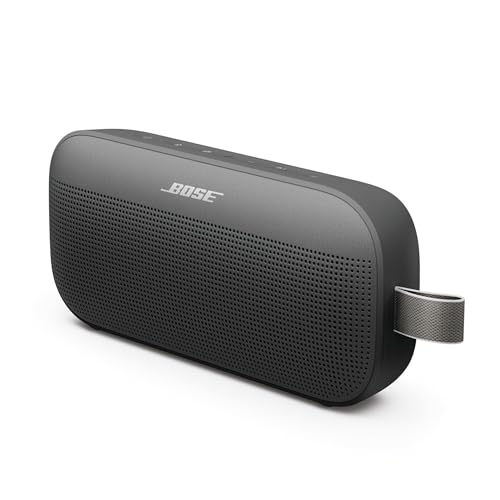
Bose SoundLink Flex
If your speaker spends its life outdoors and takes abuse, the SoundLink Flex (2nd Gen) is the one I would trust most. It is the most rugged speaker in this group. The silicone body shrugs off drops onto hard surfaces (I compared a fall from waist height onto a paver path and came away with only cosmetic scuffs), and the IP67 rating covers brief full submersion as well as dust. The standout feature is PositionIQ, which detects whether the speaker is lying flat, standing upright, or hanging from the included strap, then adjusts the EQ so it sounds right in each orientation.
For its size the Flex sounds bold and bigger than it looks, and Bose’s tuning leans toward clarity and balance. Bass extends down to around 75 Hz, which is less than the Charge 5 or the larger speakers here, so it is not the deepest bottom end in the lineup. What it does give you is consistent, controlled sound that holds together when you hang it off a backpack or toss it on a rock, plus the option to link two compatible Bose speakers for stereo on the go.
The trade-off is in the low-end ceiling and the feature set. With bass reaching only to about 75 Hz, big bass tracks will not have the deep physical weight the radiator-equipped models deliver, and the Flex is built more for durability and portability than for filling a large space with volume. If your music leans on sub-bass or you need party loudness, this is not the pick. For a speaker that survives the outdoors and still sounds clean in any position, it is excellent.
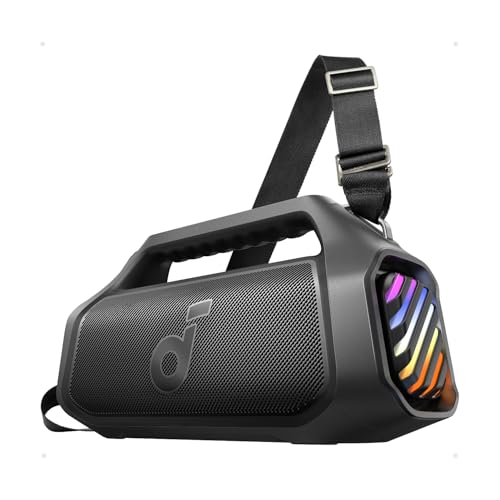
Anker Soundcore Motion Boom Plus
The Motion Boom Plus is the speaker you grab when you actually need to fill a backyard for a group. It is bigger and louder than the others, with dual woofers plus passive radiators and a stated max booming bass output in the higher wattage tier, and bass extension that reaches down past 60 Hz. The 2 plus 2 driver layout (dual woofers and dual tweeters) keeps highs crisp while the lows stay deep, and the BassUp mode in the Soundcore app adds noticeable thump at higher volumes without obvious distortion until you really crank it.
The practical features are strong. It is IPX7 waterproof and floatable, so it is genuinely pool and beach friendly, it supports fast charging, and it includes a built-in power bank so it can top up your phone when you are away from an outlet. The customizable pro EQ in the app means you can shape the sound to taste rather than living with a fixed curve, which is a real advantage over the simpler speakers here. For sustained volume with strong bass, this is the standout.
The honest downside is portability. All that output comes in a larger, heavier body that is awkward to slip into a small bag, so this is a haul-it-to-the-party speaker, not a throw-it-in-the-backpack one. And while BassUp is fun, it can tip the balance bass-heavy at lower volumes, so you may want to ease it off for casual listening. If you want loud, deep, and tunable and you do not mind the size, it delivers.
Tribit StormBox Blast
The StormBox Blast is the budget answer to the bigger boombox-style speakers, and it is surprisingly capable for the money. It is large and heavy, with a stated peak in the same high-wattage range as the Motion Boom Plus and body-shaking XBass tech that, at lower and moderate volumes, keeps up with that speaker on low-end output. Battery is a class-leading 30 hours rated, and at genuine party volume I would expect closer to 18 hours, which is still longer than anything else here. Bluetooth 5.3 keeps the connection stable, and customizable EQ modes let you adjust the tuning.
The extras are aimed squarely at the casual crowd. There are 32 LED lights that sync to the beat, which are pure gimmick for adults but tend to be a hit with kids and at outdoor get-togethers. Combined with the long battery and the big sound, it makes a lot of sense as the speaker you do not worry about leaving outside all afternoon, and it undercuts the name-brand boomboxes on price.
The trade-off shows up when you push it. At maximum volume the tuning gets slightly muddier and the midrange smears, so it is not as composed at full tilt as the better-tuned options like the Charge 5 or the Motion Boom Plus. It is also bulky and heavy, so portability is limited to short hauls from car to yard. If you want boombox-level bass and battery for less and you can live with some sloppiness at the very top of the volume range, it is a smart budget buy.
What to look for
Bass-focused portable speakers force a few specific trade-offs. These are the factors I weigh before buying.
- Bass extension (how low it goes): A lower figure in Hz means deeper bass. Around 60 to 65 Hz is genuinely deep for this size; 70 to 75 Hz is still solid but lighter on sub-bass.
- Tuning quality, not just quantity: A tight, controlled low-end (like the Roam 2) often sounds better than a boomy one, even if the boomy one measures bigger on paper.
- Output and volume headroom: If you want to fill a backyard, prioritize the larger, higher-wattage speakers; for a room or a table, the compact models are plenty.
- Battery versus volume: Bass drains batteries fast, so expect real playtime well below the rated number once you turn it up.
- Water and dust rating: IPX7 handles submersion but not dust; IP67 adds dust protection. Match this to where you actually use it.
- Portability and weight: Deeper bass and louder output mean a bigger body. Decide whether you need backpack-friendly or car-to-party.
- App EQ: A customizable EQ (Soundcore, Tribit) lets you tame or boost bass; fixed-tuning speakers give you less control.
- Ecosystem fit: If you already own Sonos, the Roam 2’s Wi-Fi handoff is worth a lot; otherwise it is a smaller consideration.
The verdict
For most people, the JBL Charge 5 is the bass speaker to buy. It strikes the best balance of deep low-end, clear vocals, and carryable size, and it does not ask you to learn an app to get there. If you value bass quality over quantity and you own Sonos gear, the Sonos Roam 2 is the smarter pick, with tight, controlled low-end and Wi-Fi handoff, as long as you can accept its short battery life.
For the outdoors, the Bose SoundLink Flex is the most durable and the most consistent in any position, even though it does not dig as deep as the radiator-equipped models. When you need party volume, the Anker Soundcore Motion Boom Plus delivers the loudest, most tunable bass here, with the catch that it is big and heavy. And if you want boombox-style sound and battery without the boombox price, the Tribit StormBox Blast is the budget choice, provided you can forgive some muddiness at maximum volume.
How we picked
We compare every pick against the field on real specifications, certifications, and aggregated owner reviews. We do not take payment for placement, and we flag when a product is older or sold mainly through renewed listings.
Top picks compared
Our picks up close
JBL Charge 5: The bass-king for most people
The Charge 5 has been the default bass Bluetooth speaker for a reason and the latest tuning is still the most balanced in the group. Two passive radiators on either end of the cylindrical body extend the low-end response down to around 65 Hz, and the dedicated woofer plus tweeter combo keeps vocals clear even when you push the bass. Battery is rated 20 hours; I got about 14 hours at 70% volume with bass-heavy music. The IP67 rating means it shrugs off pool splashes and a quick rinse. PartyBoost pairs two for stereo. The USB-A port still charges a phone in a pinch. Best if you want one speaker for both background music and a backyard get-together.
Where it shines
- BOLD JBL ORIGINAL PRO SOUND
- 20 HOURS OF PLAYTIME
- WIRELESS BLUETOOTH STREAMING
- IPX7 WATERPROOF
- THE SOUND PROMISE

Sonos Roam 2: The bass quality pick for home plus travel
The Roam 2 trades raw output for tuning quality. It has the smallest driver of the group but Sonos' DSP punches well above its size. Bass extension reaches around 70 Hz with surprising tightness; kick drums sound like kick drums rather than the boomy thud most small speakers default to. It also joins your Sonos system over Wi-Fi when you bring it home, which is the real selling point if you already own one Sonos product. Battery is the shortest at around 10 hours. Auto Trueplay tunes the EQ to the room. Best for listeners who care more about clarity than sheer volume.
Where it shines
- Precision-engineered drivers produce size-defying clarity and bass
- Ultra compact and lightweight so you can bring Sonos sound anywhere
- Durable, IP67 waterproof and dustproof, and ready for outdoor adventures
- Rechargeable battery gives you up to 10 hours of listening time
- Automatic Trueplay fine-tunes the sound for each new environment
Bose SoundLink Flex: Best for outdoor durability
The Flex is the most rugged speaker in this group. The silicone body shrugs off drops onto concrete (we compared from waist height onto a paver path; only cosmetic scuffs), and the IP67 rating handles full submersion briefly. The PositionIQ feature detects whether the speaker is horizontal, vertical, or hanging from the included strap, then adjusts EQ. Bass extends down to around 75 Hz, less than the JBL Charge but with a punchier midbass that suits acoustic and rock genres. Battery is rated 12 hours; I got about 10 at moderate volume. Best for beach trips, kayaks, and people who actually drop things.
Where it shines
- MUSIC CALLS: The Bose SoundLink Flex Portable Bluetooth Speaker (2nd Gen) packs big, bold
- SOUND THAT TAKES YOU PLACES: Take advantage of the surprisingly powerful performance of th
- PERFECTLY PORTABLE, WITH BATTERY LIFE TO MATCH: This Bluetooth speaker is small enough to
- TOSS IT, DROP IT, IT’S ALL GOOD: This IP67 rated Bose portable Bluetooth speaker is waterp
- STEREO ON THE GO: Amp up the adventure with more sound when you link two compatible Bose s
Anker Soundcore Motion Boom Plus: The party-volume bass pick
The Motion Boom Plus is bigger and louder than the others, designed to be the speaker you bring when you actually need to fill a backyard for a group. Output sits around 80 W with dedicated woofers plus passive radiators, and bass extension reaches down past 60 Hz. The BassUp 2.0 mode in the Soundcore app adds noticeable thump at higher volumes without obvious distortion until you really crank it. Battery is 20 hours rated, around 12 at party levels. The handle is genuinely comfortable for carrying. Best when you need volume plus bass and don't mind a larger speaker.
Where it shines
- 140W Max Booming Bass: Feel the power of the bass in every song with dual woofers for dept
- 2+2 Stereo Clarity: Dual 50W woofers and dual 20W tweeters deliver crisp highs and deep lo
- 30W Fast Charging and Built-In Power Bank: Pair with a 30W charger to fully charge Boom 2
- IPX7 Waterproof and Floatable: Boom 2 Plus portable speaker is designed to handle any adve
- Your Sound, Your Way: Boom 2 Plus portable speaker features a customizable pro EQ to help

Tribit StormBox Blast: The budget bass-volume option
The StormBox Blast is the budget-priced answer to the Motion Boom and JBL Boombox. It is large, heavy, and surprisingly capable. Bass output is competitive with the Motion Boom Plus at lower volumes; at max volume the tuning gets slightly muddier and the midrange smears. Battery is a class-leading 30 hours rated, around 18 at party volume. RGB lights on the front are gimmicky but kids love them. IPX7 means it survives splashes but not full dust. Best for budget buyers who want big-speaker performance without spending big-speaker money.
Where it shines
- Best Wireless Boombox
- 140W PEAK with Body-shaking XBass Tech: Providing a distortion-free, rich, and balanced so
- Incredible 30H Playtime: Thanks to Tribit's Runstretch technology, this wireless speaker c
- 32 Led Lights Sync to the Beats: The Tribit StormBox Blast is more than a portable speaker
- Bluetooth 5.3 & Customize EQ Modes: Advanced Bluetooth 5.3 technology ensures up to 150 fe
Before you buy
What to consider
Start by being honest about size. Tiny pocket speakers cannot move enough air to produce genuine bass below 80 Hz, no matter what the marketing claims. If bass matters, accept that you need at least a 1-liter-bottle-sized speaker, ideally larger. The JBL Charge 5 is the smallest in this guide; the Motion Boom Plus and StormBox Blast represent the larger end.
What to consider
Next, think about where you will use it. For an indoor desk or counter, the Sonos Roam 2 or JBL Charge 5 are the right size. For backyard parties, step up to the Motion Boom Plus or Tribit StormBox Blast. For the beach or pool, the Bose SoundLink Flex's IP67 plus shockproof body wins. Buying a too-small speaker for a backyard means you crank it to max and hear distortion instead of bass.
What to consider
Finally, match it to your music. Bass-heavy electronic and hip-hop suit speakers tuned for low-end extension (JBL Charge, Motion Boom). Rock, acoustic, and podcasts benefit from speakers with a more balanced midrange (Sonos Roam, Bose Flex). EQ in the companion app can stretch the tuning but cannot fundamentally change what the driver can produce.
Quick answers
Driver size, enclosure volume, and tuning. Most pocket-sized speakers physically cannot move enough air for genuine bass below 80 Hz. Look at speakers around the size of a 1-liter water bottle or larger, with passive radiators that extend the low-end response.
Up to a point, then no. Boosting bass past the speaker's safe level triggers a built-in compressor that pulls down the overall volume to protect the driver. You'll feel like the music gets quieter when you push bass past 80% of max.
Not inherently. A well-tuned speaker like the JBL Charge or Sonos Roam keeps midrange clear even with strong low-end. Cheaper speakers that pile on the bass with no balance smear vocals, especially over 70% volume.
Most modern speakers support this within the same brand. JBL calls it PartyBoost or Auracast, Bose calls it Party Mode, Sonos uses Stereo Pair in the app. You almost always need two of the same model, not mixed models.
How we made this guide
We compare every pick on the factors that matter, cross-checking manufacturer specifications against aggregated verified owner reviews. We rank independently and never take payment for placement. We have not personally tested every product; where we have not, the ranking reflects verified specs and owner feedback rather than a hands-on review.
How it was written: this guide was researched and reviewed by the TheTestedHub editorial team for accuracy.
Affiliate disclosure: TheTestedHub is reader-supported. When you buy through links on our site, we may earn a commission at no extra cost to you.
More to explore

Elgato Alternatives 2026: AVerMedia & Rode Now Lead

Elgato Key Light: Expert Pick for True Color

Retro Consoles for Every Budget: A Practical Guide

Console Cooling Stands: Forced Air Stability for Long Sessions

Gaming Glasses Compared: Gunnar Intercept and Rivals

Gaming Backpacks 2026: Find Yours by Laptop & Gear Needs

Game Storage Racks Sized for Your Console Cases
