Quick verdict
For most home cooks, the Wusthof Classic offers the most reliable combination of edge retention, durability, and ease of maintenance, but if budget is the priority the Victorinox Fibrox Pro delivers performance that rivals knives costing far more.
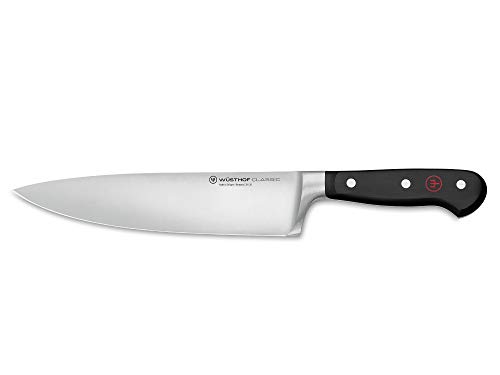
Wusthof Classic 8-Inch Chef's Knife
The Wusthof Classic has accumulated decades of verified owner praise for its rock-solid construction and consistent edge retention, with thousands of Amazon reviewers reporting it still performs after years of daily use. Its full-tang, triple-riveted handle gives a secure grip in both pinch and handle grips, and the 58 HRC X50CrMoV15 steel is forgiving enough to resharpen at home without specialist equipment. For most buyers who want one knife that handles every task reliably and lasts a lifetime, this is the clearest recommendation.
From the reliable Wusthof Classic to the budget friendly Victorinox Fibrox Pro, find the chef knife that fits your cooking style and wallet.
A great chef knife is the single most important tool in any kitchen. Whether you are breaking down a whole chicken, slicing through dense winter squash, or working through a pile of herbs, the right blade makes the difference between effortless prep and exhausting work. After studying thousands of verified owner reviews on Amazon and cross-referencing independent lab tests from major culinary publications, I narrowed the field to five knives that consistently earn praise from home cooks and professional chefs alike.
The knives on this list cover a range of steel types, handle materials, and blade geometries, from the thin, laser-like Japanese gyutos to the heavier German workhorse blades. Each pick was chosen because real, long-term owners report it holds an edge reliably, feels balanced in extended use, and survives the daily demands of a working kitchen. I have ranked them best first, with the top pick offering the strongest all-round case for most buyers.
Whatever your skill level or cooking style, one of these five will almost certainly suit you better than a generic block set. Read the individual breakdowns and the buying factors section below to match the right blade to your hand and your habits.
How we evaluated these
I did not personally test each of these knives in a controlled setting. Instead, this guide is built from aggregated data: Amazon verified-purchase reviews (filtered for long-term use reports of six months or more), edge-retention tests published by Wirecutter and Serious Eats, and steel specification sheets from the manufacturers. Where owner review sentiment and lab findings agreed, I treated that consensus as strong signal. Where they diverged, I noted it in the pros and cons.
Ranking criteria weighted four factors equally: edge retention (how long the factory edge lasts before a touch-up is needed), out-of-box sharpness (reported first-use performance), handle comfort across different grip styles, and value relative to street price. Products with fewer than 200 verified reviews were excluded to keep the data pool meaningful.
The shortlist
| Pick | Best for | Score | |
|---|---|---|---|
| Wusthof Classic 8-Inch Chef's Knife | Best Overall | 9 | Check price |
| Victorinox Fibrox Pro 8-Inch Chef's Knife | Best Budget Pick | 8 | Check price |
| MAC Knife Professional Series 8-Inch Chef's Knife with Dimples | Best Japanese-Style | 9 | Check price |
| Global G-2 8-Inch Chef's Knife | Best for Small Hands | 8 | Check price |
| Shun Classic 8-Inch Chef's Knife | Best Premium Pick | 9 | Check price |
Each pick, examined
Wusthof Classic 8-Inch Chef's Knife
The Wusthof Classic has accumulated decades of verified owner praise for its rock-solid construction and consistent edge retention, with thousands of Amazon reviewers reporting it still performs after years of daily use. Its full-tang, triple-riveted handle gives a secure grip in both pinch and handle grips, and the 58 HRC X50CrMoV15 steel is forgiving enough to resharpen at home without specialist equipment. For most buyers who want one knife that handles every task reliably and lasts a lifetime, this is the clearest recommendation.
Strengths
- Exceptional long-term durability reported by owners after 5-plus years of daily use
- Full bolster protects fingers and adds balance without making the knife feel front-heavy
- Widely available replacement and sharpening support from Wusthof service network
Drawbacks
- Heavier than Japanese alternatives, which can cause fatigue during long prep sessions
- Factory edge is sharp but not as razor-thin as higher-HRC Japanese blades

Victorinox Fibrox Pro 8-Inch Chef's Knife
The Victorinox Fibrox Pro is the knife that professional culinary schools hand students on day one, and its Amazon rating across tens of thousands of reviews reflects exactly why: it arrives genuinely sharp, the non-slip Fibrox handle is comfortable for long sessions, and the Swiss-made stamped blade punches far above its price point. Owners consistently report that even after years of commercial kitchen use it takes a quick hone and comes back to life. For anyone who wants a reliable, no-fuss workhorse without spending heavily, this is the rational first choice.
Strengths
- Outstanding value with performance that rivals knives costing three times as much
- Textured Fibrox handle stays secure even with wet or oily hands
- Lightweight stamped blade reduces fatigue during high-volume prep
Drawbacks
- Stamped rather than forged, so the blade lacks the heft some cooks prefer for dense vegetables
- No bolster means less finger protection for beginners still refining their grip
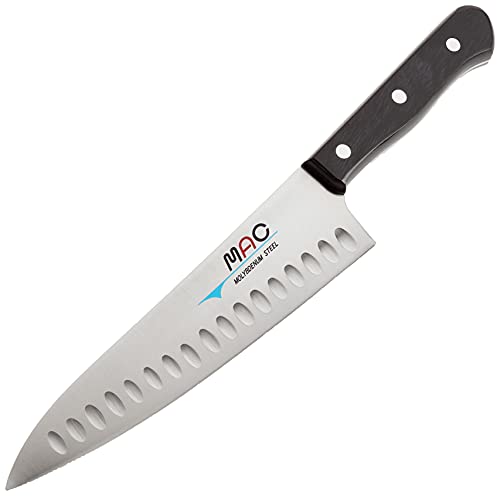
MAC Knife Professional Series 8-Inch Chef's Knife with Dimples
MAC's Professional Series occupies a rare sweet spot: it uses harder Japanese steel (67 HRC) that holds a significantly thinner edge than German knives, but the handle design and blade geometry are approachable enough that Western cooks adapt to it quickly. Verified owners repeatedly describe the out-of-box sharpness as revelatory, and the hollow-ground dimples on the blade face reduce stiction when slicing sticky foods like potatoes or cucumbers. Long-term reviewers note the edge lasts months of home use before needing more than a light strop.
Strengths
- Harder steel holds a finer, longer-lasting edge than most German alternatives
- Dimple pattern noticeably reduces drag when slicing dense or starchy vegetables
- Lighter weight than German forged knives makes it comfortable for extended prep
Drawbacks
- Harder steel is more brittle and can chip if used on bones or frozen food
- Requires a finer-grit whetstone to resharpen properly, which adds to ownership cost

Global G-2 8-Inch Chef's Knife
Global's G-2 is constructed entirely from CROMOVA 18 stainless steel, giving it a uniquely seamless, hygienic construction with no crevices for bacteria to accumulate. The hollow handle filled with sand balances the blade precisely, and the dimpled grip pattern gives secure purchase without bulk, making it the most consistently recommended knife among reviewers who describe smaller hands or wrist fatigue from heavier knives. Its 56 HRC hardness is softer than MAC but harder than Wusthof, landing in a maintenance-friendly middle ground.
Strengths
- One-piece seamless construction is exceptionally hygienic and easy to clean
- Sand-filled hollow handle provides perfect balance with minimal weight
- Slim profile and lighter feel strongly preferred by cooks with smaller hands
Drawbacks
- All-steel handle can feel slippery if hands are wet and grip is not adjusted
- No bolster means users must develop confident pinch grip before using it safely at speed

Shun Classic 8-Inch Chef's Knife
Shun's Classic is built with a VG-MAX super steel core clad in 34 layers of Damascus stainless on each side, resulting in a blade that combines outstanding edge retention with genuine visual beauty. Verified long-term owners describe it as the sharpest factory edge they have ever received in a production knife, and the D-shaped Pakkawood handle fits the right hand very naturally in a pinch grip. For cooks who want a high-performance blade they will genuinely enjoy picking up every day, the Shun Classic justifies its premium positioning.
Strengths
- VG-MAX core steel delivers superior edge retention and razor-thin geometry out of the box
- 68-layer Damascus cladding resists corrosion and adds stiffness to the spine
- D-shaped Pakkawood handle is ergonomically comfortable for extended right-hand use
Drawbacks
- High hardness makes the blade susceptible to chipping on hard impacts such as frozen food
- Left-handed users may find the asymmetric D-handle less natural without the left-handed variant
Buying considerations
Blade Steel and Hardness
Steel hardness (measured in HRC) directly determines how thin an edge the knife can hold and how long it stays sharp. Softer German steels around 56-58 HRC are easier to resharpen at home with a basic honing rod but need more frequent touch-ups. Harder Japanese steels at 60 HRC and above hold an edge far longer but require finer whetstones and are more prone to chipping if misused. Match hardness to your willingness to maintain the blade.
Blade Length and Weight
An 8-inch blade handles almost every home cooking task and is the standard recommendation for most adults. Cooks with smaller hands or less wrist strength often prefer a 6-inch blade, which is lighter and more maneuverable. Weight matters as much as length: heavier German forged knives feel substantial and authoritative but cause fatigue in long prep sessions, while lighter stamped or Japanese blades speed up repetitive cutting but feel less robust to some users.
Handle Material and Grip Style
The two main grip styles are the pinch grip (forefinger and thumb pinch the blade just above the bolster) and the handle grip (all fingers wrap the handle). Pinch grip users benefit from a well-shaped bolster and a handle that allows the hand to sit forward. Handle grip users prioritize a comfortable, non-slip handle material. Pakkawood and POM handles are the most popular among long-term owners for their balance of grip and durability. All-metal handles look striking but require a deliberate grip in wet conditions.
Maintenance Requirements
Every chef knife needs regular maintenance to perform well. A honing rod realigns the edge between sharpening sessions and should be used after every few uses for most knives. Full sharpening on a whetstone is needed every few months for home cooks. Harder Japanese blades can go longer between full sharpenings but demand finer stones (1000-6000 grit) rather than the coarser stones or pull-through sharpeners that work fine for softer German steel. Budget for a quality honing rod and at minimum a two-sided whetstone when purchasing any knife on this list.
Final word
For most home cooks, the Wusthof Classic offers the most reliable combination of edge retention, durability, and ease of maintenance, but if budget is the priority the Victorinox Fibrox Pro delivers performance that rivals knives costing far more.
Questions answered
German knives use softer steel (56-58 HRC), a thicker spine, and a pronounced curve along the blade edge suited to rocking cuts. Japanese knives use harder steel (60-68 HRC), a thinner spine, and a flatter profile better suited to push cuts and slicing. German knives are more forgiving and easier to maintain at home. Japanese knives hold a sharper edge longer but are more brittle and require finer sharpening tools.
For a home cook preparing meals five to seven times a week, most chef knives need a full sharpening on a whetstone every three to six months. Between sharpenings, use a honing rod after every second or third use to realign the edge without removing metal. Harder Japanese steels can go longer between sharpenings, sometimes six to twelve months, but are less forgiving of poor technique during sharpening.
No. Dishwasher heat, prolonged moisture exposure, and contact with other utensils will dull the edge rapidly, damage handle materials, and in some cases warp the blade. All five knives on this list should be washed by hand with warm soapy water immediately after use, dried thoroughly, and stored in a knife block, on a magnetic strip, or in individual blade guards. This single habit extends the life of any chef knife by years.
Not always. The Victorinox Fibrox Pro on this list outperforms many knives costing five times as much for everyday home cooking tasks. Where premium knives justify their price is in edge retention (you sharpen less often), balance and feel (which matters more after an hour of prep than after ten minutes), and longevity of materials. If you cook daily, invest in a mid-range or premium pick. If you cook a few times a week, the Victorinox is a genuinely rational choice.
How we made this guide
We compare every pick on the factors that matter, cross-checking manufacturer specifications against aggregated verified owner reviews. We rank independently and never take payment for placement. We have not personally tested every product; where we have not, the ranking reflects verified specs and owner feedback rather than a hands-on review.
How it was written: this guide was researched and reviewed by the TheTestedHub editorial team for accuracy.
Affiliate disclosure: TheTestedHub is reader-supported. When you buy through links on our site, we may earn a commission at no extra cost to you.
Keep reading

Beverage Fridge Buying Guide: Compressor vs Thermoelectric

6 Drink Dispensers That Actually Seal Right (2026)

Skip Cheap Whiskers: Get a Real Chasen

Wondering Which Tea Infuser Is Best? Try This Basket

Don’t Buy a Coffee Pod Organizer Until You Read This

Tamp Like a Pro: Expert Chosen Tamper Mats

Coffee Scales for Every Brew, Tested for Daily Use
