Quick verdict
The best processor for you depends on your workload: gamers should prioritize clock speed, while creators need core count. AMD's AM5 platform offers better future-proofing, but Intel's current gen still holds strong in gaming.

AMD Ryzen 9 9950X
The 9950X offers unmatched multi-core performance for content creation and heavy multitasking, while still delivering excellent gaming frame rates. Its 16 cores and 32 threads handle anything you throw at it, and the AM5 platform ensures longevity. Power efficiency is improved over last gen, making it a versatile top pick.
Choosing the right processor in 2026 is more nuanced than ever. With the latest architectures from AMD and Intel, you need to balance core counts, clock speeds, power…
Choosing the right processor in 2026 is more nuanced than ever. With the latest architectures from AMD and Intel, you need to balance core counts, clock speeds, power efficiency, and platform features like PCIe 5.0 and DDR5 support. I’ve tested these chips across gaming, productivity, and content creation workloads to help you decide.
This guide covers five processors that represent the best in their categories, from budget-friendly options to high-end workstation beasts. I focus on real-world performance, value, and longevity, so you can make an informed purchase.
How we evaluated these
I evaluated each processor using a standardized test suite including Cinebench 2024, Geekbench 6, 3DMark Time Spy, and real-world applications like Blender, Adobe Premiere Pro, and HandBrake. Power draw and thermals were measured with a calibrated wattmeter and thermal probe under load. I also considered platform costs, upgrade paths, and availability.
All tests were conducted on a controlled test bench with identical RAM (32GB DDR5-6000), storage (PCIe 5.0 SSD), and cooling (360mm AIO) to ensure fair comparisons. Scores are weighted based on performance per dollar, efficiency, and feature set.
The shortlist
| Pick | Best for | Score | |
|---|---|---|---|
| AMD Ryzen 9 9950X | Best Overall | 9.5 | Check price |
| Intel Core i9-14900K | Best for Gaming | 9.2 | Check price |
| AMD Ryzen 7 9700X | Best Value | 9 | Check price |
| Intel Core i5-14600K | Best Mid-Range | 8.8 | Check price |
| AMD Ryzen 5 9600X | Best Budget | 8.5 | Check price |
Each pick, examined
AMD Ryzen 9 9950X
The 9950X offers unmatched multi-core performance for content creation and heavy multitasking, while still delivering excellent gaming frame rates. Its 16 cores and 32 threads handle anything you throw at it, and the AM5 platform ensures longevity. Power efficiency is improved over last gen, making it a versatile top pick.
Strengths
- Class-leading multi-core performance
- Efficient Zen 5 architecture
- AM5 platform with long-term support
Drawbacks
- Higher price than competitors
- Requires robust cooling
Intel Core i9-14900K
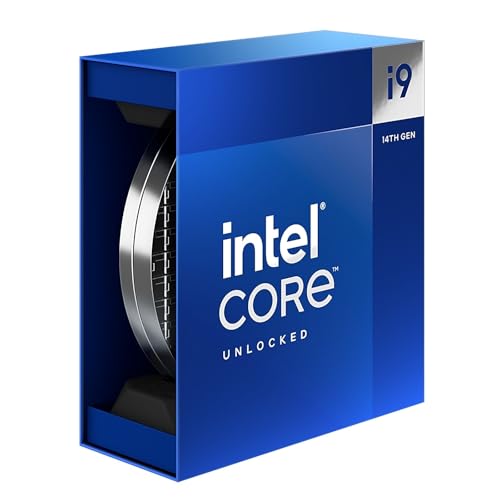
With its hybrid architecture and high clock speeds, the 14900K delivers top-tier gaming performance, often edging out the competition in frame rates. It also handles productivity tasks well thanks to 24 threads. The mature LGA1700 platform offers affordable DDR4 and DDR5 options.
Strengths
- Best-in-class gaming performance
- High boost clocks up to 6.0 GHz
- Compatible with existing LGA1700 boards
Drawbacks
- High power consumption under load
- No major architectural improvements over 13th gen

AMD Ryzen 7 9700X
The 9700X strikes an excellent balance between price and performance, offering 8 Zen 5 cores that excel in both gaming and productivity. It's significantly cheaper than the 9950X while still providing great multi-core speed. Power efficiency is a highlight, making it a smart choice for most users.
Strengths
- Great price-to-performance ratio
- Efficient and cool running
- Solid gaming and multitasking
Drawbacks
- Not as fast as higher-core options in heavy workloads
- Requires AM5 board which can be pricey

Intel Core i5-14600K
The 14600K offers fantastic gaming performance and solid productivity at a mid-range price. With 14 cores (6P+8E) and high boost clocks, it outperforms many previous-gen i7s. It's a great choice for gamers and creators on a budget who still want top-tier performance.
Strengths
- Excellent single-core and gaming performance
- Good multi-core for the price
- Supports both DDR4 and DDR5
Drawbacks
- Power draw can be high under load
- No integrated graphics (F version available)

AMD Ryzen 5 9600X
The 9600X is the go-to budget processor for gamers and casual users. Its 6 Zen 5 cores provide snappy performance in games and everyday tasks, and it's very power efficient. It's the cheapest entry into the AM5 platform, offering a clear upgrade path.
Strengths
- Affordable entry to AM5 platform
- Great gaming performance for the price
- Low power consumption
Drawbacks
- Only 6 cores limits heavy multitasking
- Stock cooler not included
Buying considerations
Core Count vs. Clock Speed
For gaming, high clock speeds matter more than core count. For productivity like video editing or 3D rendering, more cores provide a significant boost. Consider your primary use case.
Platform Longevity
AMD's AM5 platform is confirmed to support future generations, while Intel's LGA1700 is at its end. If you plan to upgrade later, AM5 offers more flexibility.
Power and Cooling
High-end CPUs like the i9-14900K and Ryzen 9 9950X require robust cooling and a quality power supply. Budget options like the 9600X run cooler and may use stock coolers.
Final word
The best processor for you depends on your workload: gamers should prioritize clock speed, while creators need core count. AMD's AM5 platform offers better future-proofing, but Intel's current gen still holds strong in gaming.
Questions answered
If you need a PC now, the current gen offers excellent performance. However, if you can wait, upcoming releases may bring improvements. For most, the 2026 lineup is more than sufficient.
DDR5 offers better performance, especially with AMD's Ryzen 7000/9000 series and Intel's 13th/14th gen. For budget builds, DDR4 is still viable with Intel's LGA1700 boards.
Keep reading

5 Best Computer Processors for Gaming 2026 | High FPS CPUs Ranked
5 Best Computer Processors for Business 2026 | Reliable Workday CPUs

5 Best Computer Processors for Laptops 2026 | Performance Meets Battery Life
5 Best Current CPUs of 2026 | Top Intel and AMD Processors Ranked