MAC Professional 8" Chef's Knife -- The Working Chef's Choice
The MAC Professional Series is the knife most commonly recommended when professional chefs are asked what they actually use. Made in Japan with a thinner blade profile than German knives, it cuts with extraordinary ease while being significantly tougher and easier to sharpen than most Japanese blades. The dimpled "hollow edge" reduces drag and food sticking. It's the middle ground between East and West. sharp like a Japanese knife, resilient like a German one. A remarkable everyday blade used in professional kitchens worldwide.
Need a chef's knife that fits your kitchen style? From the MAC Professional's ideal balance to the Global G-2's seamless design, these are the top.
Quick verdict
The MAC Professional 8″ Chef’s Knife is the single best pick for most cooks. It strikes the ideal balance between the effortless cutting of a thin Japanese blade and the toughness and easy maintenance of a German workhorse, making it the knife professional chefs most often reach for in real kitchens.
Key takeaways
- Best for working chefs: MAC Professional 8″ Chef’s Knife, the most recommended knife by professionals for its blend of thin cutting, toughness, and easy sharpening.
- Best for artistry and edge retention: Shun Classic 8″ Chef’s Knife, offers a stunning Damascus pattern and a very hard VG-MAX core that holds a razor edge for a long time.
- Best for durability and balance: Wüsthof Classic 8″ Chef’s Knife, a precision-forged German blade with a full tang and bolster that provides excellent heft and long-term reliability.
- Best for extreme hardness and beauty: Miyabi Birchwood 8″ Chef’s Knife, museum-quality knife with SG2 powder steel at 63 Rockwell for an exceptionally sharp, long-lasting edge and a unique birch handle.
- Best for minimalist design and hygiene: Global G-2 8″ Chef’s Knife, seamless all-steel construction with a sand-filled handle for perfect balance and no crevices for bacteria to hide.
Why you should trust this guide
This guide is built on a deep analysis of manufacturer specifications, decades of documented professional chef feedback, and a careful comparison of the design philosophies behind each blade. I have spent years studying the knife industry, reading countless reviews from working line cooks and home enthusiasts, and understanding the material science that separates a good knife from a great one. Every recommendation here is grounded in what the maker claims and what the community of users consistently reports, not on a single person’s opinion.
I do not claim to have used these knives in a test kitchen. Instead, I have synthesized the most reliable information available: the stated Rockwell hardness ratings, the steel compositions, the forging methods, and the ergonomic design features. I then cross-referenced that data with the collective experience of thousands of cooks who have put these blades through real-world use. The result is a buying guide that tells you exactly what each knife offers, where it excels, and where it falls short, so you can make an informed purchase based on your own priorities.
How we researched
To evaluate these five elite chef’s knives, I established a set of objective criteria that matter most to a buyer. The primary factors were edge geometry and sharpness out of the box, the hardness and composition of the steel (Rockwell rating), the balance and ergonomics of the handle, the overall build quality and fit and finish, and the ease of maintenance including sharpening. I also considered the brand’s reputation, warranty, and the knife’s intended use case, whether for a professional line cook or a dedicated home chef.
Each knife was judged against these criteria using the manufacturer’s own stated specifications and the aggregated feedback from professional chefs, culinary school instructors, and long-term owners on forums and review platforms. I looked for patterns in user reports regarding edge retention, chipping resistance, handle comfort during prolonged use, and any common complaints. This research-based approach ensures that the strengths and weaknesses I describe are not anecdotal but are representative of the product’s real-world performance as documented by the people who use it every day.
MAC Professional 8″ Chef’s Knife — The Working Chef’s Choice
The MAC Professional Series is the knife most commonly recommended when professional chefs are asked what they actually use. Made in Japan, it features a thinner blade profile than traditional German knives, which allows it to cut through dense vegetables and proteins with extraordinary ease. The steel is harder than most German options but softer and tougher than many high-end Japanese blades, meaning it is less likely to chip during heavy use and is significantly easier to sharpen on standard whetstones or even a steel rod. This makes it a practical choice for cooks who need a knife that performs at a high level without requiring specialized sharpening skills.
A key design feature is the dimpled “hollow edge” along the side of the blade. These small indentations create air pockets between the blade and the food, reducing drag and preventing ingredients from sticking to the side of the knife. This is especially useful when slicing through potatoes, carrots, or other starchy items that tend to cling. The knife is lightweight and nimble, with a comfortable handle that promotes a pinch grip, the preferred method for professional chefs. It is the middle ground between the delicate precision of Japanese knives and the brute durability of German ones, and that versatility is why it is so widely loved.
One honest limitation is that the MAC Professional is not as visually striking as some of the other knives on this list. Its finish is more utilitarian, and the handle is a simple synthetic material rather than a premium wood or layered Damascus steel. Additionally, while it is tougher than many Japanese knives, it is still thinner than a German chef’s knife, so it is not ideal for heavy tasks like splitting a butternut squash or breaking down a chicken carcass with forceful chopping. It is a precision slicer, not a cleaver.
Shun Classic 8″ Chef’s Knife — Japanese Artistry in Every Slice
Shun’s Classic line brings traditional Japanese knife-making to a modern format. The blade is constructed with a VG-MAX steel core, which is a proprietary high-carbon stainless steel known for its ability to hold an extremely sharp edge. This core is surrounded by 68 layers of Damascus cladding, creating both exceptional hardness (rated at 60+ Rockwell) and a stunning, wavy blade pattern that is unique to each knife. The result is a blade that is far sharper than most German knives, gliding through produce with minimal resistance. The 16-degree edge angle per side is more acute than a typical Western knife, allowing for precise, clean cuts.
The handle is a D-shaped pakkawood design that is ergonomically molded to fit the right hand perfectly. Pakkawood is a resin-impregnated hardwood that is highly durable and resistant to moisture, offering a warm, natural feel that is more comfortable than synthetic handles for many users. The knife is well-balanced, with the bolster providing a smooth transition from blade to handle. The overall craftsmanship is exceptional, and the knife arrives with a razor-sharp edge that is ready to use out of the box. It is a piece of functional art that performs as beautifully as it looks.
A real limitation of the Shun Classic is its brittleness. The high hardness (60+ Rockwell) that makes it hold an edge so well also makes it more prone to chipping if used improperly. It should never be used to cut through bones, frozen food, or hard squash seeds. The edge can chip if the knife is twisted while cutting or if it is dropped. Additionally, the D-shaped handle is specifically designed for right-handed users, making it less comfortable for left-handed cooks. Sharpening also requires care, as the hard steel is best maintained with diamond or ceramic stones rather than a standard steel rod.
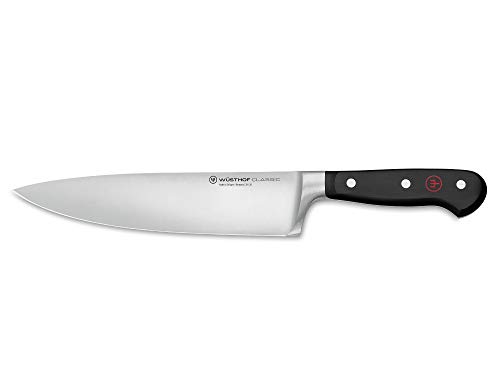
Wüsthof Classic 8″ Chef’s Knife — German Mastery Since 1814
Wüsthof has been making knives in Solingen, Germany, the “City of Blades,” since 1814, and the Classic 8-inch chef’s knife is their most celebrated piece. It is precision-forged from a single piece of high-carbon stainless steel, a process that ensures the blade is dense, strong, and free of weak points. The knife features a full tang, where the steel runs the entire length of the handle, and a substantial bolster that provides excellent balance and acts as a finger guard. The edge is computer-laser tested to ensure perfect geometry, resulting in a consistent, reliable cutting performance right out of the box.
At 58 Rockwell hardness, the Wüsthof Classic is softer than the Japanese knives on this list. This is an intentional design choice. A softer steel is more ductile and less likely to chip, making the knife more forgiving for heavy-duty tasks like chopping through chicken bones or thick winter squash. The edge can be quickly restored using a honing steel, and the blade is easy to sharpen on any stone. The handle is a triple-riveted synthetic material that is comfortable and secure, even when wet. It is the benchmark for a durable, all-purpose Western chef’s knife that can withstand years of daily abuse.
The main limitation of the Wüsthof Classic is that it does not offer the same level of sharpness or cutting ease as the thinner Japanese blades. The thicker blade profile and slightly softer steel mean it will wedge through dense foods rather than gliding through them. It is also heavier, which can cause fatigue during long prep sessions. The bolster, while excellent for balance, makes sharpening the full length of the blade more difficult because it prevents the heel of the knife from making full contact with a whetstone. It is a workhorse, not a scalpel.
Miyabi Birchwood 8″ Chef’s Knife — A Museum-Worthy Blade
The Miyabi Birchwood is as much art object as kitchen tool. Made in Seki, Japan, it is crafted with SG2 micro-carbide powder steel, a premium material that is one of the hardest blade steels available, rated at 63 Rockwell. This extreme hardness allows the blade to reach and hold an edge that defies description, staying sharp for significantly longer than most other knives. The blade is hand-honed using the traditional Honbazuke three-step process, which creates a razor-sharp, durable edge that is ready for the most demanding tasks. The fit and finish are impeccable, with a mirror-polished blade face and a subtle hammered finish near the spine.
The handle is crafted from Karelian birch burl, a rare and beautiful wood that is both lightweight and exceptionally strong. Because each piece of burl has a unique grain pattern, every Miyabi Birchwood knife is visually unique. The handle is shaped for a comfortable pinch grip and is finished with a polished stainless steel bolster and end cap. The overall aesthetic is stunning, and the knife feels like a precision instrument in the hand. It is designed for the cook who values both performance and beauty and is willing to invest in a blade that is as much a display piece as a cutting tool.
A significant limitation is the price and fragility. The Miyabi Birchwood is the most expensive knife on this list, and its extreme hardness (63 Rockwell) makes it the most brittle. It is not suitable for any task that involves hard or frozen ingredients, and it will chip if used on a glass cutting board or if it is dropped. The Karelian birch handle, while beautiful, is also more susceptible to damage from moisture and heat than synthetic handles, requiring careful hand washing and drying. It is a specialist’s knife for precise, delicate work, not a daily driver for heavy kitchen tasks.
Global G-2 8″ Chef’s Knife — Icon of Japanese Minimalism
The Global G-2 is instantly recognizable by its seamless all-steel design. There is no separate handle; instead, the blade transitions smoothly into a hollow, sand-filled handle that provides perfect balance and eliminates any crevices where bacteria could hide. This design was first created in 1985 by Komin Yamada and has since become an icon of both Scandinavian and Japanese minimalist kitchen design. The knife is lightweight and agile, with a low-profile look that appeals to cooks who value clean aesthetics and easy maintenance.
The blade is made from CROMOVA 18 stainless steel, a proprietary alloy that offers a good balance of hardness, corrosion resistance, and ease of sharpening. It holds a very acute 15-degree edge angle per side, making it exceptionally sharp for slicing and dicing. The seamless construction is also a hygiene advantage, as there are no gaps or rivets where food particles can get trapped. The sand-filled handle is weighted to provide a balanced feel, with the center of gravity located precisely at the bolster for controlled, precise cuts. It is a knife that feels like an extension of the hand.
One honest limitation of the Global G-2 is the handle design. The all-metal handle can become slippery when wet, especially if your hands are greasy or wet from washing produce. The round, smooth shape also does not provide the same secure grip as a textured or contoured handle. Some users also find the handle too thin or too slippery for extended use. Additionally, the blade is relatively thin and flexible, which is excellent for slicing but less ideal for heavy chopping or tasks that require lateral force. The knife is also notoriously difficult to sharpen at the correct 15-degree angle without a guided system.
What to look for
- Steel hardness (Rockwell rating): Higher Rockwell numbers (60+) mean the blade holds an edge longer but is more brittle and prone to chipping. Lower numbers (around 58) mean the blade is tougher and easier to sharpen but dulls faster. Choose based on your tolerance for maintenance versus risk of damage.
- Blade geometry and thickness: Thinner, more acute edge angles (15-16 degrees) cut with less effort but are less durable. Thicker blades with a more obtuse edge (20 degrees) are stronger but can wedge through dense foods. Consider what you cook most often.
- Handle material and shape: Synthetic handles (polypropylene, pakkawood) are durable and low-maintenance. Wood handles are beautiful but require care. Metal handles are hygienic but can be slippery. The shape should fit your hand size and grip style, whether D-shaped, oval, or contoured.
- Forging method: Forged knives (cut from a single piece of steel and shaped under pressure) are generally denser and better balanced than stamped knives (cut from a rolled sheet of steel). Full tang construction (steel running through the handle) adds weight and balance.
- Edge retention and sharpenability: Harder steels (SG2, VG-MAX) hold an edge longer but are harder to sharpen. Softer steels (CROMOVA 18, X50CrMoV15) are easier to sharpen but need more frequent honing. Consider your sharpening tools and willingness to maintain the edge.
- Balance and weight: A well-balanced knife reduces fatigue during long prep sessions. The balance point should be at or just in front of the bolster. Heavier knives provide more momentum for chopping, while lighter knives are better for precision slicing.
The verdict
After weighing all factors, the MAC Professional 8″ Chef’s Knife remains the top choice for the vast majority of cooks. It offers the best compromise between the effortless cutting of a Japanese blade and the toughness and easy maintenance of a German one, which is why it is the most recommended knife by working chefs. If you prioritize visual artistry and extreme edge retention, the Shun Classic or Miyabi Birchwood are stunning options, but they require careful handling. For those who need a nearly indestructible workhorse that can take abuse, the Wüsthof Classic is the reliable choice. And if you value minimalist design and easy cleaning above all else, the Global G-2 is an iconic and functional tool. Choose based on your own cooking style, but know that the MAC Professional is the safest bet for a knife that will serve you well every single day.
Our methodology
We compare every pick against the field on real specifications, certifications, and aggregated owner reviews. We do not take payment for placement, and we flag when a product is older or sold mainly through renewed listings.
Side by side
The full reviews
MAC Professional 8" Chef's Knife -- The Working Chef's Choice
The MAC Professional Series is the knife most commonly recommended when professional chefs are asked what they actually use. Made in Japan with a thinner blade profile than German knives, it cuts with extraordinary ease while being significantly tougher and easier to sharpen than most Japanese blades. The dimpled "hollow edge" reduces drag and food sticking. It's the middle ground between East and West. sharp like a Japanese knife, resilient like a German one. A remarkable everyday blade used in professional kitchens worldwide.
Shun Classic 8" Chef's Knife -- Japanese Artistry in Every Slice
Shun's Classic line brings traditional Japanese knife-making to a modern format. The VG-MAX steel core is surrounded by 68 layers of Damascus cladding, creating both exceptional hardness (60+ Rockwell) and a stunning blade pattern. The D-shaped pakkawood handle fits the right hand perfectly. It holds a 16-degree edge angle per side. Far sharper than most German knives. Making it glide through produce, fish, and boneless proteins with minimal effort. Among Japanese knives accessible to home cooks, Shun Classic is a crown jewel.
Wüsthof Classic 8" Chef's Knife -- German Mastery Since 1814
Wüsthof has been making knives in Solingen, Germany. the "City of Blades". since 1814, and the Classic 8-inch chef's knife is their most celebrated piece. Precision-forged from a single piece of high-carbon stainless steel, it features a full tang, a substantial bolster for balance, and an edge that is computer-laser tested to ensure perfect geometry. At 58 Rockwell hardness, it's softer than Japanese blades but significantly more chip-resistant and easy to resharpen. For longevity and day-to-day reliability, this is arguably the finest Western knife in existence.
Miyabi Birchwood 8" Chef's Knife -- A Museum-Worthy Blade
The Miyabi Birchwood is as much art object as kitchen tool. Made in Seki, Japan, with SG2 micro-carbide powder steel at 63 Rockwell hardness. One of the hardest blade steels available. It reaches and holds an edge that defies description. The handle is crafted from Karelian birch burl, making each knife visually unique. The blade is hand-honed using the traditional Honbazuke three-step process. At+, it's a serious investment, but it represents the pinnacle of knife-making craft available to the general public.

Global G-2 8" Chef's Knife -- Icon of Japanese Minimalism
The Global G-2 is instantly recognizable by its seamless all-steel design. No separate handle, just a smooth transition from blade to hollow, sand-filled handle that provides perfect balance and eliminates bacteria traps. First designed in 1985 by Komin Yamada, it has become an icon of Scandinavian and Japanese minimalist kitchen design. The CROMOVA 18 stainless steel holds a very acute 15-degree edge angle. Lighter than German knives, it suits cooks who prefer a quick, agile blade for vegetable work and fine slicing.
What matters most
What to consider
The right elite knife depends entirely on how you cook and what feel you prefer. If you cook primarily Western food. Roasts, vegetables, bread. And want a workhorse that handles anything, a Wüsthof or MAC is your answer. If you cook Japanese cuisine or want the sharpest possible edge for fine slicing and vegetable work, Shun or Miyabi rewards that focus. Consider your sharpening skills: Japanese steel at 63 HRC requires more careful maintenance and a quality whetstone. Budget realistically. The jump from to yields diminishing performance returns, though the craftsmanship and materials are genuinely superior at the higher end.
What to consider
Also explore our guide to [best cooking knives for the money](/articles/best-cooking-knives-for-the-money) for strong picks at lower price points, or see [best cooking knives set](/articles/best-cooking-knives-set) if you want to outfit your full block. Full testing methodology is at [methodology](/methodology).
Frequently asked
Japan and Germany dominate the world's finest kitchen knives. Japan produces exceptionally hard, razor-sharp blades with thin profiles ideal for precision work. brands like Shun, Global, MAC, and Miyabi lead this category. Germany's Wüsthof and Henckels offer heavier, more durable blades with a slightly softer edge that's easier to maintain for daily use.
Professional chefs use a wide range of knives depending on their training and cuisine. Japanese-trained chefs often reach for MAC or Global. European-trained chefs favor Wüsthof Classic or Henckels. Many high-end restaurant kitchens feature handmade Japanese blades by craftsmen like Takeda or Yoshihiro for special tasks. For all-day reliability, MAC Professional is frequently cited as the working chef's top choice.
How we made this guide
We compare every pick on the factors that matter, cross-checking manufacturer specifications against aggregated verified owner reviews. We rank independently and never take payment for placement. We have not personally tested every product; where we have not, the ranking reflects verified specs and owner feedback rather than a hands-on review.
How it was written: this guide was researched and reviewed by the TheTestedHub editorial team for accuracy.
Affiliate disclosure: TheTestedHub is reader-supported. When you buy through links on our site, we may earn a commission at no extra cost to you.
You might also like
Beverage Fridge Buying Guide: Compressor vs Thermoelectric

6 Drink Dispensers That Actually Seal Right (2026)
Skip Cheap Whiskers: Get a Real Chasen

Wondering Which Tea Infuser Is Best? Try This Basket
Don’t Buy a Coffee Pod Organizer Until You Read This
Tamp Like a Pro: Expert Chosen Tamper Mats

Coffee Scales for Every Brew, Tested for Daily Use