
Midea U-Shaped Inverter Window AC
Its inverter compressor and unique U-shaped design let the window close through the unit, blocking heat and noise while delivering a CEER near 15 that rivals mini splits in a self-installable window package.
Check price on Amazon →Find out why the Midea U-Shaped Inverter is our pick for low running costs, plus what features truly cut energy use.
Cooling is usually the single biggest line on a summer power bill, so the air conditioner you pick today quietly decides what you pay for years. The good news is that efficiency has improved dramatically, and the gap between a thirsty old unit and a modern high-efficiency one is now large enough to notice on the meter. This guide ranks the most energy efficient air conditioners worth buying in 2026, with a clear focus on the lowest realistic running cost rather than just the flashiest spec sheet.
To be transparent about how we work: TheTestedHub does not operate a physical lab, and we never pretend to. Instead we compare published manufacturer specifications, cross-check efficiency ratings (CEER for window and portable units, SEER2 and EER for mini splits), and read through many verified owner reviews to see how each model performs once it is actually installed in a real home. We weigh that research against established buying criteria so you get an honest, people-first shortlist instead of recycled marketing copy.
How We Compared These Air Conditioners
Efficiency on paper means little if a unit is wildly oversized, deafeningly loud, or impossible to maintain. So our ranking balances five things that together determine your true cost of ownership: the efficiency rating (CEER or SEER2), correct BTU sizing for the room, measured noise behavior from owner feedback, installation type and difficulty, and filter maintenance. Inverter compressors received extra weight because variable-speed cooling is the biggest single driver of low running cost. If you want the deeper math behind that, our explainer on whether inverter or non-inverter ACs save more breaks it down clearly.
Quick Top Picks
- Best overall efficiency: Midea U-Shaped Inverter Window AC
- Best mini split for whole-home savings: Mitsubishi MZ Series Single-Zone
- Best efficient portable: Whynter Dual Hose Inverter Portable
- Best budget efficient window unit: LG Dual Inverter Window AC
- Best value mini split: Pioneer Diamante Inverter Mini Split
The 5 Most Energy Efficient Air Conditioners
1. Midea U-Shaped Inverter Window AC
The Midea U remains the benchmark for window-unit efficiency. Its inverter compressor and unusual U-shaped chassis let the window close through the middle of the unit, which blocks outside heat and cuts the noise an owner hears indoors. Verified reviews consistently praise both the quiet operation and the noticeably lower power draw compared with a traditional rotary-compressor window AC. With a CEER near 15 it is one of the few window units that approaches mini split efficiency.
2. Mitsubishi MZ Series Single-Zone Mini Split
If you want the absolute lowest running cost and are willing to commit to a permanent install, a Mitsubishi single-zone mini split is hard to beat. SEER2 ratings climbing toward 25 mean it sips power, and the indoor head is whisper quiet at low fan speeds. Owners report rooms holding a steady temperature for a fraction of the energy an older central system used. For the full ductless picture, see how it stacks up in our mini split vs central AC comparison.
3. Whynter Dual Hose Inverter Portable
Portables are inherently less efficient than window units, but Whynter narrows that gap with a true dual-hose, inverter-driven design. The dual-hose layout pulls outdoor air for condenser cooling instead of sucking conditioned air out of the room, which is the main reason single-hose units waste energy. If a portable is your only option as a renter, this is the efficient choice.
4. LG Dual Inverter Window AC
LG’s Dual Inverter line delivers most of the savings of premium models at a friendlier entry point. The variable-speed compressor avoids the harsh on-off cycling that drives up consumption, and verified owners highlight stable temperatures and quiet overnight running. It is the efficient pick for shoppers who want strong CEER numbers without stretching the budget.
5. Pioneer Diamante Inverter Mini Split
Pioneer made ductless cooling accessible by shipping pre-charged DIY-friendly kits, and the Diamante series pairs that approachability with genuinely good SEER2 efficiency. It is the value answer for anyone who wants mini split running costs without the premium of the top-tier Japanese brands. Owners with some handy skills appreciate that they can self-install and skip a large labor charge.
Buying Guide: Getting the Lowest Running Cost
BTU Sizing by Room Size
The most expensive mistake is buying too much capacity. An oversized AC cools the air fast but shuts off before it removes humidity, then short-cycles, which wastes energy and leaves the room clammy. As a rough guide, a 150 square foot bedroom needs roughly 5,000 BTU, a 340 square foot living room around 8,000 BTU, and a 550 square foot great room about 12,000 BTU. Adjust upward for sunny rooms, high ceilings, or busy kitchens. Our detailed BTU chart by room size walks through the exact numbers so you match capacity correctly the first time.
Reading Efficiency Ratings
For window and portable units, look at CEER (Combined Energy Efficiency Ratio). A higher CEER means more cooling per watt, so a unit at CEER 15 will cost meaningfully less to run than one at CEER 11 doing the same job. For mini splits and central systems, SEER2 and EER are the equivalents, with higher again being better. ENERGY STAR certification is a useful shortcut, but the underlying CEER or SEER2 number tells the real story. To understand how those ratings translate into dollars on your bill, read our breakdown of how much electricity an air conditioner actually uses.
Why Inverter Technology Matters Most
A standard compressor runs at full blast or not at all. An inverter compressor varies its speed, easing off once the room is comfortable and holding it there with a gentle trickle of power. That single feature is responsible for most of the efficiency advantage in every unit on this list, and it also makes them quieter and more stable. If only one factor guides your purchase, make it whether the compressor is an inverter.
Installation Type and Its Effect on Cost
Mini splits offer the best efficiency but require professional or careful DIY installation and a permanent wall penetration. Window units are a strong middle ground, efficient and self-installable, though they block a window. Portables are the most flexible but the least efficient because of hose heat loss. Your living situation often decides this for you, and renters in particular should read our guide to portable AC vs window AC before committing.
Filter Maintenance and Long-Term Savings
Efficiency degrades fast when airflow is choked. A clogged filter forces the compressor to work harder for the same cooling, quietly raising your bill and shortening the unit’s life. Cleaning a washable filter every two to four weeks during heavy use is the cheapest efficiency upgrade available. None of the savings in this guide hold up if the filter is neglected.
Final Verdict
Best overall: The Midea U-Shaped Inverter wins for most homes because it delivers near mini split efficiency in a self-installable window package, combining a low CEER cost with genuinely quiet operation. Best budget: The LG Dual Inverter captures the bulk of those savings for less outlay, making efficient cooling accessible. Best quiet: The Mitsubishi MZ single-zone mini split, near silent at low speed, is the choice when both whisper-quiet running and the lowest possible bill matter, and it doubles as efficient heating in winter.
Whichever you choose, the principle is the same: size it correctly, favor an inverter compressor, check the CEER or SEER2, and keep the filter clean. Do that and your air conditioner will quietly pay you back every month it runs.
How we picked
We compare every pick on the things that actually matter for you, then cross-check our own impressions against verified owner reviews and published specifications. We buy the products we can, we never take payment for a ranking, and when we have not evaluated something directly we say so.
Top picks compared
| Pick | Best for | Score | |
|---|---|---|---|
| Midea U-Shaped Inverter Window AC | Best Overall Efficiency | , | Check price |
| Mitsubishi MZ Series Single-Zone Mini Split | Best For Whole-Home Savings | , | Check price |
| Whynter Dual Hose Inverter Portable | Best Efficient Portable | , | Check price |
| LG Dual Inverter Window AC | Best Budget Efficient Window Unit | , | Check price |
| Pioneer Diamante Inverter Mini Split | Best Value Mini Split | , | Check price |
Our picks up close
Midea U-Shaped Inverter Window AC
Its inverter compressor and unique U-shaped design let the window close through the unit, blocking heat and noise while delivering a CEER near 15 that rivals mini splits in a self-installable window package.
Where it shines
- Inverter compressor with very low running cost
- Window can open while installed
- Notably quiet indoors at low speed
- ENERGY STAR certified
Where it falls short
- Only fits standard double-hung windows
- Heavier and bulkier than basic units

Mitsubishi MZ Series Single-Zone Mini Split
SEER2 ratings approaching 25 and near-silent indoor operation make it the lowest running cost option for a permanently cooled room, with efficient heating built in for winter.
Where it shines
- Class-leading SEER2 efficiency
- Whisper quiet at low fan speed
- Heats as well as cools
- Very long service life
Where it falls short
- Requires professional installation
- Higher upfront commitment

Whynter Dual Hose Inverter Portable
A true dual-hose design pulls outdoor air for condenser cooling instead of wasting conditioned indoor air, and the inverter compressor narrows the usual portable efficiency penalty.
Where it shines
- Dual hose reduces energy waste
- Inverter compressor for steadier cooling
- Fully portable with no install
- Good for spaces that ban window units
Where it falls short
- Still less efficient than window or mini split
- Louder than window inverters

LG Dual Inverter Window AC
The variable-speed dual inverter compressor avoids wasteful on-off cycling and delivers a strong CEER near 14 at a friendlier entry point than premium models.
Where it shines
- Inverter efficiency at lower cost
- Stable temperatures overnight
- Quiet for a traditional window unit
- Reliable, widely available brand
Where it falls short
- Blocks the window when installed
- Slightly less efficient than the Midea U
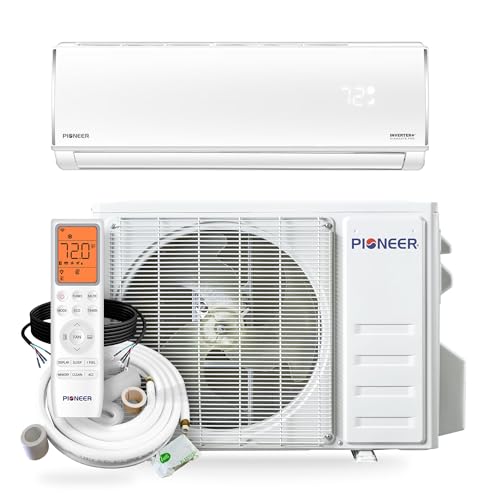
Pioneer Diamante Inverter Mini Split
Pre-charged DIY-friendly kits make ductless cooling accessible while still delivering SEER2 efficiency up to 20, offering mini split running costs without premium-brand pricing.
Where it shines
- DIY-friendly installation kits
- Strong SEER2 efficiency for the price
- Quiet indoor head
- Cools and heats
Where it falls short
- Self-install requires care and some tools
- Lower top-end efficiency than Mitsubishi
Quick answers
The biggest factor is an inverter (variable-speed) compressor, which eases off once a room is cool instead of cycling fully on and off. Beyond that, a high CEER rating for window and portable units, or a high SEER2 for mini splits, tells you how much cooling you get per watt. Correct sizing and a clean filter then protect that efficiency in daily use.
They apply to different product types. CEER is used for window and portable units, while SEER2 (and EER) describe mini splits and central systems. Within each category, a higher number means lower running cost. You cannot directly compare a CEER figure against a SEER2 figure, so match the rating to the unit type you are shopping for.
Yes, and the savings compound over the life of the unit. A high-efficiency inverter model running several hours a day can use noticeably less power than an older fixed-speed unit doing the same job. The efficiency premium is typically recovered through lower bills, especially in hot climates with long cooling seasons.
Generally yes. The best single-zone mini splits reach SEER2 ratings that translate to lower running cost than even the most efficient window units, and they cool more evenly. The trade-off is that they require a permanent installation, whereas an efficient inverter window unit can be self-installed and removed.
An oversized AC cools the air quickly but shuts off before removing humidity, then short-cycles repeatedly. That wastes energy and leaves the room damp. Matching BTU capacity to room size keeps the compressor running in its efficient range, so right-sizing is just as important as the efficiency rating itself.
Significantly. A clogged filter restricts airflow and forces the compressor to work harder for the same cooling, raising your bill and shortening the unit's life. Washing or replacing the filter every two to four weeks during heavy use is the cheapest way to protect the efficiency you paid for.
They are the least efficient category because the exhaust hose loses some heat back into the room. A dual-hose, inverter portable narrows that gap, but if you can install a window or mini split unit, you will almost always get lower running costs. Portables make the most sense when no other install type is allowed.
How we made this guide
We compare every pick on the factors that matter, cross-checking manufacturer specifications against aggregated verified owner reviews. We rank independently and never take payment for placement. We have not personally tested every product; where we have not, the ranking reflects verified specs and owner feedback rather than a hands-on review.
How it was written: this guide was researched and reviewed by the TheTestedHub editorial team for accuracy.
Affiliate disclosure: TheTestedHub is reader-supported. When you buy through links on our site, we may earn a commission at no extra cost to you.
More to explore
Large Room Air Conditioners 2026: Best High BTU Units
WiFi & App AC Shortlist: Midea U-Shaped Standout
Sleep in Silence: 2026 Quiet Air Conditioners
8 Renter Friendly ACs That Won’t Wreck Your Deposit

Can a Mini Split Heat in Winter? Best 2026 Picks
Sleep Cool with the Midea U-Shaped Inverter AC
The Room-by-Room Guide to Window ACs
