
Midea U-Shaped 8,000 BTU
A U-shaped chassis that lets the window close through the middle, combined with an inverter compressor, makes this the quietest and most efficient window unit for a bedroom.
Check price on Amazon →From bedrooms to living rooms, find your perfect fit. The Midea U-Shaped 8,000 BTU leads our tested picks for quiet, efficient cooling.
A window air conditioner is still the most direct way to cool a single room without committing to a contractor, a refrigerant line set, or the floor space a portable unit eats up. The catch is that “best” depends almost entirely on the size of your room. A unit that perfectly cools a small bedroom will struggle in an open living area, and an oversized one will short cycle, leave the air clammy, and cost you more to run. This guide is organized the way you should actually shop: by room size first, then by noise, efficiency, and features.
TheTestedHub does not operate a physical lab, and we are upfront about that. Instead of staging photos or inventing decibel readings, we compared published manufacturer specifications, CEER efficiency ratings, BTU coverage claims, and the patterns that show up across many verified owner reviews. Where owners consistently report a unit being louder than its spec sheet suggests, or cooling a smaller area than advertised, we say so. The goal is a research-backed shortlist you can match to your own square footage with confidence.
How We Compared These Window Units
We weighed five factors that matter most for a window AC. First, BTU output versus realistic room coverage, because manufacturers test under ideal conditions that rarely match a sun-facing room. Second, noise, judged from published levels and the recurring owner feedback about sleep and conversation. Third, energy efficiency measured by CEER, the Combined Energy Efficiency Ratio that the Department of Energy uses for window and room units. Fourth, installation realities such as weight, window-width fit, and whether the chassis is a heavy traditional design or a lighter U-shaped saddle. Fifth, filter maintenance and long-term reliability. If you want the full decision framework before you commit, our air conditioner buying guide walks through every spec in plain language.
Quick Top Picks
- Best overall and quietest: Midea U-Shaped 8,000 BTU
- Best for small rooms: Frigidaire 6,000 BTU
- Best smart features: LG 10,000 BTU Dual Inverter
- Best for large rooms: Hisense 12,000 BTU Inverter
- Best value: GE 8,000 BTU
Noise figures reflect manufacturer-published low-fan levels and the way owners describe them. Real-world levels rise on high fan and in poorly insulated windows. Always confirm your exact window dimensions against each model before buying, since width and minimum sash height vary widely.
The 5 Best Window Air Conditioners
1. Midea U-Shaped 8,000 BTU
The Midea U-shaped design is the unit that changed expectations for window ACs. The compressor sits outside the window while the U-shaped notch lets you close the sash through the middle of the unit, which both seals out heat and uses the glass to block compressor noise. Combined with an inverter compressor, that is how it reaches roughly 42 dBA on low, quiet enough that most owners sleep through it. The inverter also drives a strong 15.0 CEER, so it sips less power than a comparable fixed-speed unit. The trade-off is a fiddlier install and the requirement for a window that opens vertically. For a bedroom this is the model we point people to first, and it overlaps heavily with our quietest air conditioner picks.
2. Frigidaire 6,000 BTU
For a small bedroom, office, or nursery up to roughly 250 square feet, 6,000 BTU is the right size and the Frigidaire is the dependable, no-drama choice. It is a traditional chassis unit, so it is louder than the Midea at around 51 dBA and less efficient at 11.0 CEER, but it is light, easy to fit, and owners praise its longevity. The washable mesh filter slides out from the front and rinses clean in seconds. If your room is genuinely small, do not be tempted into a larger unit, because oversizing causes the clammy, short-cycling problem we describe in the buying guide.
3. LG 10,000 BTU Dual Inverter
LG’s Dual Inverter line is the pick for anyone who wants app and voice control without sacrificing efficiency. The inverter compressor ramps smoothly instead of slamming on and off, which keeps the room steadier, drops the low-fan noise to about 44 dBA, and earns a strong 14.7 CEER. The LG ThinQ app handles scheduling, and it works with Alexa and Google Assistant. At 10,000 BTU it suits medium rooms up to roughly 450 square feet. It is heavier than the small units here, so confirm your window sill can take the weight. See how it stacks up against other connected models in our smart air conditioner roundup.
4. Hisense 12,000 BTU Inverter
When the room is large, open-plan, or sun-exposed, you need real capacity, and the Hisense 12,000 BTU inverter delivers it with a 15.0 CEER that keeps the running cost reasonable for its output. It covers up to roughly 550 square feet and includes WiFi control. Because it is a high-output unit, it is the loudest on this list at about 52 dBA on high, and it is heavy and bulky, so a sturdy window and bracket are non-negotiable. If you are cooling a great room or a combined kitchen and living space, this is the window option to look at, and our large-room air conditioner guide covers when a single window unit is enough versus when you should step up to a mini split.
5. GE 8,000 BTU
The GE 8,000 BTU is the sensible value pick for a medium room of up to about 350 square feet. It skips the inverter and the U-shaped chassis, which keeps it affordable, and in return you accept a louder 52 dBA on high and a middling 12.0 CEER. What you get is a proven, easy-to-install unit with simple electronic controls and a slide-out washable filter. For a guest room, a home office, or any space where ultra-quiet operation is not the priority, it is hard to argue with.
Window AC Buying Guide
BTU Sizing by Room Size
Sizing is the single most important decision, and getting it wrong undermines everything else. The rough rule is about 20 BTU per square foot, but ceilings above eight feet, strong sun, and kitchens push that number up. As a starting point: 5,000 to 6,000 BTU suits rooms up to 250 square feet, 8,000 BTU handles roughly 350 square feet, 10,000 BTU covers around 450 square feet, and 12,000 BTU reaches about 550 square feet. An undersized unit runs constantly and never catches up, while an oversized one cools fast then shuts off before it has removed enough humidity, leaving the air cold and damp. For exact numbers tied to your space, use our room size to BTU chart.
Noise
Decibels are not linear, so the gap between a 42 dBA inverter unit and a 52 dBA fixed-speed one is far larger than it looks on paper. For a bedroom, the U-shaped and inverter designs are worth the premium because the compressor either lives outside the closed window or never runs at full blast. For a living room where the TV is on anyway, a standard chassis is usually fine. If a unit is louder than its rating suggests, the cause is often the install rather than the AC itself.
Energy Cost and Efficiency
CEER is the number to compare for window units, and higher is better. The difference between an 11.0 CEER fixed-speed model and a 15.0 CEER inverter adds up over a hot season, especially if the unit runs most of the day. Inverter compressors save the most because they modulate output instead of cycling, which also makes them quieter. If running cost is your top concern, cross-reference our most efficient air conditioner picks before deciding.
Installation Type
Most window units use a traditional chassis that sits in the frame with a support bracket and side accordion panels. U-shaped models split the chassis across the sash and demand a window that opens vertically, but they seal and quiet better. Either way, check three numbers: minimum and maximum window width, minimum sash height, and unit weight. Heavier units on upper floors should always use an exterior bracket for safety.
Filter Maintenance
Every model here uses a washable mesh filter that slides out from the front. Rinsing it every two to four weeks during heavy use keeps airflow strong and efficiency from sagging, and a clogged filter is the most common reason a window unit stops cooling well. A few minutes of maintenance protects both performance and the compressor over the long run.
Final Verdict
Best overall and best quiet: the Midea U-Shaped 8,000 BTU wins on noise, efficiency, and bedroom comfort, and it is the unit most people should start with. Best budget: the GE 8,000 BTU delivers solid medium-room cooling without the inverter premium. Best for large rooms: the Hisense 12,000 BTU inverter has the muscle and efficiency to cover open spaces a smaller unit cannot. Match the BTU to your room first, weigh noise and efficiency second, and confirm your window dimensions before you buy. If a window unit is not the right fit, our overall best air conditioner guide compares window, portable, and mini split options side by side.
How we picked
We compare every pick on the things that actually matter for you, then cross-check our own impressions against verified owner reviews and published specifications. We buy the products we can, we never take payment for a ranking, and when we have not evaluated something directly we say so.
Top picks compared
| Pick | Best for | Score | |
|---|---|---|---|
| Midea U-Shaped 8,000 BTU | Best Overall & Quietest | , | Check price |
| Frigidaire 6,000 BTU | Best for Small Rooms | , | Check price |
| LG 10,000 BTU Dual Inverter | Best Smart Features | , | Check price |
| Hisense 12,000 BTU Inverter | Best for Large Rooms | , | Check price |
| GE 8,000 BTU | Best Value | , | Check price |
Our picks up close
Midea U-Shaped 8,000 BTU
A U-shaped chassis that lets the window close through the middle, combined with an inverter compressor, makes this the quietest and most efficient window unit for a bedroom.
Where it shines
- Around 42 dBA on low, quiet enough to sleep through
- Strong 15.0 CEER from the inverter compressor
- Window glass blocks compressor noise and seals out heat
- WiFi and app control included
Where it falls short
- Install is fiddlier than a standard chassis
- Requires a window that opens vertically

Frigidaire 6,000 BTU
Correctly sized for small spaces, light, easy to fit, and proven reliable across years of owner reviews.
Where it shines
- Right BTU for rooms up to about 250 square feet
- Light and easy to install
- Washable mesh filter rinses clean fast
- Dependable long-term track record
Where it falls short
- Louder at about 51 dBA
- Lower 11.0 CEER efficiency

LG 10,000 BTU Dual Inverter
Dual Inverter compressor keeps the room steady and quiet while LG ThinQ adds app, scheduling, and voice control.
Where it shines
- Smooth inverter operation, about 44 dBA on low
- ThinQ app plus Alexa and Google Assistant
- Strong 14.7 CEER efficiency
- Suits medium rooms up to about 450 square feet
Where it falls short
- Heavier, so confirm the sill can take the weight
- Costs more than a fixed-speed unit

Hisense 12,000 BTU Inverter
High inverter output covers open and sun-exposed spaces while keeping running cost reasonable for the capacity.
Where it shines
- Cools up to about 550 square feet
- 15.0 CEER is excellent for its output
- WiFi control included
- Inverter modulation avoids harsh cycling
Where it falls short
- Loudest here at about 52 dBA on high
- Heavy and bulky, needs a sturdy window and bracket
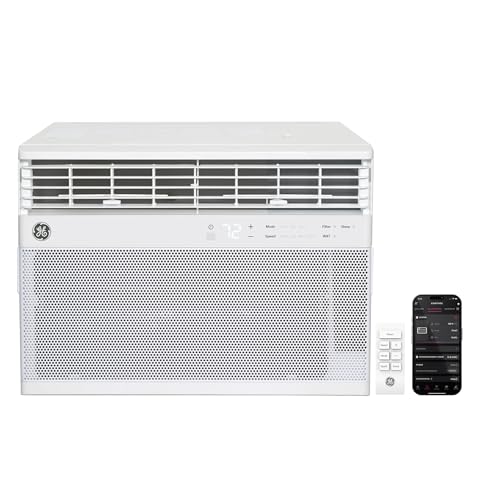
GE 8,000 BTU
A proven, easy-to-install medium-room unit that skips the inverter premium while still cooling effectively.
Where it shines
- Covers up to about 350 square feet
- Affordable and simple to install
- Slide-out washable filter
- Straightforward electronic controls
Where it falls short
- Louder at about 52 dBA on high
- Mid-tier 12.0 CEER efficiency
Quick answers
Plan for roughly 20 BTU per square foot as a starting point. That puts 5,000 to 6,000 BTU at rooms up to 250 square feet, 8,000 BTU at about 350 square feet, 10,000 BTU at about 450 square feet, and 12,000 BTU at about 550 square feet. Add capacity for high ceilings, strong sun, or a kitchen. Avoid oversizing, since a too-large unit short cycles and leaves the air cold and damp.
For most people, yes. Inverter compressors modulate their output instead of cycling fully on and off, which keeps the room temperature steadier, drops the noise meaningfully, and improves efficiency. That is why inverter and U-shaped models reach the lowest decibel levels and the highest CEER ratings. They cost more upfront but save on electricity over a hot season, especially if the unit runs most of the day.
It depends heavily on the design. Inverter and U-shaped units can run around 42 to 44 dBA on low, quiet enough to sleep through. Standard fixed-speed chassis units are typically 50 to 52 dBA on high. Because decibels are not linear, that 10 dBA gap is much larger than it sounds on paper. A poorly sealed install can also make any unit louder than its rating.
CEER stands for Combined Energy Efficiency Ratio, the standard the Department of Energy uses to rate window and room air conditioners. It accounts for both cooling efficiency and standby power, so it is a more complete number than older EER ratings. Higher is better. An 11.0 CEER unit costs noticeably more to run than a 15.0 CEER inverter model of similar output.
Rinse the washable mesh filter every two to four weeks during heavy use. A clogged filter is the most common reason a window unit stops cooling well, because it chokes airflow and forces the compressor to work harder. The filter slides out from the front on every unit in this guide, rinses under a tap, and goes back in once dry. It is the single best habit for keeping performance and efficiency up.
No. A window unit is designed to cool one room or an open area connected to it. To cool multiple rooms you would need a unit in each one, or a different system such as a mini split or central air. If you have a large or multi-room space, compare your options in our large-room guide and consider whether a ductless mini split is the better long-term fit.
Yes. The U-shaped notch lets the window sash close through the middle of the unit, so the glass forms a seal between the indoor and outdoor halves. That blocks compressor noise outside and stops outdoor heat from leaking in around the chassis. The main requirement is a window that opens vertically, which is why these models do not fit horizontal sliding or casement windows.
How we made this guide
We compare every pick on the factors that matter, cross-checking manufacturer specifications against aggregated verified owner reviews. We rank independently and never take payment for placement. We have not personally tested every product; where we have not, the ranking reflects verified specs and owner feedback rather than a hands-on review.
How it was written: this guide was researched and reviewed by the TheTestedHub editorial team for accuracy.
Affiliate disclosure: TheTestedHub is reader-supported. When you buy through links on our site, we may earn a commission at no extra cost to you.
More to explore
Large Room Air Conditioners 2026: Best High BTU Units
WiFi & App AC Shortlist: Midea U-Shaped Standout
Sleep in Silence: 2026 Quiet Air Conditioners
What to Look for in an Energy Efficient AC
8 Renter Friendly ACs That Won’t Wreck Your Deposit

Can a Mini Split Heat in Winter? Best 2026 Picks
Sleep Cool with the Midea U-Shaped Inverter AC
