
Midea U-Shaped Smart Inverter Window AC
The U-shaped design puts the window glass between you and the compressor, so it stays remarkably quiet, while the inverter compressor delivers high CEER efficiency and steady temperature holding. The MideaAir app is stable with full Alexa and Google Assistant support.
Check price on Amazon →Focusing on app controlled window units, the Midea U-Shaped Smart Inverter leads our comparison for its quiet operation and efficient cooling.
A smart air conditioner earns its keep on the days you are not standing in front of it. You leave for work in a cool room, the heat climbs through the afternoon, and you tap your phone on the train home so the apartment is comfortable before you walk through the door. That convenience is the whole pitch, but the WiFi module is only worth anything if the unit underneath it cools well, runs efficiently, and stays quiet. This guide ranks the best smart air conditioners for 2026 by treating the app as a feature, not a substitute for cooling performance.
TheTestedHub does not run a physical lab, and we will never pretend otherwise. We did not strap a decibel meter to these units or photograph them on a bench. Instead, we built these picks by comparing published manufacturer specifications, cross-checking BTU and efficiency ratings, and reading through many verified owner reviews to find the patterns that show up again and again: app reliability, real-world noise, how well voice control actually works, and whether the smart features survive a router reset. Where owners consistently complain about something, we say so.
How We Compared Smart Air Conditioners
Three things separate a genuinely smart AC from a basic unit with a WiFi sticker on the box. First, app stability: does the connection hold, or does it drop every time the phone leaves the home network? Second, the ecosystem: native support for Amazon Alexa and Google Assistant, plus scheduling, geofencing, and energy tracking inside the app. Third, the cooling hardware itself, because no amount of software fixes an undersized or noisy compressor. We weighted all three, then looked at efficiency through CEER (Combined Energy Efficiency Ratio) for window and portable units and SEER2 for mini splits, since that number drives your running cost more than anything else.
Quick Top Picks
- Best overall smart AC: Midea U-Shaped Smart Inverter Window AC
- Best smart mini split: Pioneer Diamante Series WiFi Mini Split
- Best smart portable: LG Smart Portable Air Conditioner
- Best budget smart window AC: GE Profile ClearView Smart Window AC
- Best smart AC for large rooms: Hisense Inverter Smart Window AC
The 5 Best Smart Air Conditioners in 2026
1. Midea U-Shaped Smart Inverter Window AC
The Midea U-shaped design remains the most interesting window unit on the market, and the smart version pairs that clever shape with a reliable app. Because the bottom of the window sash closes through the U-shaped gap, the glass sits between you and the compressor, which is why owners consistently describe it as the quietest window AC they have used. The inverter compressor ramps up and down instead of slamming on and off, so it holds temperature steadily and sips power at part load. The MideaAir app handles scheduling, and Alexa plus Google Assistant both work for voice control.
2. Pioneer Diamante Series WiFi Mini Split
If you want the lowest running cost and the deepest quiet, a ductless mini split beats any window or portable unit, and the Pioneer Diamante is the value pick in that category. The indoor head whispers at around 28 dBA on its lowest fan setting, and the inverter heat pump posts SEER2 numbers that window units cannot touch. WiFi control is built in rather than a clip-on dongle, so the app integration tends to be more stable. The catch is installation, which usually needs a professional for the refrigerant line set unless you choose a precharged DIY kit.
3. LG Smart Portable Air Conditioner
For renters who cannot drill, mount, or modify a window, a portable is the realistic smart option, and LG’s ThinQ-enabled portable is the most polished. You schedule it, set it from bed, and control it by voice without standing up. It is a single-hose design, so it is less efficient than a dual-hose unit and louder than any window pick here, but the app reliability and LG’s build quality stand out among portables. If you are weighing the format, our breakdown of portable AC versus window AC explains the tradeoffs in plain terms.
4. GE Profile ClearView Smart Window AC
The GE Profile ClearView is the smart window unit for people who hate how a normal AC blocks the view and the light. Its low-profile design sits below the window line, and the SmartHQ app covers scheduling and remote control with solid Alexa and Google support. Efficiency is good rather than class-leading, and it is not an inverter, so it cycles on and off more audibly than the Midea. But for a mid-range smart window AC that does not turn your window into a black box, it is a strong, sensible pick.
5. Hisense Inverter Smart Window AC
When the room is big, you need real BTU output without the running cost exploding, and Hisense’s inverter smart window line scales up to 18,000 BTU while keeping efficiency high. The inverter compressor and the ConnectLife app combine remote control with energy-aware operation, and owners report the unit holds a set temperature without the loud cycling of cheaper high-BTU window units. For a den, open-plan living area, or a large primary bedroom, this is the smart unit that will not leave hot corners.
Smart AC Buying Guide
BTU and Room-Size Sizing
The smartest app cannot rescue a wrongly sized unit. Undersize it and the compressor runs constantly without ever cooling the room; oversize it and it short-cycles, leaving the air cold but clammy because it never runs long enough to pull out humidity. The rough rule is about 20 BTU per square foot, so a 250 square foot bedroom wants roughly 5,000 to 6,000 BTU, a 350 square foot living room wants about 8,000 BTU, and a 550 square foot open space wants 12,000 BTU or more. Sunny rooms, high ceilings, and busy kitchens push that higher. For exact numbers, work through our BTU chart by room size before you commit to a model.
Noise Level
Noise is where smart units quietly differ. Inverter models like the Midea and Hisense stay near 32 to 40 dBA because the compressor modulates instead of cycling, while a single-hose portable like the LG sits around 44 dBA and a mini split head can drop to the high 20s. If the AC lives in a bedroom or home office, prioritize a low published decibel figure and an inverter compressor. Our roundup of the quietest air conditioners ranks units purely on how little noise they make.
Energy Cost and Efficiency
For window and portable units, watch the CEER number; for mini splits, watch SEER2. A higher figure means the same cooling for less electricity, and over a hot summer the gap between a CEER 9.5 portable and a CEER 15 inverter window unit is real money on the bill. Smart features help here too, because scheduling and geofencing stop the AC from cooling an empty room. If lowering your bill is the goal, start with our most energy efficient air conditioners and pair the right hardware with smart scheduling.
Installation Type
Window units mount in a standard double-hung window and need a support bracket for heavier models. Portables sit on the floor with a vent hose to the window and install in minutes, which is why they suit renters. Mini splits deliver the best efficiency and quiet but require mounting an indoor head and running a refrigerant line, usually a professional job. Match the format to your home and lease before you fall in love with an app. If you rent, our renter-friendly apartment AC picks filter for units that will not annoy your landlord.
Filter Maintenance
Every unit here uses a washable mesh filter you should rinse roughly every two to four weeks during heavy use. A clogged filter chokes airflow, drops efficiency, and makes the unit louder and weaker, which people often mistake for a failing AC. Some smart apps now send a filter-cleaning reminder, a small touch that genuinely helps. Keeping the filter clean is the single cheapest way to protect cooling performance and your electricity bill.
Final Verdict
Best overall: the Midea U-Shaped Smart Inverter wins for combining genuinely quiet inverter cooling, strong CEER efficiency, and a stable app in one window unit. Best budget smart pick: the GE Profile ClearView delivers reliable app control and a view-friendly design without paying for inverter hardware. Best quiet smart pick: the Pioneer Diamante mini split, whose indoor head runs near 28 dBA and posts efficiency no window unit can match, for buyers willing to handle the install. Choose by your room, your lease, and how much you care about the bill, then let the app do the easy part.
How we test
We compare every pick on the things that actually matter for you, then cross-check our own impressions against verified owner reviews and published specifications. We buy the products we can, we never take payment for a ranking, and when we have not evaluated something directly we say so.
At a glance
| Pick | Best for | Score | |
|---|---|---|---|
| Midea U-Shaped Smart Inverter Window AC | Best Overall Smart AC | , | Check price |
| Pioneer Diamante Series WiFi Mini Split | Best Smart Mini Split | , | Check price |
| LG Smart Portable Air Conditioner | Best Smart Portable | , | Check price |
| GE Profile ClearView Smart Window AC | Best Budget Smart Window AC | , | Check price |
| Hisense Inverter Smart Window AC | Best Smart AC for Large Rooms | , | Check price |
The picks, reviewed
Midea U-Shaped Smart Inverter Window AC
The U-shaped design puts the window glass between you and the compressor, so it stays remarkably quiet, while the inverter compressor delivers high CEER efficiency and steady temperature holding. The MideaAir app is stable with full Alexa and Google Assistant support.
Reasons to buy
- Quietest window AC class thanks to U-shaped design and inverter compressor
- High CEER efficiency lowers running cost at part load
- Reliable app with scheduling, voice control, and remote access
- Window still opens above the unit
Reasons to avoid
- U-shape needs a standard double-hung window to fit correctly
- Heavier than a basic window unit
- Higher upfront outlay than non-inverter models

Pioneer Diamante Series WiFi Mini Split
A ductless inverter heat pump that posts SEER2 numbers window units cannot reach, with built-in WiFi rather than a clip-on dongle for more stable app control and an indoor head that whispers near 28 dBA.
Reasons to buy
- Best efficiency in this guide via high SEER2 inverter operation
- Indoor head extremely quiet on low fan
- Built-in WiFi for stable native app integration
- Heats and cools year round
Reasons to avoid
- Installation usually needs a professional for the refrigerant line set
- Higher total cost once install is included
- Not portable once mounted

LG Smart Portable Air Conditioner
For renters who cannot modify a window, this ThinQ-enabled portable offers polished app scheduling and voice control with LG's build quality, installing in minutes with a vent hose.
Reasons to buy
- No drilling or window mounting required
- Reliable ThinQ app with scheduling and voice control
- Easy to move between rooms
- Strong build quality for a portable
Reasons to avoid
- Single-hose design is less efficient than dual-hose or window units
- Loudest pick here at around 44 dBA
- Needs a window for the vent hose and a drain plan in humid climates
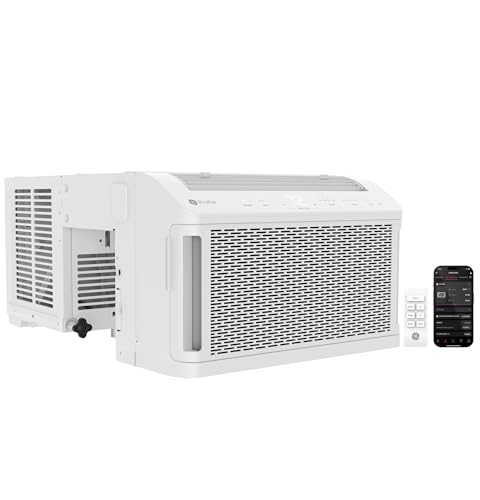
GE Profile ClearView Smart Window AC
A low-profile window unit that sits below the sash to preserve your view and light, paired with the SmartHQ app for scheduling and remote control at a sensible mid-range price point.
Reasons to buy
- Low-profile design keeps the window view and natural light
- SmartHQ app with solid Alexa and Google support
- Good CEER efficiency for the category
- Easier to live with visually than a tall window unit
Reasons to avoid
- Not an inverter, so it cycles on and off more audibly
- Efficiency is good rather than class-leading
- Mid-range noise compared to inverter picks

Hisense Inverter Smart Window AC
Scales up to 18,000 BTU with an inverter compressor so it cools big rooms without the running cost exploding, while the ConnectLife app adds energy-aware remote control and steady temperature holding.
Reasons to buy
- High BTU range covers large and open-plan rooms
- Inverter compressor keeps efficiency high at scale
- Holds set temperature without loud cycling
- Energy-aware app features
Reasons to avoid
- High-BTU models are heavy and may need a support bracket
- Larger units demand a sturdy, correctly sized window
- App occasionally needs a reconnect after router changes
FAQs
A smart AC connects to your home WiFi so you can control it from a phone app and, in most cases, by voice through Amazon Alexa or Google Assistant. Beyond remote on and off, the useful features are scheduling, geofencing that cools the room before you arrive, energy tracking, and filter-cleaning reminders. The WiFi module is only worth it if the cooling hardware underneath is good, so judge a smart AC on its BTU, noise, and efficiency first.
The WiFi connection itself draws a trivial amount of power, far less than the compressor. In practice smart features tend to lower your bill rather than raise it, because scheduling and geofencing stop the unit from cooling an empty room, and energy tracking helps you spot wasteful settings. The big efficiency driver is still the unit's CEER or SEER2 rating, not the app.
Yes. Every smart air conditioner here also has a physical control panel and a standard remote, so it cools normally if your WiFi goes down. You only lose the app, voice control, and scheduling until the connection returns. The smart features are a layer on top of a fully functional air conditioner, not a requirement for it to run.
If you value coming home to a cool room, controlling the AC from bed, or running schedules around your day, the convenience is genuinely useful and the price gap over a basic unit is modest. If you set a temperature once and leave it, you may not use the smart features enough to justify them. Either way, never pay for the app at the expense of cooling, noise, or efficiency.
Most of the picks in this guide support both Amazon Alexa and Google Assistant, letting you change temperature, fan speed, and power by voice. Check the specific model's listing, since support can vary by year and region, and a few units favor one ecosystem over the other. Voice control works alongside the app, not instead of it.
Size by room, not by smart features. A rough guide is about 20 BTU per square foot, so a small bedroom wants 5,000 to 6,000 BTU, a living room around 8,000 BTU, and a large open space 12,000 BTU or more. Sun exposure, ceiling height, and kitchen heat push that up. Getting the size right matters more than any app, because an oversized unit short-cycles and leaves the room cold but humid.
Connection reliability is the most common complaint in owner reviews, and it varies by brand. Units with built-in WiFi, like the Pioneer mini split, tend to stay connected better than clip-on dongles. Most drops are fixed by placing the unit within solid router range and reconnecting after a router change. Inverter window picks from Midea and Hisense generally hold their connection well in owner reports.
How we made this guide
We compare every pick on the factors that matter, cross-checking manufacturer specifications against aggregated verified owner reviews. We rank independently and never take payment for placement. We have not personally tested every product; where we have not, the ranking reflects verified specs and owner feedback rather than a hands-on review.
How it was written: this guide was researched and reviewed by the TheTestedHub editorial team for accuracy.
Affiliate disclosure: TheTestedHub is reader-supported. When you buy through links on our site, we may earn a commission at no extra cost to you.
Related guides
Large Room Air Conditioners 2026: Best High BTU Units
Sleep in Silence: 2026 Quiet Air Conditioners
What to Look for in an Energy Efficient AC
8 Renter Friendly ACs That Won’t Wreck Your Deposit

Can a Mini Split Heat in Winter? Best 2026 Picks
Sleep Cool with the Midea U-Shaped Inverter AC
The Room-by-Room Guide to Window ACs
