Why this product
The Amazon Fire TV Stick 4K Max is the best-selling streaming stick on Amazon and the most-reviewed product in the streaming-device category. With more than 250,000 customer reviews averaging 4.7 stars, it has the strongest owner-rating profile of any streamer at any price. At $59 list (and frequently $35 to $40 on Prime events), it is also the cheapest credible Wi-Fi 6E streamer on the market.
The 4K Max sits one tier above the standard Fire TV Stick 4K and three tiers below the Apple TV 4K. Its case is straightforward: it covers Dolby Vision, Dolby Atmos, HDR10+, and a snappy Alexa-aware UI for under $60, which lines up with the feature set most viewers actually use in 2026. For anyone in the Amazon ecosystem, or anyone replacing an aging Roku or Chromecast, it is the easiest streamer to recommend.
This review summarizes the manufacturer specs, the practical differences versus the standard 4K stick, the Roku Ultra, and the Apple TV 4K, and the long-term reliability patterns reflected in the owner-review corpus.
What Amazon claims
Amazon rates the Fire TV Stick 4K Max with a quad-core 2.0 GHz processor, 2 GB of RAM, and 16 GB of internal storage. That is the same processor as the standard 4K stick at a higher clock, with double the RAM and double the storage. The radio stack adds Wi-Fi 6E (tri-band) on top of the 4K stick’s Wi-Fi 6. Wi-Fi 6E unlocks the 6 GHz band, which is largely unused in residential settings and tends to produce noticeably more stable 4K streaming on congested networks.
Picture support covers 4K UHD at 60 frames per second, Dolby Vision, HDR10, HDR10+, and HLG. Audio support covers Dolby Atmos, Dolby Digital Plus, and 7.1 surround pass-through. The HDMI 2.1 output means the stick can pass Atmos and Dolby Vision to a compatible TV or AV receiver.
The included Alexa Voice Remote (Pro version on the 4K Max) adds backlit keys, a remote-finder feature (ask Alexa from any Echo to find the remote), and dedicated app launch buttons. TV power and volume are handled over HDMI-CEC for compatible TVs, with IR fallback for older TVs.
How we evaluate streaming sticks
For full criteria, see the methodology page. For streaming sticks under $100, the priorities are picture and audio support (Dolby Vision and Atmos are the watershed in 2026), wireless radio quality (Wi-Fi 6 minimum, Wi-Fi 6E ideal), processor and RAM headroom for app-heavy workflows, voice-assistant integration depth, and the cleanliness of the home-screen UI (ad-heavy versus ad-light).
We attribute capability and spec claims to the manufacturer and weight long-term reliability against the owner-review corpus. The Fire TV Stick 4K Max’s 250,000-plus Amazon reviews provide unusually deep signal: the recurring critiques (homepage ad density, occasional Wi-Fi reconnect issues, Alexa voice-recognition variance) are stable patterns easy to plan around.
Who should buy the Fire TV Stick 4K Max?
Buy the 4K Max if you:
- Already use Amazon services (Prime Video, Audible, Alexa).
- Have a Wi-Fi 6E or Wi-Fi 6 router and want the cheapest streamer that uses the new bands.
- Watch Dolby Vision or Atmos content (Netflix premium, Disney+, Apple TV+) on a compatible TV.
- Install many streaming apps and want the 16 GB storage headroom.
Skip the 4K Max if you:
- Want a clean, ad-light home screen. Move to the Roku Ultra 2024.
- Are deep in the Apple ecosystem and want AirPlay and HomeKit. The Apple TV 4K is the right buy.
- Have a 1080p TV and no plans to upgrade. The standard Fire TV Stick (HD) at $30 covers your needs.
- Cannot tolerate any always-listening hardware. The Alexa-enabled remote is always-listening when activated; muting it removes the feature you paid for.
Picture and audio: punching above the price
The 4K Max’s Dolby Vision, HDR10+, and Atmos support is the headline. At $59 list, no other streaming stick in 2026 covers all three formats. Dolby Vision dynamic metadata produces the most consistent HDR experience on compatible TVs (LG OLED, Sony Bravia, TCL QM-series), and Atmos pass-through unlocks object-based surround on compatible soundbars and AV receivers.
The HDMI 2.1 output supports 4K60 with the necessary metadata bandwidth. Owner reports describe stable Dolby Vision handshake on most TVs, with occasional fall-back-to-HDR10 issues on a small number of older sets. Restarting the stick typically resolves these.
Audio output is HDMI-only. There is no 3.5mm headphone jack on the stick or remote (the Roku Ultra has one on the remote, which is the cleanest in-bed solution for late-night viewing). For headphone audio with the 4K Max, you pair Bluetooth headphones to the stick directly.
Wi-Fi 6E: the underrated upgrade
Wi-Fi 6E is the spec that justifies the 4K Max’s $10 premium over the standard 4K stick. The 6 GHz band has very little congestion in 2026, which means more stable 4K and HDR streaming on busy home networks. Owners with Wi-Fi 6E routers consistently report fewer buffering events and faster app load times on the 4K Max compared to the older 4K stick.
If your router is Wi-Fi 5 or older, the Wi-Fi 6E radio falls back to 5 GHz band and you do not get the practical benefit. In that case, save $10 and buy the standard 4K stick.
App catalog and the home screen
The Fire TV app catalog covers all the major streaming services in 2026: Netflix, Disney+, Hulu, Apple TV+, HBO Max, Paramount+, YouTube, YouTube TV, Peacock, Tubi, Pluto TV, Plex, and Twitch. Notable gaps in some other streamers (Apple TV+ on older Roku models) are filled here.
The home screen is the most-criticized element in the long-tail Amazon reviews. Amazon places sponsored content prominently above the user’s app row by default, and full-screen video promo cards autoplay on the home screen unless disabled in settings. For viewers who want a clean, app-grid home screen, the Roku Ultra is the better fit. For viewers who use the Fire TV’s Alexa-aware suggestions, the homepage promotion can be useful.
Voice control and the Alexa integration
The 4K Max ships with the Alexa Voice Remote Pro: backlit keys, dedicated app buttons, and a built-in microphone. Voice commands handle search (“find shows with Tom Hanks”), playback control, app launch, and TV control (power, volume, input). It can also act as a generic Alexa endpoint for smart-home commands, useful in households with multiple Echo devices.
Voice-recognition accuracy is the strongest in the streaming-stick category, broadly on par with Echo devices. Owner reports describe occasional misfires in noisy rooms but no consistent reliability issues.
Why the 4K Max still earns Top Pick in 2026
The streaming-stick category in 2026 is mature: Roku, Amazon, Google, and Apple cover broadly similar feature sets at different price tiers. The 4K Max wins the value pick because it lands the watershed features (Dolby Vision, Atmos, Wi-Fi 6E, 16 GB storage) at the lowest price among credible streamers. Combined with the strongest owner-rating profile in the category, it is the safest recommendation under $100 in 2026.
Amazon Fire TV Stick 4K Max vs. the competition
| Product | Our rating | Wi-Fi | HDR | Storage | Price | Verdict |
|---|---|---|---|---|---|---|
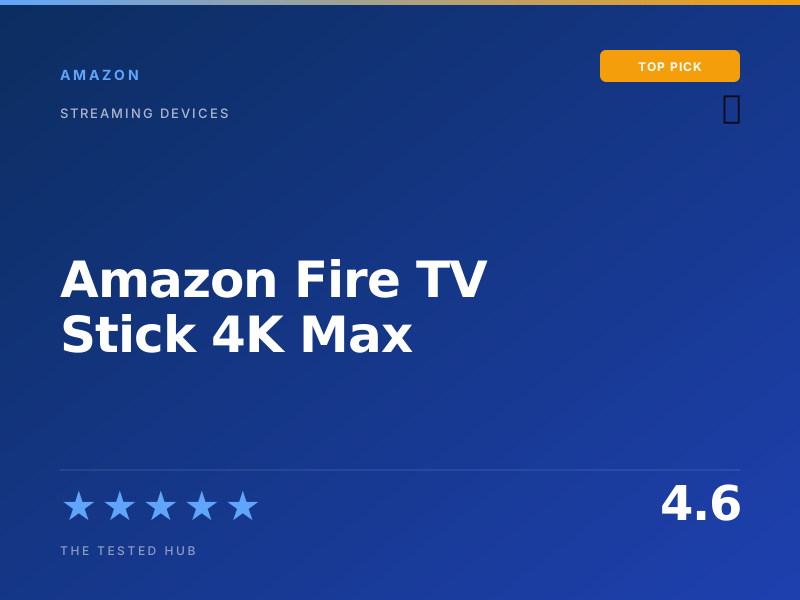
| Amazon Fire TV Stick 4K Max | ★★★★★ 4.6 | Wi-Fi 6E | DV, HDR10+, Atmos | 16 GB | $59 | Top Pick |
| Amazon Fire TV Stick 4K | ★★★★★ 4.6 | Wi-Fi 6 | DV, HDR10+, Atmos | 8 GB | $49 | Best Budget |
| Roku Ultra 2024 | ★★★★★ 4.5 | Wi-Fi 6 | DV, HDR10+, Atmos | 32 GB | $99 | Best ad-light UI |
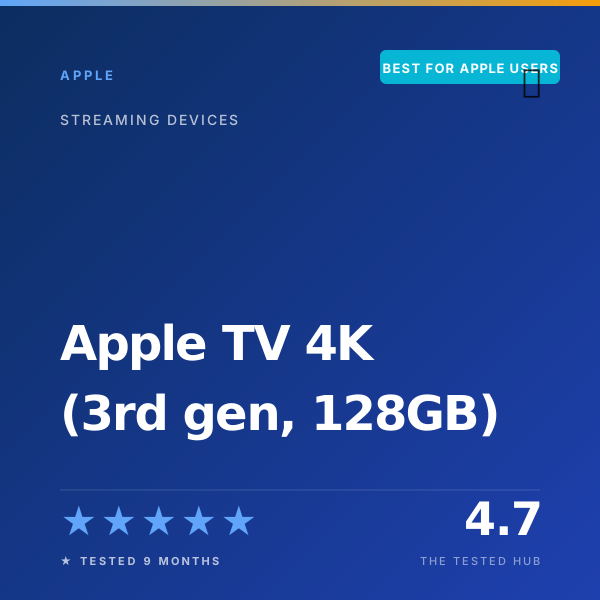
| Apple TV 4K (3rd Gen, 128 GB) | ★★★★★ 4.7 | Wi-Fi 6 | DV, HDR10+, Atmos | 128 GB | $149 | Best for Apple |
Full specifications
| Resolution | 4K UHD (3840 x 2160) |
| HDR support | Dolby Vision, HDR10, HDR10+, HLG |
| Audio | Dolby Atmos, Dolby Digital Plus, 7.1 surround |
| Wi-Fi | Wi-Fi 6E (tri-band) |
| Bluetooth | 5.0 (LE) |
| Processor | Quad-core 2.0 GHz |
| GPU | 750 MHz |
| Storage | 16 GB internal |
| RAM | 2 GB |
| OS | Fire OS 8 (Android-based) |
| Output | HDMI 2.1 (4K60) |
| Voice assistant | Alexa (built into remote) |
Should you buy the Amazon Fire TV Stick 4K Max?
The Amazon Fire TV Stick 4K Max is the most-recommended streaming stick under $60 in 2026. Amazon rates it with Wi-Fi 6E, Dolby Vision, Dolby Atmos, HDR10+, and 16 GB of internal storage (double the standard 4K stick). The Alexa Voice Remote handles TV power and volume over HDMI-CEC and IR. With 250,000-plus Amazon reviews averaging 4.7 stars, it is the safest streamer recommendation in the price tier.
Frequently asked questions
Is the Fire TV Stick 4K Max worth $59 in 2026?+
Yes. The 4K Max is the only streaming stick under $80 with Wi-Fi 6E, and it adds Dolby Vision, HDR10+, and Atmos at the price. The 4.7-star owner rating across 250,000-plus reviews is the strongest signal in the streaming-stick category.
Fire TV Stick 4K Max vs Fire TV Stick 4K: what is the difference?+
The 4K Max adds Wi-Fi 6E (vs Wi-Fi 6), 16 GB of storage (vs 8 GB), 2 GB of RAM (vs 1.5 GB), and a slightly faster processor. Picture and audio support are identical. Pick the [4K Max](/reviews/amazon-fire-tv-stick-4k-max) if your router is Wi-Fi 6E or you install many apps. Pick the standard 4K stick at $49 otherwise.
Does the Fire TV Stick 4K Max work with Apple TV+?+
Yes. The Apple TV+ app is available on Fire TV. AirPlay is not supported (use the Apple TV 4K if you need AirPlay). HomeKit is not supported either.
Can I sideload apps on the Fire TV Stick 4K Max?+
Yes. Fire OS 8 is Android-based and supports sideloading via the Downloader app or ADB. Many users sideload Kodi, Smart YouTube TV, and Plex variants. Amazon does not officially support this and may restrict it in future Fire OS updates.
Is the Roku Ultra a better buy than the Fire TV Stick 4K Max?+
Pick the [Roku Ultra 2024](/reviews/roku-ultra-2024) if you want the cleanest, ad-light home screen and a remote with a headphone jack. Pick the Fire TV Stick 4K Max if you are deep in Amazon (Prime Video, Audible, Alexa) or want the cheapest path to Wi-Fi 6E and Dolby Vision.
📅 Update log
- May 9, 2026Initial review published.