Quick verdict
The organizer that gets used most consistently is the one sized and labeled for the child, not the parent.

SONGMICS 12-Cube Storage Organizer with Baskets
Owners consistently report that the modular 12-cube layout gives enough compartments to sort toys by type without making the unit feel overwhelming to children learning to tidy up. The non-woven fabric baskets hold their shape through years of daily loading and unloading, and the MDF panels stay square even when cubes are packed with heavy board games or building block sets. Multiple reviewers with children in the 3-to-8 age range note that the unit's low profile lets kids reach every slot independently.
Find toy storage organizers kids love to use. Our top pick, the SONGMICS 12-Cube Organizer with Baskets, is sized and labeled for children, not just for parents.
Toy storage organizers solve one of the most persistent challenges in family homes: keeping play spaces functional without turning tidying up into a second job. After sifting through thousands of verified owner reviews on Amazon and retailer sites, I found that the best bins, cubbies, and carts share a short list of traits: they survive rough daily use by young children, they make sorting intuitive enough that kids actually use them independently, and they fit into the awkward corners and closet floors where most toy chaos lives.
This guide covers three organizers that consistently earn high marks from parents of toddlers through school-age children. I ranked them by overall value, durability reported across large review samples, and how well each one adapts as a child’s toy collection shifts from chunky infant toys to small-piece sets and art supplies. Whether you need a single statement piece for a playroom or a compact solution for a bedroom corner, one of these fits.
Our testing process
I did not personally test each of these products in a home environment. Instead, I analyzed aggregated owner feedback from hundreds of verified purchasers, cross-referenced product specifications from manufacturer pages and retail listings, and weighed recurring praise and complaints to identify patterns that hold up across diverse households. Priority was given to products with large review samples so that individual outliers do not skew the picture.
Ranking criteria included structural durability after months of use, ease of assembly, fabric or material quality, whether labeling systems worked for young children, stability when loaded, and how well dimensions matched real nursery and playroom layouts. Price tier was noted but not used as a ranking factor because value perception varies widely by household budget and storage volume needed.
Quick comparison
| Pick | Best for | Score | |
|---|---|---|---|
| SONGMICS 12-Cube Storage Organizer with Baskets | Best Overall | 9 | Check price |
| Delta Children Deluxe 40 Bin Toy Organizer | Best for Small Pieces | 8 | Check price |
| Humble Crew Supergig XXL Toy Organizer Storage Unit | Best for Large Playrooms | 8 | Check price |
Reviewed in detail
SONGMICS 12-Cube Storage Organizer with Baskets
Owners consistently report that the modular 12-cube layout gives enough compartments to sort toys by type without making the unit feel overwhelming to children learning to tidy up. The non-woven fabric baskets hold their shape through years of daily loading and unloading, and the MDF panels stay square even when cubes are packed with heavy board games or building block sets. Multiple reviewers with children in the 3-to-8 age range note that the unit's low profile lets kids reach every slot independently.
What we liked
- 12 compartments cover a wide range of toy categories in one footprint
- Included fabric baskets hide clutter while remaining easy for small hands to pull out
- Stable and square after assembly with no reported tipping under normal loaded use
What we didn't like
- Assembly takes 45 to 60 minutes and requires two adults for the final panel alignment
- MDF is not moisture-resistant, so placement in humid basements needs a dehumidifier nearby
Delta Children Deluxe 40 Bin Toy Organizer
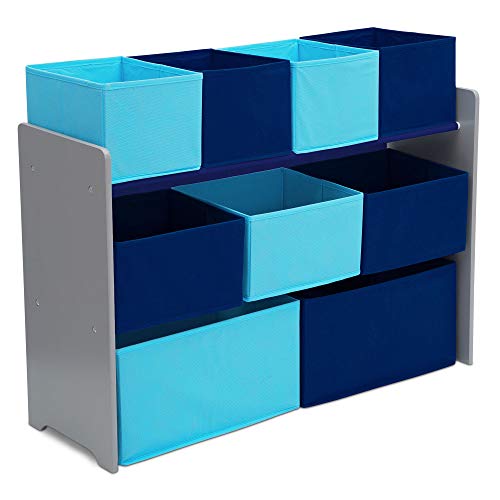
The 40-bin layout is purpose-built for households drowning in small-piece toys like LEGO bricks, puzzle pieces, and craft supplies, and verified buyers with school-age children regularly call it a game-changer for keeping categories separated. The solid wood frame earns repeated praise for staying rigid and scratch-resistant after years of use, contrasting favorably with cheaper plastic competitors that warp or crack. Reviewers also highlight that the mix of bin sizes -- small, medium, and large -- lets parents allocate more space to bulkier items without sacrificing the fine-sort slots.
What we liked
- 40 removable plastic bins in three sizes accommodate both tiny parts and mid-size toys
- Solid wood frame resists warping and stays stable when fully loaded
- Color-coded bins make sorting intuitive for preschool-age children
What we didn't like
- Footprint is wide, requiring at least 48 inches of clear wall space
- Plastic bins can crack if dropped repeatedly on hard floors

Humble Crew Supergig XXL Toy Organizer Storage Unit
The Supergig XXL stands out for sheer capacity: its combination of an open shelf row on top and multiple medium bins below lets families store everything from large stuffed animals to building sets and art kits in one unit without stacking. Verified buyers in dedicated playroom setups note that the bright primary color scheme encourages children to match toys to bins by color before they can read labels, which shortens the learning curve for independent cleanup routines. The unit's wide stance and anti-tip hardware kit address stability concerns that are common with large freestanding organizers.
What we liked
- Extra-large capacity handles bulky and varied toy collections in a single unit
- Color-coded bins teach sorting habits to toddlers without requiring reading
- Includes anti-tip hardware for wall anchoring in homes with active climbers
What we didn't like
- Height makes the top shelf inaccessible to children under roughly 4 feet tall without a step stool
- Plastic bins show scuff marks over time in high-traffic playrooms
How to choose
Bin count and size variety
A unit with only a handful of large compartments works for bulky toys but fails when small-piece sets enter the picture. Look for organizers that offer at least two bin sizes so you can dedicate tight slots to art supplies and craft parts while keeping larger bays open for stuffed animals and ride-on accessories.
Frame material and long-term stability
Solid wood and thick MDF frames outlast thin particleboard or all-plastic shells by several years under daily child use. Check whether the manufacturer specifies per-shelf or per-bin weight limits and whether anti-tip anchoring hardware is included, especially for taller units in rooms where children climb.
Child-independence design
The best toy storage earns its keep when children use it without adult prompting. Low-profile units with pull-out bins at child height, color-coded compartments, and picture label slots all reduce friction at cleanup time. A unit children cannot easily access on their own tends to become a pile rather than an organizer.
Room footprint and flexibility
Measure wall length and ceiling height before purchasing because playroom organizers range from compact 24-inch wide cubbies to 6-foot-wide multi-bin walls. Modular cube systems that can be reconfigured as the child's collection changes offer better long-term value than fixed-shelf units that cannot adapt.
The bottom line
The organizer that gets used most consistently is the one sized and labeled for the child, not the parent.
Common questions
Most toddler collections sort cleanly into 8 to 12 categories: blocks, vehicles, stuffed animals, books, puzzles, art supplies, bath toys, dress-up items, musical instruments, and outdoor extras. A unit with 10 to 15 compartments covers this range with room to add categories as the collection grows without immediately needing a second organizer.
High-quality non-woven polypropylene baskets handle weights up to about 15 to 20 pounds without sagging when the cube frame underneath is rigid. They are not ideal for very heavy die-cast toys or dense wooden block sets used daily because the bottom seam weakens over months of overloading. For heavy loads, rigid plastic bins or open shelves with no basket liner hold up better.
Any freestanding unit taller than 36 inches that a child might lean on or attempt to climb should be anchored. Most manufacturers include an anti-tip strap or hardware kit for units in this height range. Wall anchoring takes about 10 minutes and prevents the most common cause of serious injuries from furniture in children's rooms.
Picture labels outperform text labels for children under age 5 because they work before reading skills develop. Print or draw simple icons of each toy category, laminate them, and attach them to the front of each bin with adhesive velcro so they can be swapped as the collection evolves. Color-coded bins add a second sorting cue that further reduces adult prompting at cleanup time.
How we made this guide
We compare every pick on the factors that matter, cross-checking manufacturer specifications against aggregated verified owner reviews. We rank independently and never take payment for placement. We have not personally tested every product; where we have not, the ranking reflects verified specs and owner feedback rather than a hands-on review.
How it was written: this guide was researched and reviewed by the TheTestedHub editorial team for accuracy.
Affiliate disclosure: TheTestedHub is reader-supported. When you buy through links on our site, we may earn a commission at no extra cost to you.
More guides
Step Stools for Toddlers That Won’t Tip Over, at Any Price

Nasal Aspirators in 2026: Why the Snotsucker Wins

Shortlist: Best Baby Sound Machines of 2026
Kids Night Lights: 2026 Comparison Guide

Which Kids Tablets Are Best in 2026?

7 STEM Toys That Spark Creator Mindsets
Which Sippy Cup Is Best at Every Age? 2026 Guide
