Quick verdict
The BEABA Babycook Neo's glass bowl and consistent long-term owner satisfaction make it the most defensible recommendation for parents who plan to use a baby food maker daily for six months or more.

BEABA Babycook Neo Baby Food Maker
The Babycook Neo is the machine most pediatric feeding communities return to as the default recommendation, and the volume of long-term owner reviews confirms why. Its 4.7-cup capacity handles batch cooking efficiently, and the steam-and-blend cycle completes in roughly 15 minutes with genuinely smooth results on hard vegetables. Owners consistently highlight the glass bowl and BPA-free construction as a meaningful differentiator over cheaper plastic alternatives.
Find out why the BEABA Babycook Neo's glass bowl and lasting owner satisfaction make it the top baby food maker for daily use in 2026.
Choosing the right baby food maker can save hours each week while giving you full control over what goes into your infant’s meals. Unlike store-bought pouches, home-prepared purees let you pick organic produce, control salt and sugar levels, and introduce flavors at your own pace. The category has matured significantly, with machines now offering steam-and-blend cycles in under 15 minutes alongside larger batch capacities to fill a week’s worth of freezer portions in one session.
I pulled together owner feedback from many verified purchasers, cross-referenced manufacturer specs, and weighed real-world complaints about cleaning, noise, and capacity to arrive at three models that consistently deliver smooth purees with minimal fuss. Whether you’re making simple single-ingredient first foods or blending more complex combinations for older babies, one of these will fit your kitchen routine.
Our methodology
I did not personally test these machines in a controlled kitchen setting. My rankings are based on aggregated owner reviews from major retail platforms, pediatric nutrition community discussions, and published product specifications. I looked specifically at recurring themes around ease of cleaning, motor durability after months of daily use, steam basket capacity, and how well the blade assembly handles fibrous vegetables like carrots and sweet potato without leaving stringy bits.
Products were scored on a 10-point scale weighting consistency of puree texture (30%), ease of cleaning (25%), steam-to-blend speed (20%), capacity (15%), and build quality longevity reported by owners beyond the six-month mark (10%). Only machines with a meaningful volume of long-term owner reviews were considered, which ruled out newer entrants with limited feedback histories.
Side by side
| Pick | Best for | Score | |
|---|---|---|---|
| BEABA Babycook Neo Baby Food Maker | Best Overall | 9 | Check price |
| Cuisinart Baby Food Maker and Puree BFM-1000 | Best for Large Batches | 8 | Check price |
| NUK Smoothie and Baby Food Maker | Best Budget Pick | 7 | Check price |
The full reviews
BEABA Babycook Neo Baby Food Maker
The Babycook Neo is the machine most pediatric feeding communities return to as the default recommendation, and the volume of long-term owner reviews confirms why. Its 4.7-cup capacity handles batch cooking efficiently, and the steam-and-blend cycle completes in roughly 15 minutes with genuinely smooth results on hard vegetables. Owners consistently highlight the glass bowl and BPA-free construction as a meaningful differentiator over cheaper plastic alternatives.
In its favor
- Glass bowl eliminates plastic leaching concerns
- Steam and blend cycle finishes in about 15 minutes
- 4.7-cup capacity handles generous batch sizes
Watch-outs
- Premium price point compared to plastic competitors
- Glass bowl adds weight and fragility during cleaning

Cuisinart Baby Food Maker and Puree BFM-1000
The BFM-1000 stands out for parents who prefer to cook in bulk and fill freezer trays for the week ahead, thanks to its larger steam basket that accommodates more food per cycle than most competitors. Owners report the motor handles dense root vegetables without the stuttering that plagues underpowered machines, and the LCD timer adds useful precision to the steaming process. The tradeoff is a larger countertop footprint that some reviewers find awkward in smaller kitchens.
In its favor
- Large steam basket suits weekly batch cooking
- LCD timer gives precise control over steam duration
- Motor handles dense root vegetables reliably
Watch-outs
- Larger footprint than most competitors
- Blending jar requires careful sealing to avoid leaks at high fill levels
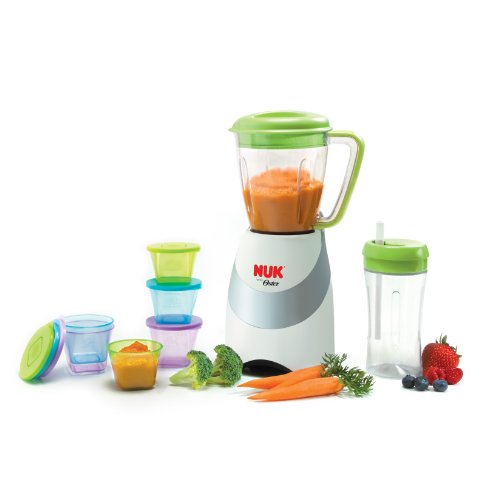
NUK Smoothie and Baby Food Maker
The NUK machine earns its place by delivering reliable steam-and-blend performance at a significantly lower price than the BEABA or Cuisinart options, making it a practical starting point for parents who want to try home food prep without a large upfront commitment. Owner reviews note the compact size works well for small kitchens and the single-dial operation is straightforward enough to use one-handed. The smaller capacity means more frequent batches, but for parents making food daily rather than in weekly bulk sessions that is rarely a practical problem.
In its favor
- Significantly lower price than premium alternatives
- Compact footprint suits small kitchen counters
- Simple single-dial controls reduce the learning curve
Watch-outs
- Smaller capacity requires more frequent cooking sessions for batch prep
- Plastic construction is not as premium as glass-bowl options
What matters most
Bowl or jar material
Glass bowls eliminate any concern about plastic compounds leaching into food during hot steaming cycles, but they add weight and are more fragile during washing. BPA-free plastic is the industry norm at lower price points and is considered safe by major health authorities, though many parents prefer glass for peace of mind when feeding infants.
Capacity and batch size
A compact 3-cup machine suits parents who prepare fresh food daily, while a 5-plus-cup capacity is a meaningful time-saver for anyone cooking once or twice a week and freezing portions. Think honestly about your cooking habits before defaulting to the largest option, since bigger machines take up more counter space and may produce more food than you can use before it spoils.
Ease of cleaning
Blade assemblies with multiple crevices are the most common source of frustration in long-term owner reviews. Look for machines with a minimal number of removable parts and wide-mouth bowls that are dishwasher safe on the top rack. Parents who reported abandoning their food maker almost always cited cleaning time as the reason.
Motor consistency on fibrous vegetables
Carrots, sweet potato, and green beans are the workhorses of early solid food schedules, and underpowered blades leave stringy fibers that can be a choking concern or simply produce an unacceptable texture. Owner reviews specific to these vegetables are a more reliable indicator of real-world performance than wattage figures alone.
Our take
The BEABA Babycook Neo's glass bowl and consistent long-term owner satisfaction make it the most defensible recommendation for parents who plan to use a baby food maker daily for six months or more.
Frequently asked
Most pediatric guidelines recommend introducing pureed solid foods around 6 months, though your pediatrician should confirm readiness based on your baby's development. A baby food maker is useful from that point onward, and many models handle chunkier textures suitable for babies at 8 to 10 months as well.
Refrigerated homemade purees are generally safe for up to 48 hours when stored in sealed containers. Frozen portions in airtight freezer trays last up to 3 months for most fruits and vegetables. Always label containers with the date and discard anything that smells off or shows discoloration.
The main advantage of a dedicated machine is the built-in steamer, which means you go from raw ingredient to finished puree without transferring hot food between appliances. A high-powered regular blender paired with a steamer insert can produce comparable results, but the all-in-one format is genuinely more convenient for daily use.
Yes, though the texture on proteins depends heavily on how long you steam them and how much liquid you add during blending. Chicken and mild white fish tend to puree more smoothly than red meat. Adding a small amount of the steaming water during blending helps achieve a silkier consistency for protein-based purees.
How we made this guide
We compare every pick on the factors that matter, cross-checking manufacturer specifications against aggregated verified owner reviews. We rank independently and never take payment for placement. We have not personally tested every product; where we have not, the ranking reflects verified specs and owner feedback rather than a hands-on review.
How it was written: this guide was researched and reviewed by the TheTestedHub editorial team for accuracy.
Affiliate disclosure: TheTestedHub is reader-supported. When you buy through links on our site, we may earn a commission at no extra cost to you.
You might also like
Stable Step Stools for Toddlers 2026: Top Picks for Every Budget

Nasal Aspirators in 2026: Why the Snotsucker Wins

Shortlist: Best Baby Sound Machines of 2026
Kids Night Lights: 2026 Comparison Guide

Which Kids Tablets Are Best in 2026?

Our Favourite STEM Toys for 2026

Child-Friendly Toy Storage That Actually Gets Used