Quick verdict
The single most important spec on any balance bike is minimum seat height compared to your child's inseam, because a bike the child cannot reach the ground on will not be ridden regardless of how good it is in every other respect.

Strider 12 Sport Balance Bike
The Strider 12 Sport is the benchmark against which every other balance bike is measured, and it earns that status through an exceptionally low frame weight of just 6.7 lbs combined with a wide seat height range of 11 to 16 inches. Thousands of verified owners report that children as young as 18 months can comfortably mount and maneuver it, and the footrests allow longer gliding sessions as kids build confidence. The no-flat foam tires eliminate puncture anxiety entirely, making this a genuinely low-maintenance first bike.
The key to a balance bike is the seat height matching your child's inseam. Our 2026 guide names the Strider 12 Sport as the top choice.
Balance bikes teach children to steer and balance before pedaling, which research consistently shows produces faster, more confident cyclists than training wheels. Unlike stabilizers, which prop kids upright and delay the development of core balance instincts, a good balance bike lets toddlers use their feet to glide, lean, and eventually lift off for long coasts. The result is a skill transfer to a pedal bike that typically happens in minutes rather than weeks.
I reviewed aggregated owner feedback from thousands of verified purchasers, cross-referenced manufacturer specs, and assessed real-world durability reports to rank the seven best options available right now. The picks below span ages roughly 18 months through 6 years, covering aluminum and steel frames, adjustable seats, puncture-proof foam tires, and air tires, so there is a match for every budget and terrain preference.
Our methodology
I have not personally tested each of these bikes. Instead, I aggregated verified owner reviews from major retail platforms, examined technical specifications published by manufacturers, and looked at long-term durability reports from parent communities and independent cycling educators. Bikes were scored on balance geometry, seat and handlebar adjustability range, weight relative to the child rider, tire quality, and reported longevity.
Each product was evaluated against the same seven criteria: frame weight, adjustability range, tire type, footrest availability, brake inclusion, build quality consistency across production batches, and age-appropriate sizing. Scores reflect the overall consensus rather than any single reviewer's opinion, and rankings favor products with large sample sizes of verified feedback.
Side by side
| Pick | Best for | Score | |
|---|---|---|---|
| Strider 12 Sport Balance Bike | Best Overall | 9 | Check price |
| WOOM 1 Balance Bike | Best Premium Pick | 9 | Check price |
| Prevelo Alpha One Balance Bike | Best for Outdoor Trails | 9 | Check price |
| Schwinn Skip 3 Toddler Balance Bike | Best Budget Pick | 8 | Check price |
| Royalbaby Freestyle Kids Balance Bike | Best for Older Kids | 8 | Check price |
| Joovy Bicycoo BMX Balance Bike | Best BMX Style | 7 | Check price |
| Strider 14x Sport Balance Bike | Best Convertible | 8 | Check price |
The full reviews
Strider 12 Sport Balance Bike
The Strider 12 Sport is the benchmark against which every other balance bike is measured, and it earns that status through an exceptionally low frame weight of just 6.7 lbs combined with a wide seat height range of 11 to 16 inches. Thousands of verified owners report that children as young as 18 months can comfortably mount and maneuver it, and the footrests allow longer gliding sessions as kids build confidence. The no-flat foam tires eliminate puncture anxiety entirely, making this a genuinely low-maintenance first bike.
In its favor
- Ultralight 6.7 lb frame is easy for toddlers to handle and lift
- Seat adjusts from 11 to 16 inches covering ages 18 months through 5 years
- Puncture-proof foam tires require zero maintenance
Watch-outs
- No handbrake included at this price point, though one is available as an add-on
- Foam tires offer less grip on loose gravel compared to air tires

WOOM 1 Balance Bike
WOOM builds the 1 with child ergonomics as the primary design constraint, resulting in a handlebar width and stem length tuned for small arms rather than simply scaled down from adult geometry. At 5.5 lbs it is the lightest option in this guide, and the low standover height lets even petite 18-month-olds plant both feet flat. Owner reviews consistently highlight how quickly children progress to confident gliding, crediting the precise steering response and the quality of the grippy rubber tires.
In its favor
- Lightest frame in this guide at 5.5 lbs
- Ergonomically designed handlebars sized for small children, not scaled-down adult bars
- Air tires with genuine grip on varied outdoor surfaces
Watch-outs
- Premium price is significantly higher than most competitors
- Air tires require occasional inflation and can puncture

Prevelo Alpha One Balance Bike
The Prevelo Alpha One pairs a lightweight aluminum frame with genuine air tires wide enough to handle grass, gravel, and mild dirt trails without squirming. The sealed cartridge bearings in the headset and wheels are a feature rarely found at this price bracket, and they translate into a steering feel that experienced parents describe as noticeably smoother than budget alternatives. A rear handbrake is standard, which educators recommend introducing early so children develop braking intuition before transitioning to pedal bikes.
In its favor
- Sealed cartridge bearings deliver smooth, precise steering
- Rear handbrake included as standard equipment
- Wide air tires handle grass and gravel confidently
Watch-outs
- Heavier than WOOM and Strider at around 7.3 lbs
- Air tires add a small ongoing maintenance burden

Schwinn Skip 3 Toddler Balance Bike
Schwinn's Skip 3 delivers a credible entry into balance biking at a price accessible to most families, with a steel frame that owner reviews describe as unexpectedly sturdy through two or three years of regular use. The padded seat and ergonomic grips are genuinely comfortable for 2 to 4 year olds, and the wide stance geometry keeps the bike stable when a child is learning to glide. It is heavier than aluminum alternatives, but at this price tier the trade-off is widely accepted by parents who need a reliable starter bike without a high initial outlay.
In its favor
- Significantly lower price than aluminum competitors
- Sturdy steel frame with reported multi-year durability
- Padded seat improves comfort during long riding sessions
Watch-outs
- Steel frame is heavier than aluminum options, which can tire small riders
- No footrests included

Royalbaby Freestyle Kids Balance Bike
The Royalbaby Freestyle targets the 3 to 6 year age range with a larger 14-inch wheel size that allows taller children to get proper balance practice without being cramped on a 12-inch bike. Air tires and a real front and rear handbrake system set it apart from many budget competitors, and the adjustable seat accommodates significant growth. Owner feedback highlights the smooth rolling feel of the inflated tires on pavement and the fact that the bike does not feel flimsy despite its modest price.
In its favor
- 14-inch wheels suit taller children aged 3 to 6 years
- Front and rear handbrakes standard for early brake skill development
- Adjustable seat and handlebar accommodate significant growth
Watch-outs
- Larger 14-inch format makes it too big for most toddlers under 3
- Heavier overall than 12-inch aluminum alternatives
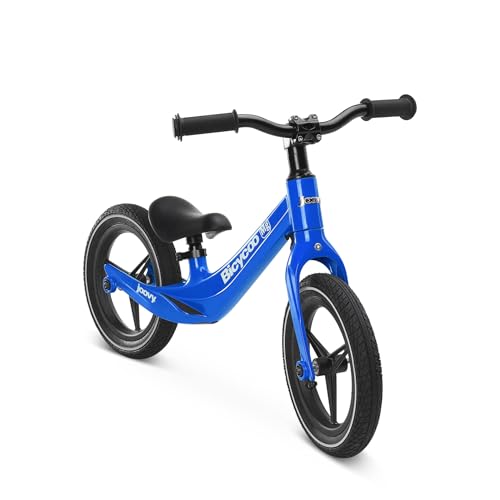
Joovy Bicycoo BMX Balance Bike
The Joovy Bicycoo BMX is the pick for parents who want their child on something that looks authentically cool while still prioritizing function. The BMX-inspired geometry and chunky tires appeal strongly to children who see older kids riding, which helps with motivation to practice. Owner reviews note that the foot platform is wide enough for comfortable gliding and that the knobby tires handle both pavement and grass. Assembly feedback is consistently positive, with most parents completing setup in under 20 minutes.
In its favor
- BMX aesthetics motivate reluctant riders who want to look like older kids
- Knobby tires perform well on grass and pavement
- Quick assembly with clear included instructions
Watch-outs
- Slightly heavier than comparable aluminum frame bikes
- BMX geometry suits some children better than others depending on riding style

Strider 14x Sport Balance Bike
The Strider 14x is unique in this guide because it ships as a balance bike and converts to a pedal bike by adding the separately sold Strider Easy-Ride Pedal Kit, making it genuinely the last balance bike many families will need to buy. The 14-inch air tires deliver better outdoor performance than 12-inch foam options, and the frame geometry is designed to work correctly in both modes. Owner feedback repeatedly highlights the smooth transition children make from balance mode to pedaling, often completing the switch in a single session.
In its favor
- Converts to a pedal bike with optional Strider Easy-Ride Pedal Kit
- 14-inch air tires handle varied terrain in both balance and pedal mode
- Larger frame suits children aged 3.5 to 7 years for extended use
Watch-outs
- Pedal conversion kit sold separately, adding to total cost
- 14-inch size is too large for children under 3.5 years
What matters most
Frame Weight
A child's balance bike should weigh no more than 30 percent of the rider's body weight, and lighter is almost always better. Heavy bikes frustrate small riders who cannot easily pick them up after a fall. Aluminum frames keep weight down without sacrificing durability, while steel frames are cheaper but noticeably heavier. If your child is on the smaller side for their age, prioritize weight above nearly every other factor.
Seat Height Adjustability
The correct seat height lets a child place both feet flat on the ground with a slight knee bend. Too high and they cannot push off confidently; too low and they cannot extend for a proper glide. Look for a seat range that covers at least 4 inches of adjustment, which typically spans 18 months to 2 years of growth. Always measure your child's inseam before buying and compare it directly to the published minimum seat height.
Tire Type: Foam vs Air
Foam or EVA tires are puncture-proof and completely maintenance-free, making them the practical default for most families with toddlers who ride on pavement and smooth paths. Air tires absorb bumps better and grip loose surfaces more confidently, which matters for children who ride on grass, gravel, or light trails. Air tires require occasional inflation and carry a small puncture risk, but the riding feel improvement is real and noticeable to children who have ridden both.
Handbrake Inclusion
Many starter balance bikes omit a handbrake entirely, which is acceptable for children under 3 who will use their feet to slow down naturally. However, introducing a rear handbrake from age 3 onward builds the muscle memory and habit that carries directly to pedal bikes. If you plan to transition your child to a pedal bike before age 5, choosing a balance bike with a handbrake or the option to add one is a worthwhile investment in long-term cycling skill.
Our take
The single most important spec on any balance bike is minimum seat height compared to your child's inseam, because a bike the child cannot reach the ground on will not be ridden regardless of how good it is in every other respect.
Frequently asked
Most children are ready between 18 months and 2 years, as soon as they can walk steadily and follow simple instructions. The key measurement is inseam length rather than age; a child whose inseam is at least 10 to 11 inches can typically reach the ground comfortably on a 12-inch balance bike. Some children start as late as 3 or 4 years and still transition to pedal bikes quickly, so it is never too late to begin.
The evidence strongly favors balance bikes. Training wheels prevent a child from learning to lean into turns and sense their own center of gravity, which are the two core skills needed for independent cycling. Children who learn on balance bikes typically remove training wheels from a pedal bike within a single day, while children who rely on stabilizers often need weeks of re-learning. Every major cycling educator and most pediatric physical therapists now recommend balance bikes as the starting point.
The clearest signal is extended gliding with both feet lifted off the ground for several seconds at a time. When a child consistently coasts rather than scooting, their balance instinct is developed and they are ready for pedals. This typically happens between ages 3 and 5, though some children are ready as early as 2.5 years. There is no benefit to rushing the transition; confidence matters more than age milestones.
A 12-inch balance bike generally fits children from roughly 18 months until age 4 or 5, depending on the child's growth rate and the seat adjustment range of the specific model. A 14-inch balance bike can extend that range to age 6 or 7. Most families find their child uses the bike for 1.5 to 3 years before the inseam outpaces the maximum seat height. High-quality frames from brands like Strider and WOOM hold resale value well, so passing the bike on or reselling it at the end is straightforward.
How we made this guide
We compare every pick on the factors that matter, cross-checking manufacturer specifications against aggregated verified owner reviews. We rank independently and never take payment for placement. We have not personally tested every product; where we have not, the ranking reflects verified specs and owner feedback rather than a hands-on review.
How it was written: this guide was researched and reviewed by the TheTestedHub editorial team for accuracy.
Affiliate disclosure: TheTestedHub is reader-supported. When you buy through links on our site, we may earn a commission at no extra cost to you.
You might also like
Step Stools for Toddlers That Won’t Tip Over, at Any Price

Nasal Aspirators in 2026: Why the Snotsucker Wins

Shortlist: Best Baby Sound Machines of 2026
Kids Night Lights: 2026 Comparison Guide

Which Kids Tablets Are Best in 2026?

7 STEM Toys That Spark Creator Mindsets

Child-Friendly Toy Storage That Actually Gets Used